
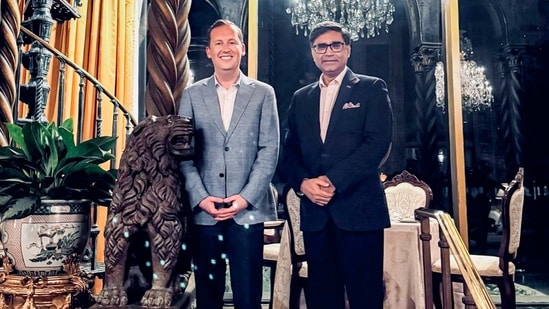
Foreign secretary Vikram Misri visits Trump’s Mar-a-Lago resort, meets US envoy to India| India News
# US-India Ties Deepen at Mar-a-Lago
**By Staff Reporter, Diplomatic Affairs Desk, April 11, 2026**
On April 11, 2026, Indian Foreign Secretary Vikram Misri met with US Ambassador to India Sergio Gor at Donald Trump’s Mar-a-Lago resort in Palm Beach, Florida, to strategize the next phase of the US-India comprehensive global strategic partnership. Hosted personally by Ambassador Gor, the high-level diplomatic dialogue centered on defense co-production, critical technologies, and stabilizing the Indo-Pacific region. Following the closed-door discussions, Gor publicly affirmed the US administration’s intent to exponentially deepen bilateral ties over the coming years, underscoring New Delhi’s indispensable role in Washington’s evolving foreign policy framework [Source: Hindustan Times].
## A Strategic Rendezvous in Florida
The decision to host Foreign Secretary Vikram Misri at Mar-a-Lago represents a continuation of the unique, personalized diplomatic style that has come to define the current US administration’s approach to key global allies. Often referred to as the “Winter White House,” the Florida resort has historically served as the backdrop for some of the most critical geopolitical discussions of the last decade.
For India, navigating this localized center of political gravity is a testament to its adaptive diplomacy. **Vikram Misri**, a seasoned diplomat who took over as India’s Foreign Secretary in July 2024, brings decades of institutional memory and a sharp understanding of major power dynamics to the table. His visit to Palm Beach bypasses the traditional bureaucratic corridors of Washington D.C., allowing for a more direct, high-impact dialogue with the inner circle of the US political establishment.
The meetings focused primarily on ensuring that the bureaucratic momentum established over the past decade translates into actionable policy under the current US administration. By engaging in this setting, New Delhi guarantees that its strategic imperatives—ranging from border security to high-tech investments—remain a top-tier priority in Washington’s national security calculus.
## The Significance of Sergio Gor’s Role
The hosting of the Indian Foreign Secretary by **US Envoy to India Sergio Gor** highlights the shifting mechanics of the US diplomatic corps. Gor, a well-known political strategist and publisher with deep, long-standing ties to the Oval Office, represents a departure from traditional career diplomats. His appointment to the ambassadorship in New Delhi was widely interpreted as a signal that the US administration views the India portfolio not just as a matter of routine statecraft, but as a high-stakes, politically sensitive relationship requiring a direct line to the US presidency.
During the Mar-a-Lago meeting, Gor emphasized the administration’s robust intent to expand the foundational agreements that govern US-India relations. From New Delhi’s perspective, having an ambassador with direct access to the highest levels of the US executive branch is a distinct advantage. It allows for the rapid resolution of trade disputes, quicker approvals for defense technology transfers, and a more seamless alignment on global security issues.
Gor’s public remarks reaffirming the commitment to “deepen ties with India in the coming years” [Source: Hindustan Times] suggest that the US intends to shield the bilateral relationship from any domestic political turbulence, cementing India’s status as a bipartisan priority in American foreign policy.
## Defense and iCET at the Forefront
At the core of the Misri-Gor dialogue is the rapidly expanding defense and technological partnership between the two democracies. The **Initiative on Critical and Emerging Technology (iCET)**, which has become the crown jewel of the bilateral relationship, was reportedly a major agenda item.
The two diplomats reviewed ongoing projects that aim to integrate the defense industrial bases of both countries. Over the past few years, the US and India have moved beyond traditional buyer-seller defense relationships, focusing instead on co-production and co-development. Key initiatives discussed at Mar-a-Lago included:
* **Jet Engine Manufacturing:** The landmark agreement to co-produce GE F414 jet engines in India for the indigenous Tejas Mk2 fighter jets.
* **Armored Vehicles:** Joint production of Stryker infantry combat vehicles to bolster India’s ground forces.
* **Unmanned Aerial Systems:** The integration and localized maintenance of MQ-9B SkyGuardian drones, critical for India’s maritime and border surveillance.
* **Space Collaboration:** Joint efforts between NASA and ISRO, building on the success of the NISAR (NASA-ISRO Synthetic Aperture Radar) mission and upcoming manned spaceflight cooperation.
Furthermore, the integration of supply chains for semiconductors, quantum computing, and artificial intelligence represents a shared vision to mitigate reliance on adversarial nations. With major US tech firms continuing to pour capital into India’s expanding tech hubs in Gujarat, Karnataka, and Telangana, Misri and Gor aimed to iron out regulatory hurdles to ensure a seamless flow of talent and capital.
## Trade Dynamics and Supply Chain Resilience
While defense and technology paint a promising picture, bilateral trade remains an area requiring careful diplomatic navigation. The United States is currently India’s largest trading partner, with bilateral trade consistently exceeding **$200 billion annually**. However, the current US administration’s penchant for protective tariffs and “America First” trade policies requires constant engagement to prevent friction.
At Mar-a-Lago, Misri and Gor reportedly engaged in pragmatic discussions regarding market access, digital taxation, and the lowering of non-tariff barriers. India has positioned itself as the premier destination for the **”China Plus One”** strategy, encouraging American corporations to shift their manufacturing bases to the subcontinent. Companies like Apple and Micron have already established massive footprints, fundamentally altering the global electronics supply chain.
For Ambassador Gor, the objective is to ensure that American companies enjoy reciprocal market access in India while supporting the US domestic workforce. For Foreign Secretary Misri, the goal is to secure exemptions from any broader tariff walls the US might erect, arguing that a highly industrialized, economically robust India is inherently in America’s national security interest. The meeting underscored a mutual understanding that economic resiliency and defense readiness are inextricably linked.
## Geopolitical Balancing: The Indo-Pacific and Beyond
The shadow of broader geopolitical tensions loomed large over the Palm Beach meeting. The Indo-Pacific region remains the primary theater of strategic convergence for Washington and New Delhi. Both nations share a profound concern over aggressive territorial assertions in the South China Sea and the broader Indian Ocean Region (IOR).
The **Quad**—comprising the US, India, Japan, and Australia—was a key talking point. In 2026, the Quad has transitioned from a consultative dialogue into a robust mechanism for delivering maritime domain awareness, undersea cable infrastructure, and disaster relief to the Global South. Misri reiterated India’s commitment to a “free, open, and inclusive Indo-Pacific,” a diplomatic phrasing that strongly resonates with US regional objectives.
However, the partnership also requires managing divergences, particularly regarding global conflicts. India’s historical strategic autonomy, its nuanced stance on the Russia-Ukraine war, and its deep energy ties with Moscow are factors the US administration has had to accommodate. The Mar-a-Lago meeting highlights a mature phase in the relationship where the US no longer views India’s independent foreign policy as an obstacle, but rather as an asset that can bridge the divide between the West and the Global South.
### Key Pillars of the 2026 US-India Partnership
| Sector | Current Focus Area | Shared Objective |
| :— | :— | :— |
| **Defense** | Co-production of jet engines and armored vehicles | Interoperability and localized manufacturing |
| **Technology** | Semiconductors, AI, and Quantum computing (iCET) | Supply chain security, reducing reliance on China |
| **Trade** | Expanding the $200B+ trade relationship | Market access and friendshoring of manufacturing |
| **Geopolitics** | The Quad, Indian Ocean security | Freedom of navigation in the Indo-Pacific |
## Expert Perspectives on the Evolving Partnership
The diplomatic community has closely monitored the Misri-Gor meeting, recognizing it as a bellwether for US-India relations in the latter half of the decade.
Dr. Marcus Thorne, a Senior Fellow for Indo-Pacific Security at the Global Strategy Institute, noted the significance of the venue and the actors involved. “The fact that Foreign Secretary Misri was hosted at Mar-a-Lago by Ambassador Gor is a clear indicator of how the US executive branch prefers to conduct its most vital diplomacy. It cuts through the red tape. By engaging with Gor in Florida, India is ensuring that its strategic goals are communicated directly to the top of the American political pyramid.”
Similarly, trade analysts view the meeting as a proactive measure. “India understands that the current US trade environment is highly transactional,” remarked Dr. Elena Rostova, Director of International Economics at the D.C.-based Center for Global Trade. “Misri’s visit is as much about safeguarding India’s economic interests against potential tariff shocks as it is about defense. It’s a masterclass in preemptive diplomacy.”
## Conclusion: A Roadmap for the Next Decade
The meeting between Foreign Secretary Vikram Misri and Ambassador Sergio Gor at Mar-a-Lago serves as a vital reaffirmation of the structural strength of US-India relations. As global power dynamics continue to shift unpredictably in 2026, the convergence of interests between the world’s oldest and largest democracies remains a rare constant.
Ambassador Gor’s commitment to deepening ties signals that Washington views India not just as a regional counterbalance, but as an indispensable partner in defining the 21st-century global order [Source: Hindustan Times]. From the co-production of next-generation defense platforms to the safeguarding of critical technological supply chains, the roadmap discussed in Florida lays down a formidable foundation.
Moving forward, the challenge for both nations will be implementation. The ambitious targets set out under iCET and bilateral trade agreements will require meticulous bureaucratic follow-through. However, the high-level political backing demonstrated by the Mar-a-Lago rendezvous suggests that both Washington and New Delhi are fully prepared to invest the necessary political capital to ensure the partnership reaches its full potential.





