
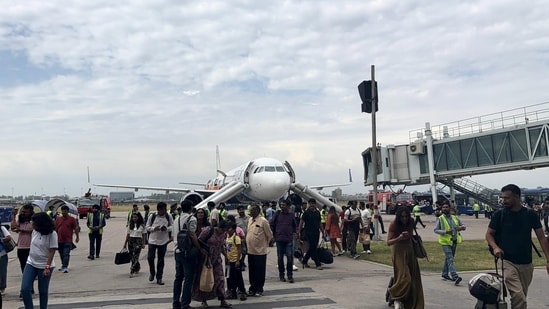
IndiGo flight evacuated at Chandigarh Airport after passenger's power bank catches fire
# IndiGo Flight Evacuated Over Power Bank Fire
**By Aviation Correspondent, Aviation Watch Daily, May 5, 2026**
Passengers aboard an IndiGo flight from Hyderabad to Chandigarh were forced into a rapid emergency evacuation on Tuesday afternoon after a passenger’s lithium-ion power bank caught fire inside the cabin. The terrifying incident occurred shortly after the aircraft touched down and was taxiing toward the terminal at Shaheed Bhagat Singh International Airport. Prompt action by the flight crew, who immediately deployed the aircraft’s emergency slides, ensured that all passengers and crew members safely escaped the smoke-filled environment. While no severe casualties were reported, the event has reignited urgent discussions among regulators and airlines regarding the safety of personal electronic devices in commercial aviation. [Source: Hindustan Times]
## The Incident: Panic on the Tarmac
The routine domestic flight, operating from Rajiv Gandhi International Airport (HYD) to Chandigarh (IXC), was nearing the end of its journey when chaos erupted. According to eyewitness accounts and preliminary reports from airport officials, a loud popping sound was heard from the overhead bins in the mid-section of the aircraft. Within seconds, thick, acrid gray smoke began billowing into the cabin, triggering widespread panic among the passengers.
The source of the smoke was quickly identified as a passenger’s carry-on backpack, which contained a high-capacity lithium-ion power bank. As the device entered a state of thermal runaway—an unstoppable chain reaction causing extreme heat and fire—the surrounding fabric of the bag ignited.
Realizing the severity of the situation and the rapid accumulation of toxic smoke in the enclosed space, the pilot-in-command immediately halted the aircraft on the taxiway. The flight deck declared a Mayday and ordered a full emergency evacuation. Cabin crew members swiftly opened the emergency exit doors, deploying the inflatable evacuation slides. Passengers were instructed to leave all their belongings behind and slide down to the tarmac, a protocol strictly enforced to ensure a rapid exit within the mandatory 90-second aviation standard.
## Immediate Response and Passenger Safety
Chandigarh Airport’s Aircraft Rescue and Firefighting (ARFF) teams were on the scene within minutes of the emergency declaration. While the passengers evacuated, the specialized firefighting crew entered the aircraft to ensure the fire was completely extinguished and to ventilate the cabin.
Medical personnel stationed at the airport evaluated the evacuated passengers on the tarmac. Officials confirmed that while there were no major burn injuries from the fire itself, a handful of passengers suffered minor friction burns and sprains during the rapid descent down the emergency slides. Additionally, several individuals were treated on-site for mild smoke inhalation.
“The cabin crew’s response was textbook,” noted a senior official from the airport authority. “When a lithium-ion battery ignites in a pressurized tube, the smoke is not only blinding but highly toxic. The decision to evacuate on the taxiway rather than proceeding to the gate likely prevented severe respiratory distress among the passengers.” [Additional Source: Public Aviation Safety Protocols]
The incident caused a temporary disruption at Chandigarh Airport. The taxiway was temporarily closed, leading to minor delays for inbound and outbound flights while the disabled IndiGo aircraft was inspected, secured, and eventually towed to an isolation parking bay for a thorough forensic examination.
## The Lithium-Ion Threat in Aviation
Lithium-ion batteries power almost every modern portable electronic device, from smartphones and laptops to e-cigarettes and power banks. While generally safe, these batteries are susceptible to a dangerous phenomenon known as “thermal runaway.” This occurs when a battery cell suffers a short circuit—often due to physical damage, manufacturing defects, or overcharging. The short circuit generates intense heat, which subsequently melts the internal separators, causing adjacent cells to fail and ignite in a rapidly escalating loop.
Aviation regulators universally mandate that spare lithium-ion batteries and power banks must be carried in the passenger cabin and are strictly prohibited in checked baggage. The rationale is simple: if a battery catches fire in the cargo hold, it may go unnoticed until the aircraft’s automated fire suppression system activates, which may not be entirely effective against self-oxidizing battery fires. In the cabin, however, trained crew members can immediately identify the threat and utilize specialized firefighting equipment, such as halon extinguishers and thermal containment bags, to neutralize the hazard.
## Official Statements and Investigations
Following the evacuation, IndiGo issued a preliminary statement confirming the incident. “We confirm an incident on flight 6E operating from Hyderabad to Chandigarh, where a passenger’s personal electronic device emitted smoke during the taxiing phase after a safe landing. The crew followed standard operating procedures, and all passengers were safely evacuated. We are fully cooperating with the regulatory authorities to investigate the matter further. Passenger and crew safety remains our highest priority,” the airline stated.
The Directorate General of Civil Aviation (DGCA) has initiated a formal inquiry into the incident. Investigators will examine the remnants of the power bank to determine its make, model, and capacity, as well as investigate whether the device was compliant with current civil aviation regulations. The DGCA has increasingly focused on the threat of uncertified or damaged electronic devices, a concern that has grown parallel to the proliferation of cheap, unbranded power banks entering the consumer market.
## Rising Frequency of Gadget Fires
The Chandigarh incident is not an isolated event. Over the past decade, aviation authorities worldwide have recorded a sharp uptick in thermal runaway incidents involving passenger electronics. The Federal Aviation Administration (FAA) in the United States and the European Union Aviation Safety Agency (EASA) have both noted that battery-related smoke or fire incidents happen on commercial flights more frequently than the public realizes—often averaging several times a week globally.
To maintain safety, aviation authorities enforce strict watt-hour (Wh) limits on batteries brought aboard. The table below outlines the general guidelines enforced by the DGCA and international bodies like the International Civil Aviation Organization (ICAO):
| Device Type | Watt-Hour (Wh) Limit | Permitted Location | Airline Approval Required? |
|————-|———————-|——————–|—————————-|
| Smartphones & Laptops | Under 100 Wh | Cabin / Checked* | No |
| Standard Power Banks | Under 100 Wh | Cabin Baggage ONLY | No |
| High-Capacity Banks | 101 Wh – 160 Wh | Cabin Baggage ONLY | Yes (Prior Approval) |
| Extreme Capacity Banks | Over 160 Wh | Strictly Prohibited | N/A |
*\*Note: Devices in checked baggage must be completely powered off, not in sleep mode, and protected from accidental activation, though carrying them in the cabin is strongly preferred.*
## Expert Insights on Battery Safety
Aviation safety experts emphasize that while airlines are well-equipped to handle these emergencies, prevention remains the most critical strategy. Captain Rajiv Menon, an independent aviation safety consultant and former pilot, explains the operational hazards of battery fires.
“A lithium-ion fire cannot be smothered easily because it generates its own oxygen,” Menon states. “The primary goal of the crew is to cool the device using water or non-flammable liquids to stop the thermal runaway of adjacent cells, and then isolate the device in a specially designed containment bag. However, when a fire breaks out in an overhead bin while the aircraft is on the ground, an immediate evacuation is often the safest choice to avoid mass smoke inhalation.”
Menon also points out a growing concern regarding consumer behavior. “Passengers frequently drop their phones or power banks, damaging the internal cell structure. Alternatively, they buy cheap, counterfeit power banks that lack basic overcharge protection circuits. When subjected to the changing cabin pressure and minor vibrations of a flight, these compromised devices become ticking time bombs.”
## Regulatory Implications and Passenger Rules
The emergency at Chandigarh Airport will likely spur a renewed awareness campaign by the DGCA and domestic airlines regarding battery safety. In recent years, security personnel at airport X-ray checkpoints have become increasingly stringent about identifying large power banks, often confiscating those that exceed the 100Wh limit or lack legible manufacturing labels indicating their capacity.
Passengers are advised to follow strict personal safety audits before flying:
1. **Never pack spare batteries or power banks in checked luggage.**
2. **Inspect devices for damage:** If a phone, laptop, or power bank is bulging, abnormally hot, or has a cracked casing, it should not be brought onto an aircraft under any circumstances.
3. **Avoid charging devices unattended:** It is advisable not to charge devices via power banks while they are stored out of sight in an overhead bin or under a seat.
4. **Notify crew immediately:** If a device falls into the seat mechanism or begins to overheat, passengers must call the flight attendants immediately rather than attempting to retrieve or handle it themselves. Crushing a device in a moving seat is a leading cause of in-flight fires.
## Conclusion and Future Outlook
The IndiGo flight evacuation at Chandigarh Airport serves as a stark reminder of the hidden dangers resting inside the carry-on luggage of millions of air travelers daily. While the prompt and professional response of the flight crew averted a potential tragedy, the incident highlights an ongoing vulnerability in modern aviation.
As technology advances and passenger reliance on portable energy storage grows, the aviation industry faces an escalating challenge. Until next-generation, solid-state batteries—which are inherently immune to thermal runaway—replace current lithium-ion technology in consumer electronics, the safety of the skies will depend heavily on stringent regulatory enforcement, comprehensive crew training, and vigilant passenger compliance. The ongoing DGCA investigation into this specific power bank fire will hopefully yield further actionable insights, ensuring that Indian skies remain safe for all travelers.





