
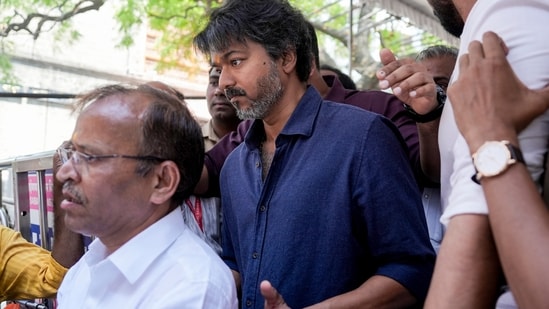
‘TVK will be able to form govt on its own’: Vijay's party goes 100+ in trends in historic Tamil Nadu debut
# Vijay’s TVK Confident of Solo TN Victory
**By Special Correspondent, India Political Desk**
**May 04, 2026**
CHENNAI — Following a highly anticipated single-phase election on April 23, actor-turned-politician Thalapathy Vijay’s Tamilaga Vettri Kazhagam (TVK) has issued a bold declaration: the party is confident of securing an absolute majority to form the Tamil Nadu state government entirely on its own. As the state eagerly awaits the counting of votes, TVK leadership has dismissed the possibility of a hung assembly, asserting that an overwhelming wave of support from youth and rural demographics will propel them past the magic number of 118 seats, fundamentally disrupting the state’s longstanding Dravidian bipolar politics.
[Source: Hindustan Times RSS | Additional: Election Commission of India 2026 Poll Data]
## The April 23 Mandate: A High-Stakes Polling Day
Voting for the Tamil Nadu Legislative Assembly elections took place on April 23, 2026. In a massive logistical undertaking by the Election Commission of India (ECI), all 234 constituencies went to the polls in a single phase. This crucial polling day coincided with the first phase of the fiercely contested West Bengal state elections, drawing national attention to two of India’s most politically significant states.
**Key Facts from Polling Day:**
* **Total Seats Contested:** 234
* **Majority Mark:** 118
* **Voter Turnout:** Preliminary ECI estimates suggest a robust turnout exceeding 73%, heavily driven by first-time voters and women.
* **Concurrent Elections:** Simultaneous polling occurred in the first phase of the West Bengal assembly elections.
While national media split its focus between the eastern and southern seaboards, the ground reality in Tamil Nadu was distinctly electric. Polling booths across Chennai, Coimbatore, Madurai, and deep rural pockets witnessed unprecedented queues, characterized notably by the presence of young voters. TVK’s organizational machinery, built upon decades of mobilized fan clubs recently transformed into political cadres, was put to its first real electoral test. According to internal post-poll assessments released by TVK headquarters in Panaiyur, the high turnout is a direct reflection of “anti-incumbency sentiment” and a desire for radical political change.
## A Bold Claim: Forming the Government “On Its Own”
Since officially launching the party in February 2024, Vijay has maintained a striking political strategy: absolute independence. Unlike previous political entrants who compromised with established giants like the Dravida Munnetra Kazhagam (DMK) or the All India Anna Dravida Munnetra Kazhagam (AIADMK) to secure a foothold, TVK opted to fly solo in all 234 constituencies.
“We are not here to play kingmakers; we are here to be the kings,” a senior TVK spokesperson announced during a press briefing on Monday morning. “Our internal surveys, cross-referenced with booth-level data from April 23, clearly indicate that TVK will comfortably cross the 118-seat threshold. We will form the government on our own without relying on post-poll alliances.”
This level of confidence is almost unheard of for a debutante regional party in Tamil Nadu. Even the legendary actor-politician Vijayakanth, whose Desiya Murpokku Dravida Kazhagam (DMDK) made massive waves in 2006, only managed an 8% vote share and a single seat in his inaugural solo outing. However, TVK leaders argue that 2026 presents a unique historical vacuum. They assert that the current electorate is fatigued by the alternating power dynamics of the DMK and AIADMK, positioning Vijay as the only viable alternative offering clean governance and an egalitarian “secular social justice” framework.
[Source: Hindustan Times RSS | Additional: Historical Tamil Nadu Electoral Archives]
## Breaking the Dravidian Duopoly
For nearly six decades, Tamil Nadu’s political landscape has been monopolized by the DMK and the AIADMK. Following the deaths of towering political figures J. Jayalalithaa (2016) and M. Karunanidhi (2018), political analysts have frequently debated whether a “third front” could emerge. Attempts by Kamal Haasan’s Makkal Needhi Maiam (MNM) and Seeman’s Naam Tamilar Katchi (NTK) have carved out niche vote shares but failed to capture state power.
Vijay’s TVK, however, operates on a much larger scale. Leveraging his status as the highest-paid and most universally recognized actor of his generation in the state, Vijay has methodically structured his party. By prioritizing grassroots social work, educational endowments, and relief operations years before his political debut, he established a credible foundation of goodwill.
“The Dravidian parties rely on legacy vote banks and welfare populism,” notes Dr. K. Rangarajan, an independent political sociologist based in Chennai. “What Vijay managed to do in the 2026 campaign was to merge the ideological appeal of Tamil pride and social justice with a strong anti-corruption narrative. If his party truly achieves a majority, it will be the most significant political disruption in southern India since M.G. Ramachandran broke away to form the AIADMK in 1972.”
## The Demographics Driving TVK’s Confidence
TVK’s staggering confidence stems primarily from its deep penetration into two distinct voter demographics: the youth and women.
**1. The Youth Vote:**
Tamil Nadu saw an influx of approximately 2.8 million new, first-time voters added to the electoral rolls between 2021 and 2026. Raised on a diet of Vijay’s socially conscious cinema, many in this demographic view him not just as an entertainer, but as a genuine leader. TVK’s manifesto heavily targeted this group, promising aggressive job creation, comprehensive educational reform, and the eradication of drug syndicates—a pressing issue in the state over the last three years.
**2. The Women Electorate:**
Historically, the AIADMK enjoyed a massive advantage among women voters during Jayalalithaa’s tenure. In recent years, the ruling DMK attempted to capture this base through financial assistance schemes like the *Kalaignar Magalir Urimai Thittam*. However, TVK strategically fielded a high percentage of women candidates in the April 23 polls and campaigned heavily on issues of women’s safety, maternal health, and equitable employment, making significant inroads into this critical demographic.
[Source: Hindustan Times RSS | Additional: Sociopolitical analysis of Tamil Nadu demographics]
## Opposition Reactions and Ground Realities
Despite TVK’s confident assertions, rival political camps have been quick to dismiss the claims as rookie enthusiasm.
The ruling DMK leadership remains steadfast that their developmental record over the past five years will yield a consecutive victory. Chief Minister M.K. Stalin’s administration has aggressively promoted the “Dravidian Model” of governance, emphasizing industrial growth, foreign direct investment, and expansive social welfare. DMK leaders have publicly brushed off the “Vijay wave” as mere cinematic hype that will not translate into ballot box reality.
Similarly, the principal opposition, the AIADMK, insists that its traditional rural vote bank remains intact. AIADMK General Secretary Edappadi K. Palaniswami has repeatedly stated during the campaign that politics is a full-time commitment of public service, contrasting his decades of experience against Vijay’s recent entry.
Meanwhile, the Bharatiya Janata Party (BJP), which has been attempting to expand its footprint in the state under the aggressive leadership of K. Annamalai, views TVK’s rise with cautious optimism. While the BJP is not allied with TVK, political strategists note that any fragmentation of the anti-BJP Dravidian vote share theoretically benefits national parties in the long run.
“TVK’s claim of an absolute majority is mathematically improbable given the entrenched nature of DMK and AIADMK booth committees,” argues veteran political journalist S. Malini. “However, even if TVK secures 30 to 40 seats, they will permanently alter the legislative mathematics of the Tamil Nadu assembly. They are claiming 118, which serves to keep cadre morale high ahead of counting day.”
## Implications of a Potential TVK Victory
If Thalapathy Vijay’s party delivers on its monumental claim of forming the government on its own, the implications for Indian national politics will be profound:
* **End of the Bipolar Era:** A solo victory would officially mark the end of the DMK-AIADMK duopoly, opening the state to multi-party democracy similar to Maharashtra or Uttar Pradesh.
* **The Blueprint for Celebrity Politicians:** It would validate the transition from cinema to politics, succeeding where contemporaries like Rajinikanth backed out and Kamal Haasan struggled to gain mass traction.
* **Policy Overhaul:** TVK’s promised administrative reforms—which include decentralizing power, enhancing state autonomy against federal overreach, and instituting a robust anti-corruption Lokayukta—would undergo immediate testing.
* **National Alliances for 2029:** A dominant TVK would immediately become a highly sought-after ally for both the NDA and the INDIA blocs ahead of the 2029 General Elections, fundamentally shifting the balance of power in New Delhi.
## Conclusion: The Final Countdown
As May progresses, the political temperature in Tamil Nadu continues to rise. The single-phase election on April 23 has left the state in a suspenseful holding pattern. While the first phase of the West Bengal polls captured the national narrative regarding regional resistance to federal hegemony, Tamil Nadu’s election represents an intense, internalized revolution.
Whether Tamilaga Vettri Kazhagam’s declaration of an absolute majority is a prophetic statement of a shifting political paradigm or merely the optimistic bluster of a new political entity will be definitively answered on counting day. Until the electronic voting machines (EVMs) are unsealed, Thalapathy Vijay has managed to achieve his primary objective: making TVK the undeniable epicenter of the 2026 Tamil Nadu political discourse.
For the millions who cast their vote under the sweltering April sun, the wait is almost over. The coming weeks will determine whether Tamil Nadu has elected a new political monarch or simply reaffirmed its traditional allegiances.





