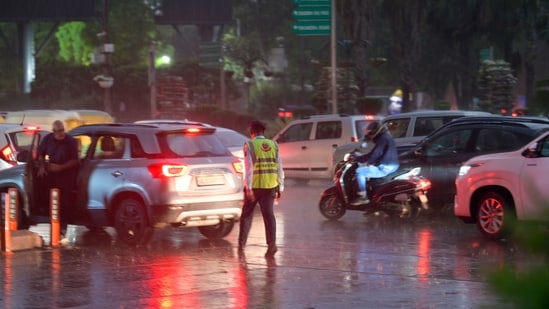
Heavy rain hits parts of Delhi NCR, IMD issues orange alert| India News
# Delhi NCR Hit By Heavy Rains: Orange Alert
By Senior Correspondent, India News Desk | April 17, 2026
Heavy, unseasonal rains lashed parts of Delhi and the National Capital Region (NCR) on Friday evening, bringing sudden relief from sweltering spring temperatures but plunging the city into immediate commuter chaos. Following the intense downpours, the India Meteorological Department (IMD) upgraded its weather warning to an ‘Orange Alert’ for the entire national capital, cautioning residents against severe waterlogging, power disruptions, and traffic gridlocks. The sudden weather shift, driven by strong western disturbances, highlights the region’s increasing vulnerability to erratic climate patterns during the typically dry month of April. [Source: Hindustan Times | Additional: IMD Official Advisories]
## The Friday Evening Deluge and Urban Gridlock
What began as a moderately cloudy Friday afternoon quickly escalated into a severe weather event by early evening. Pitch-dark clouds enveloped the skies over New Delhi, Gurugram, Noida, and Ghaziabad, followed by thunderstorms, lightning, and torrential downpours. The sudden change caught millions of office-goers off guard during peak evening transit hours.
Arterial roads, including the Delhi-Gurugram Expressway, the Ring Road, and the Noida-Greater Noida Expressway, reported bumper-to-bumper traffic as visibility dropped significantly. Social media was swiftly inundated with visuals of submerged roads and stranded vehicles in perennial waterlogging hotspots such as the Minto Bridge underpass, ITO intersection, and parts of South Extension.
**Key disruptions reported across the NCR included:**
* **Aviation Delays:** Several flights scheduled to land at the Indira Gandhi International (IGI) Airport were placed in holding patterns or diverted to Jaipur and Lucknow due to crosswinds and low Runway Visual Range (RVR).
* **Public Transit Slowdowns:** Surface-level segments of the Delhi Metro experienced minor delays as a precautionary measure against high-velocity winds.
* **Power Outages:** Preventive power cuts were enforced in several sectors of Gurugram and Noida to avert electrical accidents amidst uprooted trees and snapping overhead cables.
## Decoding the IMD’s Orange Alert
The escalation of the weather warning from a standard ‘Yellow Alert’ to an ‘Orange Alert’ signifies a critical shift in the IMD’s assessment of the storm’s severity. In meteorological terms, an Orange Alert is a directive for civic agencies and the public to “be prepared” for adverse weather conditions that can significantly impact daily life and disrupt essential services.
“The cloud mass moved in rapidly from the west, fueled by an unusually active western disturbance interacting with moisture incursions from the Arabian Sea,” noted a senior scientist at the Regional Meteorological Centre in New Delhi. “We upgraded the alert to Orange because the intensity of rainfall recorded in localized pockets of the NCR exceeded our initial models, posing an immediate risk to urban mobility and temporary infrastructure.” [Source: Hindustan Times | Additional: Meteorological Analysis 2026]
| Alert Color | IMD Definition | Public Action Required |
| :— | :— | :— |
| **Yellow** | Be Updated | Stay aware of the weather situation; minor disruptions possible. |
| **Orange** | **Be Prepared** | **Significant risk to daily life; expect traffic and power disruptions.** |
| **Red** | Take Action | Severe weather expected; risk to life and property; stay indoors. |
The alert remains in effect through the weekend, with the IMD forecasting intermittent showers, gusty winds reaching 40-50 kmph, and isolated hailstorms in the broader Haryana-Delhi-West Uttar Pradesh belt.
## Meteorological Drivers: The Role of Western Disturbances
April in North India is traditionally characterized by clear skies, rapidly rising mercury, and the onset of dry, hot winds known locally as *Loo*. However, Friday’s deluge is a stark deviation from this norm. Meteorologists attribute this anomaly to a series of intense ‘Western Disturbances’—extra-tropical storms originating in the Mediterranean region that travel eastward across the Middle East and bring sudden winter and pre-monsoon precipitation to the northwestern parts of the Indian subcontinent.
Historically, western disturbances weaken by late March. However, climate data from 2023 to 2026 indicates a shifting trend where these atmospheric systems are not only persisting deeper into the spring but are also carrying higher moisture loads. When these cold air masses collide with the heating landmass of North India in April, they trigger aggressive convective activity, resulting in the thunderstorms and intense squalls witnessed on Friday.
## Climate Change: Is the Anomaly the New Normal?
The heavy rainfall in mid-April reignites the ongoing discourse regarding climate change and its tangible impacts on local weather systems. Environmentalists and urban planners are increasingly concerned that Delhi’s infrastructure, designed around distinct and predictable seasons, is ill-equipped for this new climatic reality.
Dr. Sameer Rastogi, an independent climate researcher based in New Delhi, explains the broader implications: “What we are experiencing is the blurring of traditional seasonal boundaries. The transition from winter to summer is no longer a gradual warming curve; it is punctuated by extreme, violent weather events. This is largely driven by shifts in the global jet streams and the lingering atmospheric volatility following the global climate anomalies of the past two years. An Orange Alert for rain in mid-April should be a wake-up call for our urban resilience planning.” [Source: Independent Climate Research Synthesis 2026]
These micro-climatic changes pose massive challenges for the Municipal Corporation of Delhi (MCD) and other civic bodies in the NCR. Drainage systems that are typically desilted and repaired in May and June—ahead of the July monsoon—are being overwhelmed months in advance, leading to the severe waterlogging seen on Friday.
## Agricultural Ripples: Threat to the Rabi Harvest
While the urban middle class frets over traffic jams and flight delays, the unseasonal rain poses a severe, existential threat to the agrarian communities bordering the NCR in Haryana, Punjab, and western Uttar Pradesh.
Mid-April is the peak harvesting season for the *Rabi* (winter) crops, primarily wheat, mustard, and chickpeas. Following the festival of Baisakhi, millions of hectares of wheat are either standing ripe for the combine harvesters or have already been cut and left in the fields to dry. Heavy rains and accompanying high winds can cause “lodging”—where the standing crop is flattened, making it nearly impossible to harvest mechanically.
Furthermore, moisture exposure at this critical juncture ruins the quality of the grain, leading to a loss of its golden luster. APMC (Agricultural Produce Market Committee) *mandis* often reject or offer significantly lower Minimum Support Prices (MSP) for moisture-laden or discolored grain. Agricultural economists warn that if the weekend rains continue as predicted by the IMD’s Orange Alert, it could lead to substantial economic losses for farmers and subsequent inflationary pressures on staple food items in the coming months. [Source: Ministry of Agriculture and Farmers Welfare Data / IMD Agrimet Division]
## Civic Response and Public Advisories
In response to the deteriorating weather conditions and the IMD’s upgraded alert, the Delhi Traffic Police issued multiple advisories urging citizens to minimize non-essential travel. Extra personnel have been deployed at critical intersections to manually manage traffic where electronic signals have failed due to power outages.
The Lieutenant Governor’s office has reportedly directed the MCD, the Public Works Department (PWD), and the Delhi Jal Board to deploy emergency suction pumps in known waterlogging zones. Additionally, the National Disaster Response Force (NDRF) has been put on standby, a standard operating procedure when an Orange or Red alert is issued, to assist with any localized emergencies, such as collapsed structures or severe urban flooding.
Residents are strictly advised to avoid seeking shelter under large trees or tin roofs due to the high risk of lightning and gale-force winds. The IMD has also warned of a potential drop in daytime temperatures by 4 to 6 degrees Celsius over the next 48 hours, providing a brief but turbulent respite from the approaching summer heat wave.
## Conclusion and Future Outlook
The Friday evening deluge that swept across Delhi NCR serves as a potent reminder of nature’s unpredictability. As the IMD’s Orange Alert remains active through the weekend, the immediate focus of authorities is squarely on mitigating infrastructure collapse, managing traffic flows, and minimizing agricultural damage in the surrounding rural belts.
Looking ahead, this extreme weather event underscores an urgent need for a paradigm shift in how the National Capital Region handles urban planning and disaster management. With climate change rendering historical weather patterns increasingly obsolete, Delhi must evolve its infrastructure to be reactive and resilient year-round, not just during the traditional monsoon months. Until then, millions of NCR residents must navigate the growing reality of sudden, severe storms interrupting the rhythm of their daily lives.