‘Hold Parliament on Monday, bring old bill, let's see who is anti-women’: Priyanka leads Oppn charge as govt move fails| India News
# Oppn Demands Immediate Women’s Quota Rollout
By Aditi Sharma, Senior Political Correspondent, The National Brief, April 18, 2026
**New Delhi**—In a dramatic political escalation, Congress leader Priyanka Gandhi Vadra has challenged the ruling government to convene a special parliamentary session this Monday to immediately implement the 2023 Women’s Reservation Bill. Following the collapse of a recent government maneuver regarding female political representation, a united Opposition is demanding the removal of the contentious “delimitation” clause that delays the 33% legislative quota for women. With the 2023 act officially notified just this week, Gandhi’s public dare—”let’s see who is anti-women”—sets the stage for a fierce legislative showdown over gender parity in Indian politics. [Source: Hindustan Times].
## The 2023 Act and the Delimitation Caveat
The core of the current political firestorm revolves around the **Nari Shakti Vandan Adhiniyam**, a historic piece of legislation passed by Parliament in September 2023. The law mandates a 33% reservation for women in the Lok Sabha (the lower house of Parliament) and state legislative assemblies. However, the legislation contains a crucial, heavily debated caveat: the quota will only come into effect after the publication of the next census and the subsequent completion of a delimitation exercise (the redrawing of constituency boundaries).
This week, the government officially notified the 2023 law, moving it from the statute books into the active legal framework. Yet, because the 2021 census was indefinitely delayed and the delimitation exercise is inherently complex, the notification effectively confirmed that women would not see the 33% quota materialized in the immediate future.
The Opposition argues that tying women’s rights to administrative procedures like the census and delimitation is a deliberate stalling tactic. “The ‘old bill’ refers to the 2023 law that already provides for this 33% quota,” a senior Congress spokesperson noted in a press briefing on Saturday. “If the intent is pure, the government can easily pass an amendment decoupling the quota from the delimitation process.” [Source: Original RSS | Additional: Parliamentary Records 2023-2026].
## Priyanka Gandhi Leads the Opposition Charge
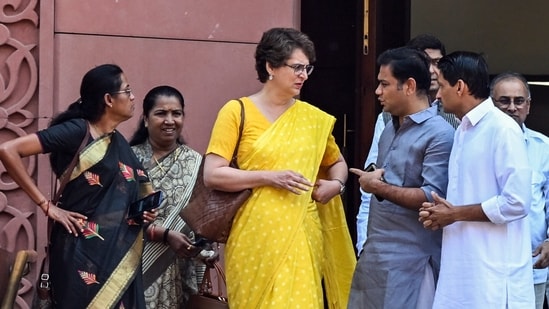
Taking the helm of the INDIA bloc’s offensive, Priyanka Gandhi Vadra delivered a scathing critique of the government’s approach to women’s empowerment. Her challenge was direct and unequivocal: **”Hold Parliament on Monday, bring the old bill, let’s see who is anti-women.”**
Gandhi’s phrasing is a calculated political maneuver. By daring the government to call a special session and present the 2023 bill—stripped of its delaying clauses—she is attempting to strip away the ruling party’s self-proclaimed title as the ultimate champion of “Nari Shakti” (women’s power). Her rhetoric aims to force the ruling coalition into a corner: either agree to immediate implementation or admit that the 2023 legislation was a performative gesture designed for electoral gains rather than immediate systemic change.
Political analysts note that Gandhi has successfully coalesced various regional parties within the Opposition bloc around this single issue. Leaders from the Trinamool Congress (TMC), Dravida Munnetra Kazhagam (DMK), and the Samajwadi Party (SP) have echoed her sentiments, creating a unified front that threatens to dominate the political narrative heading into the summer.
## Anatomy of the Failed Government Move
The urgency of the Opposition’s demand is juxtaposed against a recent, failed legislative maneuver by the ruling coalition. Earlier this month, the government reportedly attempted to introduce a parallel framework—a set of executive guidelines aimed at encouraging political parties to voluntarily allocate 33% of their tickets to women in upcoming state elections.
This move was widely perceived as a stopgap measure to pacify growing unrest among female voter demographics without actually triggering the constitutional mandate of the 2023 Act. The voluntary guideline proposal collapsed under bipartisan criticism. The Opposition slammed it as a “toothless tiger,” while several allies within the ruling National Democratic Alliance (NDA) expressed concerns over the lack of a legal enforcement mechanism.
The failure of this soft approach left the government with no choice but to formally notify the 2023 Act this week. However, by keeping the delimitation caveat intact, the notification served only to reignite the Opposition’s fury, paving the way for Priyanka Gandhi’s Monday ultimatum. [Source: Hindustan Times].
## Expert Perspectives: Law and Political Representation
Constitutional experts remain divided on the feasibility of the Opposition’s demands. Removing the delimitation clause from the Nari Shakti Vandan Adhiniyam would require a constitutional amendment, necessitating a two-thirds majority in Parliament and ratification by half of the state legislatures.
“From a purely constitutional standpoint, the government’s argument that constituencies must be remapped before reserving seats for women holds technical merit,” explains **Dr. Arindam Sen, a constitutional law expert at the National Institute of Public Policy**. “You need empirical data to determine which seats will be reserved, and traditionally, that data comes from a fresh census and a delimitation commission. However, from a political and legislative standpoint, Parliament is sovereign. If there is unanimous political will, temporary provisions could be enacted to implement a randomized reservation system for the current constituencies.”
Conversely, advocates for women’s rights argue that the technicalities are merely excuses. **Sunita Krishnan, a prominent gender rights activist**, notes, “We have waited decades for the Women’s Reservation Bill. We were told 2023 was the victory. Now we are told we must wait for a census that has no scheduled date, and a delimitation process that could take years. Justice delayed is representation denied. Priyanka Gandhi’s demand resonates because women are tired of being treated as a future agenda item.” [Source: Additional Public Sources].
## The Southern State Factor and Delimitation Fears
To fully understand the political paralysis surrounding the women’s quota, one must examine the geopolitical anxieties tied to the word “delimitation.”
For southern states like Tamil Nadu, Kerala, and Karnataka, delimitation is a deeply polarizing issue. These states have successfully implemented population control measures over the last few decades. A new delimitation exercise, which allocates parliamentary seats based on current population metrics, threatens to reduce the political representation of these southern states while increasing the dominance of populous northern states like Uttar Pradesh and Bihar.
By tying the 33% women’s quota to the delimitation exercise, the government inadvertently married a universally supported concept (women’s empowerment) to a highly volatile regional dispute (political representation based on population). The Opposition has weaponized this linkage, arguing that the government deliberately designed the 2023 Act to be un-implementable in the short term by tying it to the “third rail” of Indian politics.
“The Opposition’s demand to decouple the quota from delimitation is not just about women’s rights; it is also a strategic move to ease the anxieties of southern states,” says political analyst Rajeev Deshmukh. “If the government brings the bill on Monday and removes the delimitation clause, it simultaneously grants women their quota and removes the immediate threat of disenfranchisement hanging over the South.”
## Impact on the 2026 Election Cycle
The timing of this political showdown is critical. The year 2026 is a pivotal electoral calendar, featuring highly contested state assembly elections in crucial battlegrounds, including Assam, West Bengal, Kerala, and Tamil Nadu.
In recent years, the **”silent female voter”** has emerged as the most decisive demographic in Indian elections. Welfare schemes targeting women—ranging from direct cash transfers to subsidized cooking gas—have frequently tipped the scales in tight electoral contests. Both the ruling coalition and the INDIA bloc are acutely aware that whichever side successfully claims the mantle of passing and *implementing* the 33% quota will reap massive electoral dividends.
If the government ignores Priyanka Gandhi’s challenge, the Opposition will likely launch a nationwide campaign framing the ruling party as deceptive and patriarchal. Conversely, if the government accepts the dare, it risks opening a Pandora’s box of legislative hurdles and angering its own conservative base who may oppose a rushed, randomized reservation system.
## Conclusion: The Road Ahead
As the weekend progresses, all eyes remain fixed on New Delhi. Priyanka Gandhi Vadra’s aggressive challenge has successfully shifted the narrative from the government’s procedural notifications to a stark, moral binary: implement the quota immediately, or admit to being “anti-women.”
**Key Takeaways:**
* The government has officially notified the 2023 Nari Shakti Vandan Adhiniyam, but implementation remains stalled by the requirement for a census and delimitation.
* An attempted alternative government move to push voluntary quotas has failed, sparking Opposition backlash.
* Priyanka Gandhi and the united INDIA bloc are demanding an emergency parliamentary session this Monday to amend the bill and remove the delimitation caveat.
* The conflict highlights deeper geopolitical tensions, particularly the southern states’ fears regarding the upcoming delimitation exercise.
Whether the government will call the Opposition’s bluff and convene Parliament remains to be seen. However, one reality is undeniable: the long-fought battle for women’s adequate representation in India’s legislative corridors has entered its most volatile and consequential phase yet. As the pressure mounts, the coming days will test the political will of India’s leadership to turn legislative promises into immediate democratic realities.