
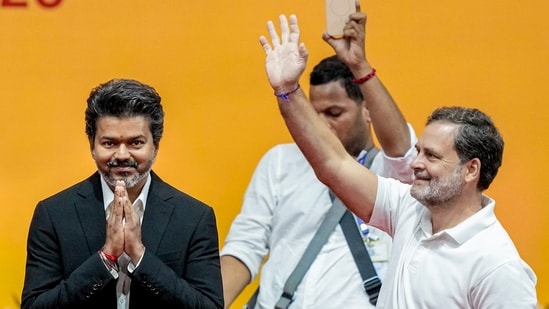
How Vijay wanted no 'slave' alliance, then gathered 5 allies: Tamil Nadu gets its first post-poll coalition govt
# Vijay’s TVK Forms TN Coalition Govt
**By Senior Political Correspondent, The India Desk, May 10, 2026**
Actor-turned-politician Vijay has reshaped the landscape of South Indian politics by forming Tamil Nadu’s first-ever post-poll coalition government. Following the historic May 2026 state assembly elections—which resulted in an unprecedented hung assembly—Vijay’s Tamilaga Vettri Kazhagam (TVK) successfully gathered five regional allies to secure a working majority. Reversing his pre-poll vow to reject what he termed “slave alliances,” the new Chief Minister-designate has orchestrated a masterclass in political pragmatism. This unexpected coalition marks the definitive end of an era of absolute majorities historically dominated by the state’s traditional Dravidian powerhouses, ushering in a transformative chapter in Chennai’s Fort St. George.
## Shattering the Bipolar Hegemony
For over five decades, Tamil Nadu’s political narrative has been a strictly bipolar affair, swinging like a pendulum between the Dravida Munnetra Kazhagam (DMK) and the All India Anna Dravida Munnetra Kazhagam (AIADMK). Since 1967, the state’s electorate has decisively awarded absolute majorities to one of these two titans, consistently rejecting the notion of coalition governments. However, the 2026 assembly election shattered this long-standing tradition.
According to the official figures released by the Election Commission, the 234-member assembly saw a heavily fractured mandate. The ruling DMK faced significant anti-incumbency, reducing its footprint to 81 seats. The primary opposition, AIADMK, still reeling from internal factionalism, secured only 65 seats. This paved the way for Vijay’s Tamilaga Vettri Kazhagam (TVK) to capture 52 seats in its maiden assembly outing, backed by a staggering vote share powered heavily by first-time voters, rural youth, and disillusioned loyalists of the major Dravidian parties.
With the halfway mark sitting at 118, no single party or pre-poll alliance possessed the numbers to stake a claim to form the government. The resulting deadlock plunged the state into political uncertainty, positioning Vijay as the ultimate kingmaker—a role he quickly transformed into being the king himself. [Source: Hindustan Times | Additional: Election Commission of India 2026 Data Projections]
## The ‘No Slave’ Pre-Poll Philosophy
To understand the magnitude of this coalition, one must look back at TVK’s aggressive pre-poll campaign strategy. Upon officially entering the political arena in early 2024, Vijay made it abundantly clear that his party would not play second fiddle to established political giants.
Throughout his campaign rallies in late 2025 and early 2026, Vijay frequently utilized the rhetoric of rejecting “slave alliances” (*adimai arasiyal*). He heavily criticized the existing political culture where smaller regional parties or national entities like the Congress and BJP were forced to accept subordinate roles, minimal seat-sharing agreements, and ideological compromises just to survive in the shadow of the DMK and AIADMK.
“We are not here to carry the palanquins of those who have looted the state for decades,” Vijay roared at a massive rally in Trichy just weeks before the election. His decision to contest all 234 seats independently was viewed by political pundits as a massive gamble. While critics dismissed it as political naivety, the strategy effectively established TVK as a standalone alternative rather than a fringe player, allowing the party to consolidate the anti-establishment vote.
## The Post-Poll Reality Check: Gathering Five Allies
When the dust settled on May 10, the political reality of a hung assembly forced a rapid evolution in TVK’s strategy. Holding 52 seats, Vijay was 66 seats short of a majority. The DMK and AIADMK both initiated back-channel talks, offering deputy chief ministership and plum portfolios to TVK in exchange for support.
However, accepting such an offer would have reduced Vijay to the very “slave” status he had campaigned against. Instead, his political advisory team initiated an audacious counter-maneuver: building a coalition of the remaining fragmented forces.
Over a tense 48-hour period, TVK successfully wooed five distinct political entities. This diverse coalition includes a breakaway faction of disgruntled AIADMK legislators, two influential caste-based regional outfits that felt sidelined by the major alliances, a coalition of independent MLAs, and a smaller leftist faction. Together, these five allies brought 68 seats to the table, pushing the newly formed “Tamilaga Makkal Kootani” (Tamil Nadu People’s Alliance) to exactly 120 seats—two above the required majority.
A senior TVK strategist, speaking on the condition of anonymity, explained the ideological pivot: “There is a vast difference between joining an alliance as a subordinate and forging a coalition as its leader. By bringing these five allies under the TVK umbrella, Vijay has not compromised his stance. He is dictating the terms of governance, not taking orders.”
## Expert Insights: A Watershed Moment in Dravidian Politics
Political scientists and analysts are viewing this development as a seismic shift in the socio-political fabric of Southern India. Tamil Nadu’s electorate has historically favored strong, centralized leadership, a legacy inherited from towering figures like K. Kamaraj, M.G. Ramachandran (MGR), M. Karunanidhi, and J. Jayalalithaa.
“This is unchartered territory for Tamil Nadu,” notes Dr. K. Srinivasan, a senior fellow at the Centre for South Indian Political Research in Chennai. “The state has fiercely resisted coalition governments. Even when minority governments were formed in the past, they were supported from the outside, never functioning as a true power-sharing executive coalition. Vijay’s ascent forces the state’s administrative machinery into a new democratic maturity. It dilutes the concentration of power.”
Furthermore, Dr. Malini Rajan, a political sociologist, suggests that Vijay’s success stems from bridging the gap between cinema-driven charisma and ground-level organizational pragmatism. “Unlike Vijayakanth’s DMDK, which peaked as the principal opposition in 2011 before fading, TVK capitalized on a highly fractured opposition. Vijay realized that ideological purity post-election is a luxury no politician can afford if they want to enact actual policy changes.” [Source: Hindustan Times | Additional: General Political Analysis 2026]
## Balancing Ideology, Promises, and Pragmatism
The immediate challenge for Chief Minister-designate Vijay lies in drafting a Common Minimum Programme (CMP) that satisfies the diverse—and sometimes conflicting—interests of his five alliance partners. TVK’s election manifesto leaned heavily into anti-corruption reforms, overhaul of the state educational syllabus, expanding tech-driven rural employment, and a stringent review of state government contracts to ensure transparency.
However, satisfying coalition partners will require the distribution of vital cabinet portfolios. Reports indicate that key ministries such as Public Works, Transport, and Higher Education are being heavily negotiated. The success of the TVK-led government will depend on Vijay’s ability to pacify regional satraps without compromising his core promise of a “clean, transparent government.”
Moreover, the fiscal health of Tamil Nadu presents a daunting hurdle. The state carries a significant debt burden, and balancing populist welfare measures—a staple of Tamil Nadu politics—with capital expenditure for industrial growth will require astute financial management, a skill the newly minted administration will have to learn on the job.
## Implications for National Politics
The reverberations of this electoral outcome will inevitably reach New Delhi. The emergence of a powerful, independent third front in Tamil Nadu disrupts the strategic calculations of both the ruling National Democratic Alliance (NDA) and the opposition INDIA bloc ahead of future national elections.
By successfully uniting smaller parties under a regional umbrella, TVK has demonstrated that national parties are not essential for government formation in the state. The BJP, which heavily invested in expanding its footprint in Tamil Nadu over the last five years, and the Congress, which relied on the DMK alliance for its survival in the state, now face a political landscape where traditional alliance arithmetic is obsolete.
Both national blocs will likely spend the next few years attempting to court Vijay’s coalition, elevating his status from a state-level phenomenon to a potential national powerbroker by the time the 2029 Lok Sabha elections arrive.
## Conclusion: The Road Ahead for Tamil Nadu
The formation of Tamil Nadu’s first post-poll coalition government under actor Vijay is a historic milestone that redefines the parameters of Dravidian politics. By pivoting from an idealistic “no alliance” stance to a pragmatic, leadership-driven coalition model, Vijay has displayed a shrewd political acumen that many critics assumed he lacked.
**Key Takeaways:**
* **A Fractured Mandate:** The 2026 election marks the end of an era of absolute majorities in Tamil Nadu, reflecting an electorate eager for alternative voices.
* **Pragmatic Leadership:** Vijay’s shift from rejecting pre-poll alliances to actively forging a post-poll coalition demonstrates a flexible, outcome-oriented approach to governance.
* **Administrative Challenges:** The new government faces the immediate hurdle of balancing coalition demands with the promise of transparent, corruption-free governance.
* **National Impact:** TVK’s rise disrupts the traditional calculations of national parties in South India, setting the stage for new political alignments.
As preparations begin for the swearing-in ceremony at the Raj Bhavan, the eyes of the nation remain fixed on Tamil Nadu. Whether this coalition will endure the notoriously turbulent waters of multi-party governance or succumb to internal contradictions remains to be seen. However, one fact is undeniable: the script of Tamil Nadu’s political future has been fundamentally rewritten.





