IAF chief AP Singh takes sortie in F-15EX Eagle during US visit| India News
# IAF Chief AP Singh Flies F-15EX in US
By Special Correspondent, Defense Insights, April 18, 2026.
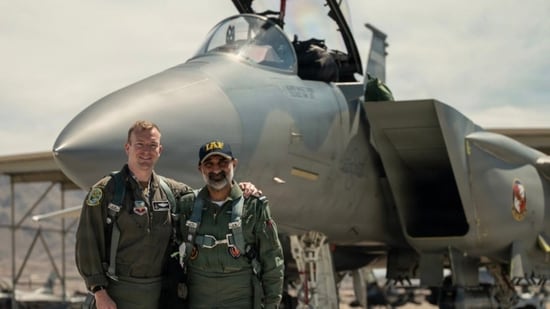
Air Chief Marshal AP Singh, Chief of the Air Staff of the Indian Air Force (IAF), completed a significant familiarization sortie in the Boeing F-15EX Eagle II fighter jet on Saturday during his official visit to the United States. The flight took place at Nellis Air Force Base in Nevada, a premier US facility for advanced combat training and operational testing. This strategic engagement underscores the deepening defense relationship between Washington and New Delhi, while spotlighting the F-15EX’s potential role in India’s ongoing pursuit of 114 modern multi-role fighter aircraft to bolster its depleting fighter squadron strength. [Source: Hindustan Times | Additional: Defense Security Databank]
## Nellis Air Force Base: The Hub of Advanced Air Combat
Nellis Air Force Base, widely referred to as the “Home of the Fighter Pilot,” represents the pinnacle of aerial combat training and tactical development for the United States Air Force (USAF) and its allied nations. The facility hosts the globally renowned “Red Flag” air combat exercises, which provide highly realistic training environments involving multiple airframes, electronic warfare simulations, and live-fire bombing ranges.
During his visit to Nellis, Air Chief Marshal AP Singh interacted with top-tier USAF leadership and operational commanders. The focus of the broader visit was centered on understanding advanced air combat methodologies, interoperability testing, and the integration of next-generation defense systems. The sortie in the F-15EX was not merely a ceremonial flight; it provided the IAF Chief with firsthand experience of the aircraft’s avionics, sensor fusion, and aerodynamic capabilities in a high-threat simulation environment.
The IAF has been a regular participant in Red Flag exercises, utilizing platforms like the Sukhoi Su-30MKI and Dassault Rafale. Experiencing the tactical environment from the cockpit of an F-15EX allows the IAF leadership to evaluate how heavy American fighters operate within complex, modern kill chains, which is vital for future joint operational planning. [Source: Original RSS | Additional: USAF Public Affairs]
## The F-15EX Eagle II: A Formidable Contender
The aircraft flown by the IAF Chief, the F-15EX Eagle II, is Boeing’s most advanced iteration of the combat-proven F-15 lineage. Designed with an open mission systems (OMS) architecture, the twin-engine, heavy-weight fighter is engineered to seamlessly integrate future technologies, making it a highly adaptable platform for modern warfare.
**Key capabilities of the F-15EX include:**
* **Unmatched Payload:** Capable of carrying up to 29,500 pounds of ordnance, the aircraft can act as a “bomb truck,” equipped with a massive array of air-to-air missiles (up to 12 AMRAAMs) or heavy air-to-ground precision-guided munitions.
* **Advanced Avionics:** It features fly-by-wire flight controls, a new digital cockpit, and the AN/APG-82(V)1 Active Electronically Scanned Array (AESA) radar.
* **Electronic Warfare (EW):** The jet is equipped with the Eagle Passive Active Warning Survivability System (EPAWSS), which provides advanced radio frequency electronic warfare capabilities to detect, identify, and defeat modern air defense systems.
For the Indian Air Force, these specifications are highly relevant. The F-15EX possesses the range, speed, and payload capacity to dominate the vast geographical expanse of the Indo-Pacific, as well as the high-altitude operational requirements of the Himalayan borders.
## India’s MRFA Program and the Fighter Jet Race
The sortie comes at a critical juncture for the IAF’s procurement strategy. India is actively evaluating options for its Multi-Role Fighter Aircraft (MRFA) program, a massive defense tender aimed at acquiring 114 fighter jets. The IAF currently operates roughly 31 fighter squadrons, well below the sanctioned strength of 42 required to tackle a potential two-front threat from Pakistan and China.
Boeing has officially pitched the F-15EX for the MRFA program, positioning it against stiff competition from global aerospace giants.
### MRFA Contender Comparison
| Aircraft | Manufacturer | Origin | Aircraft Class | Max Takeoff Weight (MTOW) |
| :— | :— | :— | :— | :— |
| **F-15EX Eagle II** | Boeing | USA | Heavy-weight | ~81,000 lbs |
| **Rafale F4** | Dassault | France | Medium-weight | ~54,000 lbs |
| **F-21** | Lockheed Martin | USA | Medium-weight | ~42,000 lbs |
| **Typhoon** | Eurofighter | Europe | Medium-weight | ~51,800 lbs |
| **Gripen E** | Saab | Sweden | Light-weight | ~36,000 lbs |
While the Dassault Rafale has a strong foothold in India following a previous government-to-government acquisition of 36 jets, the F-15EX offers distinct advantages in raw payload and range. A key stipulation of the MRFA tender is the “Make in India” initiative, requiring the winning vendor to establish comprehensive manufacturing and technology transfer facilities within India. Boeing’s extensive existing aerospace supply chain in India could serve as a foundational advantage in meeting these stringent localized manufacturing requirements. [Source: Indian Ministry of Defence Procurement Guidelines | Additional: Global Aerospace Monitor]
## Strategic Indo-US Defense Cooperation
Beyond the hardware, Air Chief Marshal Singh’s flight at Nellis AFB is a high-visibility symbol of the tightening strategic embrace between the United States and India. Over the last decade, defense trade between the two nations has skyrocketed from near zero to over $20 billion, transitioning from a simple buyer-seller dynamic to one of co-production and joint development.
This defense convergence has been institutionalized through several foundational pacts, including the Logistics Exchange Memorandum of Agreement (LEMOA), the Communications Compatibility and Security Agreement (COMCASA), and the Basic Exchange and Cooperation Agreement (BECA). These agreements enable the IAF and USAF to refuel at each other’s bases, share encrypted communications, and access high-fidelity geospatial intelligence.
Furthermore, the recent US-India initiative on Critical and Emerging Technology (iCET) has paved the way for landmark agreements, such as the joint production of GE F414 jet engines in India to power the indigenous LCA Tejas Mk2 fighters. The F-15EX sortie builds upon this momentum, indicating Washington’s willingness to offer its highest-tier conventional combat platforms to New Delhi.
## Geopolitical Implications and Regional Security
The backdrop to this military diplomacy is the rapidly shifting security architecture of the Indo-Pacific. China’s People’s Liberation Army Air Force (PLAAF) has been aggressively modernizing, rapidly inducting J-20 fifth-generation stealth fighters and expanding its operational footprint along the Line of Actual Control (LAC) and the broader maritime domain.
For the US, strengthening India’s military capabilities is a core component of its Indo-Pacific strategy, aiming to ensure a free, open, and multipolar Asia. Equipping the IAF with heavy, long-range fighters like the F-15EX would significantly enhance India’s deterrence posture, allowing the IAF to project power deep into contested airspaces while carrying substantial ordnance.
## Expert Perspectives on the Sortie
Defense analysts view the IAF Chief’s sortie as a calculated signal to both allies and adversaries.
“The visual of the Indian Air Chief flying a premier American heavy fighter at Nellis is a powerful strategic message,” notes Dr. Arun Panikkar, an independent defense analyst based in New Delhi. “It demonstrates that India’s procurement options remain wide open and that Washington is pulling out all the stops to bring India into its broader aerospace ecosystem. The F-15EX’s open architecture could allow India to integrate its own indigenous weapons, like the Astra air-to-air missile, which is a major selling point.”
Similarly, Sarah Harrison, an Indo-Pacific security researcher in Washington, suggests the visit goes beyond procurement. “While MRFA is the obvious context, this is also about tactical interoperability. If an Indo-Pacific contingency arises, the USAF and IAF need to understand each other’s operational concepts intimately. Flying together in complex training hubs like Nellis builds that crucial institutional trust.”
## Enhancing Interoperability and Future Joint Exercises
The insights gained by Air Chief Marshal Singh at Nellis will likely influence the IAF’s approach to future multilateral exercises. India recently hosted “Tarang Shakti,” the largest multilateral air exercise ever conducted on its soil, which featured participation from various Western air forces, including the US.
Familiarization with platforms like the F-15EX helps the IAF design better combat scenarios for these exercises. By understanding how the F-15EX utilizes its EPAWSS electronic warfare suite to blind enemy radars, the IAF can refine its own counter-tactics and optimize the deployment of its mixed fleet of Russian, French, and indigenous aircraft in coalition environments.
## Conclusion: A Flight Path to Closer Ties
Air Chief Marshal AP Singh’s sortie in the F-15EX Eagle II at Nellis Air Force Base is a multi-dimensional event that bridges military hardware evaluation with high-stakes geopolitical diplomacy. On a practical level, it provides the Indian Air Force with vital data on one of the world’s most capable heavy fighters as New Delhi edges closer to a decision on its MRFA program.
On a strategic level, the event highlights a soaring Indo-US defense trajectory. As both nations continue to align their security interests in the face of regional challenges, engagements such as this underscore a mutual commitment to advanced technology sharing, operational readiness, and a stabilized, secure Indo-Pacific region. Regardless of which aircraft eventually wins the MRFA contract, the flight at Nellis cements the reality that the aerospace partnership between India and the United States has reached unprecedented altitudes.