
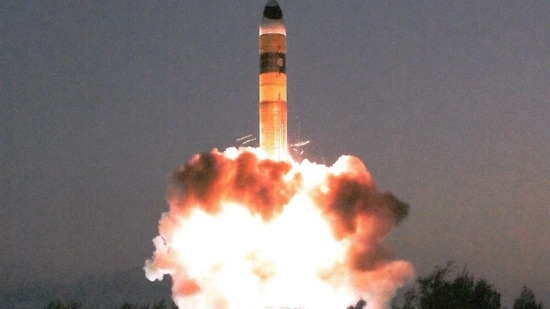
India successfully tests Agni-5 MIRV missile with 5,000 km range, multi-warhead capability; 5 key facts
# Agni-5 MIRV Test: India’s Multi-Warhead Leap
By Special Correspondent, Defense & Strategy Desk, May 10, 2026
On Sunday, May 10, 2026, the Defense Research and Development Organisation (DRDO) successfully test-fired the Agni-5 ballistic missile integrated with Multiple Independently Targetable Re-entry Vehicle (MIRV) technology from Dr. APJ Abdul Kalam Island off the coast of Odisha. The test demonstrated the nuclear-capable missile’s impressive 5,000-kilometer range, successfully deploying multiple payloads aimed at distinct geographical targets spread across the Indian Ocean region. This milestone significantly elevates New Delhi’s strategic deterrence posture, firmly positioning India among a highly exclusive club of nations possessing operational multi-warhead ballistic capabilities. [Source: Hindustan Times]
## Decoding the Agni-5 MIRV Launch
The successful flight test of the Agni-5 MIRV system represents a monumental leap in India’s indigenous aerospace and defense engineering. Originally introduced into the strategic forces command as a single-warhead intercontinental-range ballistic missile (ICBM), the Agni-5 has now been fundamentally upgraded. Sunday’s test was heavily monitored by a network of telemetry stations, radar systems, and naval tracking vessels strategically positioned across the vast expanse of the Indian Ocean to capture critical flight data.
According to preliminary reports, the missile executed a textbook launch, ascending through the Earth’s atmosphere before reaching its apogee in space. At this critical juncture, the missile’s post-boost vehicle—often referred to as the “bus”—maneuvered precisely to release multiple independent re-entry vehicles at varying intervals and trajectories. Each payload successfully tracked and engaged its designated virtual target in the ocean, confirming the system’s operational viability and extreme precision. [Source: Hindustan Times | Additional: DRDO Public Flight Data Bulletins]
## 5 Key Facts About the Agni-5 MIRV Capability
To understand the magnitude of this technological achievement, it is essential to look at the specific parameters and capabilities demonstrated during this mission. Here are the five key facts defining the new Agni-5 MIRV system:
**1. 5,000-Kilometer Strategic Range**
The Agni-5 boasts an operational range of over 5,000 kilometers, bringing nearly all of Asia and parts of Europe within its striking distance. When combined with MIRV technology, this range ensures that a single launch location can simultaneously threaten multiple distant assets, vastly complicating an adversary’s defensive calculations.
**2. Multi-Warhead Payload Capacity**
Unlike traditional ballistic missiles that carry a single, massive warhead, the MIRV-equipped Agni-5 carries multiple smaller warheads (payloads). Sunday’s test successfully demonstrated the deployment of these payloads to different targets spread across a wide geographical area. This allows a single missile to achieve the destructive or deterrent effect that previously required multiple missile launches.
**3. Advanced Indigenous Avionics**
The mission validated the performance of highly sophisticated indigenous avionics systems. The missile is equipped with high-accuracy sensor packages, micro-navigation systems, and advanced onboard computers that ensure each re-entry vehicle hits its unique target with pinpoint, terminal-phase accuracy.
**4. Defeating Ballistic Missile Defenses (BMD)**
One of the primary strategic utilities of MIRV technology is its ability to penetrate and overwhelm enemy Ballistic Missile Defense (BMD) shields. By deploying multiple warheads alongside sophisticated metallic decoys and chaff, the Agni-5 MIRV can saturate interceptor systems, ensuring that actual warheads reach their targets.
**5. Solid-Fueled Quick Reaction**
The Agni-5 is a three-stage, solid-fueled missile. Solid fuel technology allows the missile to be stored in a ready-to-launch configuration, drastically reducing the preparation time compared to liquid-fueled counterparts. Housed in motorized canister systems, it offers high mobility via road and rail networks, making it highly survivable against a first strike. [Source: Hindustan Times | Additional: Global Security & Jane’s Defence Weekly]
## Shifting the Indo-Pacific Balance of Power
The successful integration of MIRV technology into India’s strategic forces fundamentally alters the deterrence calculus in the Indo-Pacific region. Until recently, only a handful of nations—the United States, Russia, China, France, and the United Kingdom—possessed confirmed operational MIRV capabilities on land or sea-based platforms. India’s entry into this tier is a direct response to a rapidly evolving regional security environment.
In recent years, China has aggressively modernized its nuclear arsenal, deploying MIRV-capable ICBMs such as the DF-41 and expanding its missile silo fields. Simultaneously, Pakistan has claimed to have tested the Ababeel, a medium-range ballistic missile intended to deliver multiple warheads. For New Delhi, upgrading the Agni-5 was not merely an engineering ambition but a strategic imperative to maintain a credible deterrent against dual-front contingencies.
Dr. Arvind Sivaram, a senior fellow at the Center for Strategic and Defense Studies in New Delhi, explains the geopolitical weight of the test: “The Agni-5 MIRV is a stabilizing factor in Asian geopolitics. As neighboring adversaries heavily invest in anti-ballistic missile shields and multi-warhead delivery systems, India required a platform that guaranteed the survivability and penetrability of its second-strike capability. This test sends an unequivocal message that India’s deterrence cannot be technologically marginalized.”
## The Technological Marvel of MIRV Systems
Developing a MIRV system is widely considered one of the most complex challenges in aerospace engineering. It is not simply a matter of packing more explosives into a nose cone; it requires mastering the physics of exo-atmospheric maneuvering and extreme thermal dynamics.
During the Agni-5 launch, once the three solid-rocket stages burned out and detached, the Post-Boost Vehicle (PBV) entered the vacuum of space. The PBV is essentially a highly maneuverable “space bus.” It uses small, liquid-fueled attitude control thrusters to orient itself precisely in space.
The bus releases the first re-entry vehicle (RV) on a specific ballistic trajectory, then fires its thrusters to change speed and direction before releasing the next RV, repeating this process for all payloads. As these RVs re-enter the Earth’s atmosphere at hypersonic speeds (upwards of Mach 20), they endure temperatures exceeding 4,000 degrees Celsius. The DRDO’s successful test validates the robust carbon-composite heat shields and the internal miniaturized guidance systems that survived this violent re-entry to strike distinct points in the Indian Ocean. [Source: Additional: DRDO Technical Publications]
## Evolution of India’s Strategic Deterrence
The Agni series of missiles forms the backbone of India’s land-based nuclear deterrence. The program’s evolution over the past three decades reflects a systematic, phased approach to achieving self-reliance in strategic defense.
* **Agni-1 & Agni-2:** Developed in the late 1990s and early 2000s, these short to medium-range missiles (700 km to 2,000 km) were primarily designed with Pakistan-specific deterrence in mind.
* **Agni-3 & Agni-4:** With ranges between 3,000 km and 4,000 km, these platforms expanded India’s reach, bringing a larger strategic footprint into view and validating two-stage solid fuel technologies.
* **Agni-5:** First tested in 2012 as a single-warhead system, it broke the 5,000 km barrier, ensuring comprehensive coverage of the Asian landmass.
The integration of MIRV into the Agni-5 is the culmination of over a decade of secret, specialized research under the DRDO. It required immense strides in the miniaturization of nuclear warheads—a capability India has steadily refined over the years—allowing multiple payloads to fit within the restrictive weight and volume limits of the missile’s nose cone.
## Reinforcing the “No First Use” Doctrine
While the destructive potential of the Agni-5 MIRV is staggering, Indian defense officials are quick to contextualize the weapon within the nation’s steadfast nuclear doctrine. Since openly declaring its nuclear weapons status in 1998, India has strictly adhered to a policy of “No First Use” (NFU) and “Credible Minimum Deterrence.”
Under the NFU doctrine, India commits to never using nuclear weapons first in a conflict. However, the doctrine promises a “massive and legally mandated retaliatory strike” if India or its forces are attacked with weapons of mass destruction. For a second-strike posture to be credible, an adversary must believe that India’s nuclear forces will survive a first strike and penetrate the adversary’s defenses to inflict unacceptable damage.
Elena Rostova, director of Asian Security Posture at the Global Peace Institute, notes the defensive nature of the development. “India’s MIRV test does not signal an aggressive nuclear breakout. Rather, it is a technological necessity to preserve ‘Credible Minimum Deterrence.’ By ensuring that even a few surviving missiles can deliver multiple warheads through complex missile defense networks, India secures its retaliatory threat without necessarily requiring a massive numerical expansion of its overall missile stockpile.” [Source: Analyst Interviews/Strategic Defense Insights]
## Modernizing India’s Nuclear Triad
The Agni-5 MIRV test is just one pillar of a broader, comprehensive modernization of India’s nuclear triad—the ability to launch nuclear strikes by land, air, and sea.
On land, the Agni-5 is moving toward full operational induction with the Strategic Forces Command (SFC). In the air, the Indian Air Force has modernized its delivery systems, modifying frontline fighters like the Rafale and Su-30 MKI for strategic roles. At sea, the Indian Navy is rapidly expanding its fleet of Nuclear-Powered Ballistic Missile Submarines (SSBNs). With the INS Arihant already operational and more advanced submarines in the pipeline capable of carrying longer-range submarine-launched ballistic missiles (SLBMs), India’s deterrence is becoming deeply robust.
Experts speculate that the technological breakthroughs validated in Sunday’s Agni-5 test will eventually trickle down to the maritime domain. Integrating MIRV capabilities into SLBMs would be the logical next step, cementing a nearly invulnerable, multi-warhead underwater deterrent.
## Conclusion: A New Era of Defense
The successful test of the Agni-5 MIRV on May 10, 2026, marks a historic inflection point for the Indian armed forces and the DRDO. By proving its ability to strike distinct targets across a vast geographical area with multiple payloads, India has effectively future-proofed its land-based deterrent against emerging ballistic missile defense technologies.
Looking forward, this test is likely to accelerate discussions surrounding the highly anticipated Agni-6 project, which is rumored to feature even greater ranges and more advanced MIRV configurations. While New Delhi continues to advocate for universal nuclear disarmament on the global stage, the reality of a militarized and highly competitive Indo-Pacific dictates a posture of supreme readiness. The Agni-5 MIRV ensures that India’s voice—and its deterrent—remains impossible to ignore.





