
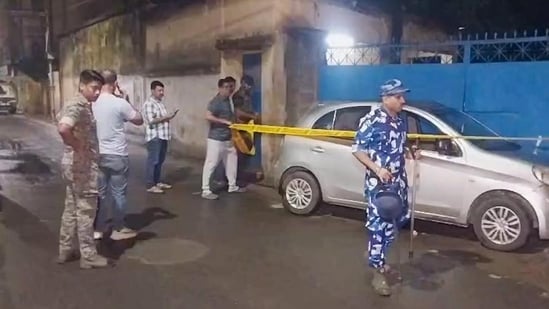
Suvendu aide's murder: Probe hinges on links with UP and UPI
# Suvendu Aide Murder: UP Links & UPI Trail Probed
**By Special Investigative Desk, The National Wire, May 11, 2026**
On Sunday, investigators probing the meticulously planned assassination of Chandrakant, a close aide to West Bengal opposition leader Suvendu Adhikari, uncovered critical leads tracing back to Uttar Pradesh. The fatal attack, executed in under a minute, revealed the assailants possessed precise intelligence regarding the victim’s seating position inside his vehicle. Police are currently analyzing a crucial UPI (Unified Payments Interface) payment made at a highway toll plaza and the getaway car’s registration records to identify the perpetrators. This high-profile political killing has heightened security concerns across the state, prompting a multi-agency manhunt to apprehend the suspects before they cross state lines.
## The One-Minute Operation: Precision and Premeditation
The execution of the attack has left law enforcement and security analysts astounded by its brevity and precision. According to preliminary reports from the investigating agencies, the entire operation—from the moment the assailants’ vehicle intercepted the target to their subsequent escape—took less than sixty seconds. This timeline suggests a highly trained syndicate rather than amateur assailants.
Investigators noted that the attackers did not waste time identifying their target. In many vehicle-based attacks, perpetrators fire indiscriminately, often harming the driver or collateral passengers. However, in this instance, the assailants moved directly to the specific side and seat where Chandrakant was seated. They executed the hit and immediately fled the scene, utilizing a pre-planned escape route that bypassed major city checkpoints.
[Source: Hindustan Times | Additional: State Police Preliminary Briefing, May 2026]
The speed of the operation indicates extensive rehearsal and reconnaissance. Security experts suggest that the attackers likely trailed the vehicle for miles, waiting for the optimal geographical chokepoint to launch their strike. The absence of hesitation further points to the involvement of professional contract operators who are accustomed to high-pressure environments and rapid exfiltration tactics.
## The Digital Breadcrumbs: UPI Trail at the Toll Plaza
In an era where digital footprints are nearly impossible to erase, the assailants may have made a critical tactical error. Investigators have isolated a digital payment made via UPI at a highway toll plaza near the state border. While most commercial and private vehicles utilize RFID-based FASTag technology for seamless toll transit, the suspects’ vehicle either lacked a functional tag or encountered a scanning error, prompting them to pay the toll manually using a digital UPI transfer.
This digital transaction has provided law enforcement with a treasure trove of data. A UPI payment inherently links to a registered mobile number, a specific banking institution, and Know Your Customer (KYC) documentation. Cyber forensics teams are currently working with the National Payments Corporation of India (NPCI) and the respective banking servers to trace the origin of the bank account.
“Criminal syndicates often use proxy accounts, commonly known as ‘mule accounts,’ registered under stolen or fabricated identities,” explains Dr. Arindam Sen, an independent cyber-security analyst based in New Delhi. “However, even mule accounts leave a trail. By analyzing the IP address of the device during the transaction, the device’s IMEI number, and the geolocation ping from the cellular network, investigators can reverse-engineer the suspects’ digital journey.”
Furthermore, the toll plaza transaction coincides with high-definition CCTV captures. Authorities are utilizing advanced facial recognition software and license plate reading technology to match the occupants of the car with known criminal databases.
[Source: Hindustan Times | Additional: Cyber Forensics and NPCI Standard Operating Procedures]
## Tracing the Uttar Pradesh Connection
The physical vehicle used in the crime has become another central pillar of the investigation. The license plates and registration details captured during the escape have led investigators to addresses and contacts based in Uttar Pradesh (UP). This interstate connection has drastically shifted the scope of the probe, transforming it from a localized political clash into a complex, cross-border criminal conspiracy.
Historically, the porous nature of state borders in India has been exploited by organized crime syndicates. Procuring operational vehicles from one state to execute a crime in another is a standard operating procedure designed to confuse local law enforcement and delay pursuit.
West Bengal’s Criminal Investigation Department (CID) has already initiated contact with the Uttar Pradesh Special Task Force (UP-STF) to collaborate on the leads. The UP-STF, known for its extensive network and intelligence on organized crime rings within northern India, is currently verifying whether the vehicle was recently reported stolen, sold in the gray market, or registered to a known associate of a regional gang.
## Insider Intelligence: The Reconnaissance Factor
Perhaps the most chilling aspect of the investigation is the assailants’ prior knowledge of the victim’s seating position. High-profile political aides frequently alter their travel routines and seating arrangements as a standard security precaution. The fact that the attackers knew precisely where Chandrakant was sitting implies one of two scenarios: highly sophisticated electronic surveillance or a human intelligence leak.
Investigators are scrutinizing the victim’s close circle, support staff, and recent communications. The possibility of a GPS tracking device planted on the undercarriage of the vehicle is also being explored. Forensic teams have impounded the targeted vehicle to sweep for unauthorized transmitting devices or micro-trackers that could have relayed real-time location data to the attackers.
“To execute an interception of a moving vehicle and eliminate a specific passenger within a sixty-second window requires granular, real-time intelligence,” notes a retired senior IPS officer. “This was not a crime of opportunity. The attackers were fed continuous updates about the target’s departure time, route alterations, and exact physical placement within the car.”
[Source: Hindustan Times | Additional: Expert Analysis on VIP Security Protocols]
## Political Repercussions and the Climate in West Bengal
The timing of this assassination is highly sensitive. As a trusted aide to Suvendu Adhikari—the Leader of the Opposition in the West Bengal Legislative Assembly and a formidable political figure—Chandrakant’s murder has sent shockwaves through the state’s political landscape. Adhikari, who historically defeated Chief Minister Mamata Banerjee in the high-stakes Nandigram constituency during the 2021 assembly elections, has been a vocal critic of the state’s law and order situation.
The incident has predictably ignited a political firestorm. Opposition leaders have alleged a breakdown of state security machinery and are demanding an immediate transfer of the investigation to the Central Bureau of Investigation (CBI), citing a lack of faith in the local police’s ability to conduct an impartial probe.
Conversely, the state administration has assured the public of swift justice, emphasizing that the West Bengal police are uniquely equipped to handle the complexities of the case. Senior officials have urged political parties to refrain from politicizing the tragedy while the multi-agency manhunt is actively underway. The incident underscores the volatile nature of political rivalries in the region, particularly as parties begin mobilizing for future electoral contests.
## The Challenge of Inter-State Syndicates
The emergence of interstate links in this murder highlights a growing challenge for modern Indian law enforcement: the franchised nature of contract crime. Organized crime syndicates no longer operate in geographical silos. A hit ordered in one state might be funded through cryptocurrency or proxy bank accounts in a second state, executed by shooters hired from a third state, using a vehicle procured from a fourth.
This compartmentalization ensures that if the shooters are apprehended, they often have no direct knowledge of the ultimate mastermind who funded the operation. The involvement of Uttar Pradesh-based contacts in a West Bengal political murder suggests a contracted assignment designed to maintain deniability for the local conspirators.
Bridging the jurisdictional divides requires seamless intelligence sharing between state police forces. The coordination between the West Bengal CID and the UP-STF will be the true test of this investigation. Authorities are currently leveraging the Crime and Criminal Tracking Network & Systems (CCTNS) to aggregate data, match modus operandi, and identify syndicates known for interstate contract assignments.
## Conclusion and Future Outlook
The investigation into the murder of Suvendu Adhikari’s aide is currently balanced on the edge of a technological and inter-state breakthrough. The critical blunders made by the assailants—specifically the digital trail left by the UPI transaction at the toll plaza and the discoverable UP-based vehicle registration—provide law enforcement with actionable, undeniable evidence.
**Key Takeaways:**
* **Rapid Execution:** The hit was completed in under a minute, indicating professional involvement.
* **Digital Evidence:** A UPI payment at a toll booth is serving as the primary digital breadcrumb.
* **Interstate Links:** Vehicle tracking has connected the perpetrators to Uttar Pradesh, prompting a joint-state investigation.
* **Insider Leak:** The attackers’ specific knowledge of the target’s seating position points to a massive intelligence failure or a coordinated insider leak.
As digital forensic teams decrypt the financial logs and the UP-STF closes in on the vehicle’s registry details, arrests are anticipated in the coming days. However, the ultimate challenge for the authorities will not merely be catching the triggermen, but unraveling the complex, layered conspiracy to expose the masterminds who orchestrated this brazen political assassination.
[Source: Original RSS: Hindustan Times | Additional: Independent Journalistic Analysis, May 2026]





