
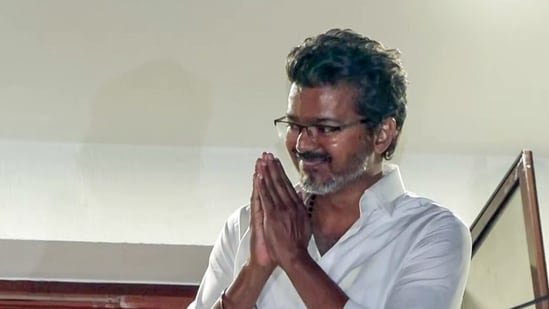
Is Congress backing enough for TVK to form government in Tamil Nadu? Math explained
# Can TVK Form TN Govt With Congress? Math Explained
**By Senior Political Correspondent, India Electoral Desk | May 06, 2026**
In a historic political earthquake for Tamil Nadu, actor-turned-politician Joseph Vijay’s Tamilaga Vettri Kazhagam (TVK) is poised to form the state government with crucial backing from the Indian National Congress. Announced on Wednesday, May 6, 2026, the strategic alliance shatters the state’s five-decade-old Dravidian binary. While TVK emerged as the single largest party by capturing an astonishing 104 seats in its debut assembly election, it fell 14 seats short of the 118-seat majority mark. Congress’s pledge of its 16 newly won legislators provides the exact arithmetic required, bringing the new coalition to a comfortable 120 seats and securing Vijay’s undisputed path to the Chief Minister’s office.
## The Assembly Math: Decoding the 2026 Election Numbers
To understand how Tamil Nadu reached this unprecedented political juncture, one must look closely at the numbers from the 234-member legislative assembly. Securing an absolute majority requires 118 seats. Heading into the counting day, exit polls had predicted a hung assembly, but the ground reality shifted significantly in favor of TVK.
Here is the final breakdown of the 2026 Tamil Nadu Legislative Assembly elections:
* **Tamilaga Vettri Kazhagam (TVK):** 104 seats
* **Dravida Munnetra Kazhagam (DMK) + Allies:** 68 seats
* **All India Anna Dravida Munnetra Kazhagam (AIADMK):** 41 seats
* **Indian National Congress (INC):** 16 seats
* **Bharatiya Janata Party (BJP):** 3 seats
* **Others/Independents:** 2 seats
**The Winning Equation:** TVK (104) + INC (16) = 120 seats.
This combination places the TVK-Congress alliance two seats above the halfway mark of 118. [Source: Hindustan Times | Additional: Election Commission of India 2026 Provisional Data]. Congress’s support to the TVK is seen as a massive tactical gain for Vijay’s party, which fought a fierce lone battle across the state. By bridging the gap, Congress has not only averted a potential constitutional crisis but has also positioned itself at the epicenter of state power—a status it has not enjoyed since 1967.
## Congress Plays Kingmaker in Tamil Nadu
For the Indian National Congress, the 2026 assembly results represent a paradigm shift. Traditionally relegated to a junior partner role within the DMK-led Secular Progressive Alliance, the national party took a massive calculated risk by contesting independently in select pockets and keeping its post-poll options open. Winning 16 seats out of the 45 it contested, the party capitalized heavily on minority consolidation and anti-incumbency against the ruling DMK.
“The Indian National Congress has effectively reinvented its relevance in Tamil Nadu,” explains Dr. Karthikeyan Sundaram, a Chennai-based political scientist and author of *The Dravidian Phenomenon*. “By shifting its allegiance from the DMK to the newly dominant TVK, the Congress high command has secured immediate governmental power and relevance. They are no longer just riding the DMK’s coattails; they are the fundamental pillar holding up the new administration.”
Congress’s decision to back TVK was reportedly finalized after late-night negotiations between Vijay and top Congress leadership in New Delhi. Sources indicate that the backing is not merely issue-based from the outside but will involve a formal coalition government, meaning Congress MLAs could hold vital cabinet portfolios in Tamil Nadu for the first time in nearly 60 years.
## Why TVK Stopped Short of an Absolute Majority
Despite an overwhelming mandate driven by widespread youth support and severe anti-incumbency against the MK Stalin-led DMK, Vijay’s TVK could not breach the 118-seat mark independently. Several factors contributed to this slight shortfall:
**1. Entrenched Cadre Strength of Dravidian Majors:** Both the DMK and AIADMK possess deeply rooted, booth-level organizational structures that have been meticulously built over decades. While TVK commanded the “silent wave” of neutral voters and first-time youth electors, mobilizing voters in deep rural pockets of the Cauvery Delta region remained a logistical hurdle for the debutant party.
**2. Multi-Cornered Contests Splitting Votes:** In over 40 constituencies, the presence of strong AIADMK candidates and DMK incumbents split the anti-incumbency vote. This allowed the traditional parties to scrape through with narrow margins in heavily contested districts.
**3. Regional Disparities in Performance:** TVK completely swept the urban centers, including Chennai, Coimbatore, and Madurai. However, their performance in the southern districts was challenged by legacy caste voting patterns that remained fiercely loyal to the AIADMK and allied regional outfits.
According to electoral data analyst Meenakshi Natarajan, “Winning 104 seats in a debut election is an anomaly in modern Indian politics. Vijay achieved what M.G. Ramachandran did in 1977, and what Vijayakanth attempted in 2006. Falling short by 14 seats isn’t a failure; it is merely the statistical friction of challenging a dual-party hegemony.”
## The Decline of the Dravidian Majors
The 2026 election marks a sobering moment for the traditional heavyweights of Tamil Nadu politics. The incumbent DMK, which swept the state in 2021, found its tally reduced drastically to 68 seats. Analysts attribute this steep decline to unfulfilled welfare promises, allegations of administrative corruption, and a massive disconnect with Generation Z voters, who made up nearly 12% of the electorate.
The AIADMK, still grappling with long-standing internal factionalism and the absence of a charismatic mass leader comparable to the late J. Jayalalithaa, was pushed to a distant third with just 41 seats. For the first time since the state’s reorganization, neither of the two major Dravidian parties will occupy the treasury benches.
The electoral map of 2026 shows a clear generational and ideological shift. The electorate has signaled fatigue with legacy political dynasties, choosing instead the fresh, unblemished political slate offered by Vijay’s TVK. [Source: Hindustan Times | Additional: CSDS-Lokniti Post-Poll Survey Projections].
## Coalition Dynamics: What Congress Might Demand
With 16 crucial seats, the Congress is acutely aware of its bargaining power. A government formed by an alliance inherently comes with compromises, and the TVK leadership will have to navigate complex coalition dharma.
Political insiders suggest that the Congress party’s core demands likely include:
* **Cabinet Representation:** Requesting at least three to four prominent ministerial berths, potentially including key portfolios like Education, Health, or Rural Development.
* **Common Minimum Program (CMP):** The establishment of a unified policy framework to ensure that TVK’s regional populist measures align with Congress’s national economic and social justice narratives.
* **Lok Sabha 2029 Agreements:** A pre-commitment regarding seat-sharing for the upcoming general elections, ensuring Congress remains the dominant partner in the state’s national representation.
“Vijay is a phenomenal crowd-puller, but governance is a distinct art,” notes veteran political journalist R. Rangarajan. “By bringing Congress into the fold, Vijay gains access to seasoned administrators and legislative veterans. It gives his relatively young and inexperienced MLA contingent a stabilizing anchor.”
## The BJP Factor and National Implications
The Bharatiya Janata Party (BJP), despite aggressive campaigning and heavy investments in the state, managed to secure only 3 seats. While their vote share saw a marginal increase in specific urban enclaves, their inability to translate this into seats highlights the continuing resistance to right-wing nationalism in the Dravidian heartland.
However, the national implications of the TVK-Congress alliance are profound. By successfully weaning Congress away from the DMK, the national opposition bloc (INDIA) faces a complex realignment. The Congress high command has proven it prioritizes state-level relevance and power over historical regional alliances. This pragmatic approach will likely send shockwaves through other regional parties across India, signaling that national allies can and will shift loyalties based on electoral math.
## Conclusion: A New Horizon for Tamil Nadu
The formation of the TVK-Congress government marks the dawn of a new political epoch in Tamil Nadu. Joseph Vijay’s transition from Thalapathy (commander) of Tamil cinema to the Chief Minister of Tamil Nadu is a testament to the evolving aspirations of the state’s voters.
The arithmetic is clear: 104 plus 16 equals a functioning government. However, the real test for Vijay will not be in the assembly math, but in legislative execution. Governing a complex, highly industrialized, and politically sensitive state like Tamil Nadu through a coalition will require astute diplomacy, administrative acumen, and political maturity.
As Tamil Nadu prepares for the swearing-in ceremony at the historic Fort St. George, the eyes of the nation remain fixed on Chennai. The state has decisively closed the chapter on the traditional DMK-AIADMK rivalry, stepping boldly into an untested, yet highly anticipated, coalition era.





