
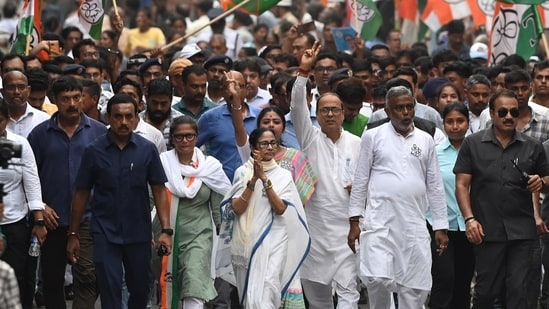
Jadavpur: Bengal's high-voltage seat where legacy, lawfare and ideologies collide
# Jadavpur: Bengal’s Clash of Legacy & Ideology
**By Staff Correspondent, The Election Desk**
**April 28, 2026**
As West Bengal enters the fervent throes of the 2026 legislative assembly elections, the Jadavpur constituency has once again emerged as the state’s most scrutinized and symbolically charged battleground. Historically represented by former Left Front Chief Minister Buddhadeb Bhattacharjee, Jadavpur currently serves as the epicenter of a fierce triangular contest. Here, the ruling Trinamool Congress (TMC), a determined Bharatiya Janata Party (BJP), and a revitalized Left-Congress alliance are locked in a high-voltage clash. Driven by deep-seated historical legacies, escalating legal battles over corruption, and starkly contrasting political ideologies, the outcome in Jadavpur is expected to set the tone for Bengal’s political future. [Source: Hindustan Times | Additional: 2026 Electoral Projections].
## A Crucible of Bengal’s Political History
To understand the weight Jadavpur carries in 2026, one must look at its unparalleled political pedigree. The constituency is not merely a geographical entity on the electoral map; it is the beating heart of West Bengal’s political evolution. Historically born out of the massive influx of East Bengali refugees post-partition, the area transformed into an impenetrable fortress for the Communist Party of India (Marxist) during the 1970s and 80s.
It was in the Jadavpur Lok Sabha seat in 1984 that a young Mamata Banerjee famously earned her “giant-killer” moniker by defeating the veteran communist leader Somnath Chatterjee. Years later, the Jadavpur assembly segment became the political home of Buddhadeb Bhattacharjee, who represented the constituency from 1987 until his shocking defeat in the historic 2011 wave that brought the TMC to power. Today, Jadavpur embodies the ghosts of Bengal’s past and the fierce anxieties of its future. The constituency encapsulates the journey from the Left’s industrialization dreams to the TMC’s welfare-populism, and now faces the ideological challenge of the BJP’s nationalistic fervor.
## Lawfare and the Shadow of Scams
The 2026 election in Jadavpur is heavily overshadowed by what political commentators are dubbing “lawfare”—the weaponization and mobilization of legal and investigative frameworks in the political arena. Over the last few years, West Bengal has witnessed sweeping investigations by central agencies, including the Central Bureau of Investigation (CBI) and the Enforcement Directorate (ED), primarily targeting the ruling TMC over alleged irregularities in the school service commission (SSC) and municipal recruitments.
For an urban, highly educated electorate like Jadavpur—home to thousands of retired teachers, government officials, and academics—these allegations resonate deeply. The BJP and the Left have made anti-corruption the cornerstone of their campaigns, urging voters to reject the incumbent government. Conversely, the TMC has crafted a counter-narrative, accusing the central government of utilizing federal agencies to orchestrate political vendettas against opposition states.
“Jadavpur’s voter base is uniquely analytical. They do not vote merely on populist waves; they weigh ideological commitments against ground realities,” notes Dr. Anirban Chatterjee, a Kolkata-based political sociologist. “The continuous loop of arrests, bail hearings, and seized assets has created a climate of skepticism. The party that can successfully control the narrative around this ‘lawfare’ will ultimately sway Jadavpur’s middle-class.” [Source: Independent Political Analysis].
## The Jadavpur University Factor
No discussion of this constituency is complete without acknowledging the profound influence of Jadavpur University (JU). As one of India’s premier educational institutions, JU has historically been a hotbed of progressive, anti-establishment, and left-wing student politics. The intellectual currents that flow out of the campus frequently spill over into the surrounding neighborhoods, influencing local discourse.
While the broader constituency’s voting patterns do not always perfectly align with the radical campus politics, the university acts as a powerful ideological anchor. The Left alliance is leaning heavily on the JU intelligentsia to rebuild its grassroots connect, framing its 2026 campaign around youth employment, academic freedom, and democratic rights. Meanwhile, the BJP has often positioned the campus as a symbol of “anti-national” sentiment, using it as a foil to consolidate conservative, nationalist votes in the neighboring urban and semi-urban pockets of the constituency.
## Ideological Collision: Welfare vs. Nationalism vs. Revival
The 2026 electoral battle in Jadavpur is fundamentally a clash of three distinct ideological paradigms, each trying to capture the imagination of a deeply fragmented electorate:
**1. The TMC’s Sub-Nationalist Welfarism:**
The ruling party continues to bank on its robust social welfare architecture. Schemes like *Lakshmir Bhandar* (direct cash transfers to women) and *Swasthya Sathi* (health insurance) have created a loyal voter base among the lower-middle-class and marginalized communities within the broader Jadavpur area. The TMC couples this with a strong Bengali sub-nationalist pitch, framing itself as the sole defender of Bengal’s cultural identity against “outsider” forces.
**2. The BJP’s Cultural Nationalism and Anti-Corruption:**
The BJP is aggressively targeting Jadavpur’s upper-middle-class and conservative Hindu voters. Their campaign marries the promise of transparent governance and rapid urban infrastructure development with their broader national ideological planks. By pointing to the infrastructural bottlenecks and the “syndicate raj” (alleged local extortion networks), the BJP hopes to breach the TMC’s urban fortress.
**3. The Left-Congress Alliance’s Democratic Revival:**
Struggling for survival but sensing an opening amidst the TMC’s anti-incumbency and the BJP’s polarization, the Left is returning to its roots. Their manifesto in Jadavpur heavily emphasizes re-industrialization, filling vacant government posts, and restoring the “lost dignity” of Bengal’s education system—a direct nod to the legacy of Buddhadeb Bhattacharjee, who championed industrialization in his twilight years as Chief Minister.
## Demographic Shifts and Urban Voter Sentiment
The demographics of Jadavpur have undergone a massive transformation over the past three decades. What were once sprawling refugee colonies—the bedrock of the Left Front’s historical dominance—have gentrified into bustling commercial hubs, upscale residential complexes, and modern urban neighborhoods.
### Key Demographic Segments and Voting Drivers
| Voter Demographic | Historical Lean | 2026 Primary Voting Drivers |
| :— | :— | :— |
| **Old Refugee Colonies** | Left Front | Welfare schemes (TMC), Heritage/Loyalty (Left), CAA implementation (BJP). |
| **Middle-Class Professionals** | Left/TMC Swing | Anti-corruption, infrastructure, urban safety, economic stability. |
| **Youth & Students** | Left / NOTA | Job creation, transparency in SSC/PSC exams, freedom of expression. |
| **Working-Class/Informal Sector** | TMC | Direct cash transfers, state-sponsored healthcare, local patronage. |
This gentrification has introduced a highly pragmatic, aspirational voter base that demands rapid modernization, clean governance, and robust infrastructure. The perennial issues of waterlogging during monsoons, traffic congestion along the Eastern Metropolitan Bypass, and the demand for better solid waste management often take precedence over high-level ideological debates in local municipal wards.
However, in an assembly election of this magnitude, hyper-local issues are seamlessly blending with macro-political narratives. A resident of Baghajatin or Santoshpur is equally concerned with their local drainage system as they are with the ongoing CBI probes at the state secretariat.
## The Battle of Heavyweights
Given its prestige, all major political outfits have historically fielded their most charismatic and heavyweight candidates in Jadavpur. The legacy of intellectuals, celebrities, and political titans contesting this seat puts immense pressure on current candidates. In the 2024 Lok Sabha polls, the TMC successfully retained the parliamentary constituency, but assembly segments often display divergent voting behavior, driven by anti-incumbency against local MLAs and councilors.
In 2026, the candidate selection reflects a meticulous calculation of caste arithmetic, intellectual appeal, and organizational muscle. The election rallies here are less about fiery rhetoric and more about strategic town halls, street-corner intellectual debates (*patha-sabhas*), and extensive digital campaigning targeting the smartphone-savvy youth.
## Conclusion: The Bellwether for Bengal’s Future
As April 2026 draws to a close and voters line up outside polling booths across Jadavpur, the stakes extend far beyond a single assembly seat. Jadavpur has come to embody the ultimate litmus test for West Bengal’s shifting political allegiances.
If the Trinamool Congress manages to retain Jadavpur, it will signal that Mamata Banerjee’s welfare economics and localized emotional connect have successfully insulated the party from the heavy onslaught of central anti-corruption probes. Should the BJP capture the seat, it will mark a historic breakthrough, proving that their brand of cultural nationalism and governance-focused critique can penetrate Bengal’s most discerning urban intellectual circles. Conversely, a victory for the Left would signify a stunning political resurrection, suggesting that the ghost of Buddhadeb Bhattacharjee’s vision still resonates with a populace exhausted by the TMC-BJP binary.
Ultimately, Jadavpur remains exactly what it has been for the past half-century: Bengal’s high-voltage political theater, where legacy meets lawfare, and where the clash of ideologies dictates the future of the state.





