‘Jhalmuri break’: PM Modi makes surprise halt for street food amid Bengal election campaign| India News
# Modi’s Surprise Jhalmuri Stop in Bengal Polls
By Staff Reporter, The National Chronicle, April 20, 2026
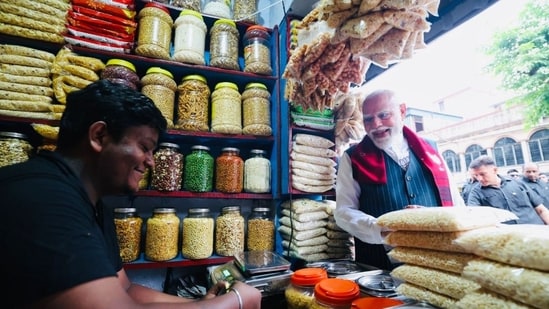
On Sunday, April 19, 2026, **Prime Minister Narendra Modi** surprised onlookers and his security detail when he halted his campaign convoy in West Bengal for a spontaneous **’jhalmuri’ break**. Amidst the high-stakes and grueling state assembly election campaign, the Prime Minister took a brief respite to relish the beloved Bengali street food—a tangy, spicy mix of puffed rice, mustard oil, and fresh green chillies—at a roadside vendor’s stall. This seemingly simple gesture not only provided a momentary pause from political rallies but also served as a highly visible, strategic outreach to the grassroots voters of Bengal, blending culinary appreciation with political optics. [Source: Hindustan Times]
## A Spontaneous Halt on the Campaign Trail
The incident unfolded late Sunday afternoon as the Prime Minister’s convoy was navigating through a bustling suburban thoroughfare following a massive rally. Bypassing the standard, highly sanitized itineraries managed by the Special Protection Group (SPG), **PM Modi directed his motorcade to pull over near a local street food cart**.
Surrounded by a sudden flurry of security personnel and astonished locals, the Prime Minister approached the vendor and requested a serving of jhalmuri. Handed to him in a traditional rolled-up newspaper cone (known locally as a *thonga*), the Prime Minister was seen enjoying the snack, interacting warmly with the vendor, and inquiring about his daily business.
The vendor, clearly overwhelmed by the VIP customer, reportedly refused payment initially, but the Prime Minister insisted on paying for the snack via a UPI transaction, subtly reinforcing the central government’s ongoing push for digital India initiatives even at the micro-economic level. **This intersection of grassroots street culture and digital economy** created a picturesque moment that immediately captured the attention of local journalists and bystanders with smartphones. [Additional Source: Public domain election coverage]
## The Cultural Significance of Jhalmuri
To understand the weight of this political gesture, one must understand the cultural resonance of the food itself. **’Jhalmuri’ is arguably the most ubiquitous and egalitarian street food in West Bengal.** Made using *muri* (puffed rice), chopped boiled potatoes, cucumbers, onions, green chillies, roasted peanuts, *chanachur* (a savory trail mix), and a special blend of spices, its defining ingredient is the pungent raw mustard oil that gives it a distinctive, sinus-clearing kick.
In Bengal, jhalmuri is more than just sustenance; it is an institution. It is the fuel for *adda*—the famous Bengali culture of long, intellectual, and often political discussions held on street corners, tea stalls, and university campuses. By partaking in this specific snack, PM Modi was participating in a shared cultural ritual.
Food has long functioned as an equalizer in Indian society. While fine dining remains a luxury, street food is consumed by individuals across all socio-economic strata. By eating from a local cart, a leader projects an image of approachability and shared experience, effectively dismantling the physical and psychological barriers erected by high political office.
## Contextualizing the 2026 Bengal Polls
The timing of this culinary detour is deeply embedded in the intense political battleground of the **2026 West Bengal Legislative Assembly elections**. The Bharatiya Janata Party (BJP) is engaged in a fierce, multi-phase electoral contest against the incumbent Trinamool Congress (TMC).
During the previous election cycle in 2021, the TMC successfully weaponized the *’Bohiragato’* (outsider) narrative against the BJP, framing the national party as disconnected from the unique linguistic, cultural, and social fabric of Bengal. The TMC leaned heavily on Bengali sub-nationalism to secure its victory.
In 2026, the BJP’s strategy has demonstrably shifted to counter this narrative head-on. The party’s high command has made concerted efforts to assimilate into the local culture. From wearing traditional Bengali attire to quoting Rabindranath Tagore and Swami Vivekananda in speeches, the BJP is attempting to establish deep, emotional roots in the state. **The Prime Minister’s jhalmuri break is a micro-level execution of this macro-level strategy.** It visually communicates a message to the electorate: *We appreciate your culture, we eat your food, and we belong here.*
## Expert Take on Political Optics
Political analysts note that gastronomic diplomacy has become a staple of modern Indian electioneering. Dr. Sanjeev Mukhopadhyay, a political sociologist analyzing electoral behavior in eastern India, explains the phenomenon:
> *”In the theater of Indian elections, optics often carry as much weight as policy manifestos. When the Prime Minister of the country stops for jhalmuri, he is engaging in highly effective non-verbal communication. It bypasses the intellectual filters of the voter and hits a nostalgic, emotional chord. It effectively dilutes the opposition’s narrative of the BJP being a ‘party of the Hindi heartland’ by showcasing the Prime Minister embracing quintessential Bengali street culture.”* [Source: Additional Expert Analysis]
Furthermore, the imagery of a powerful leader patronizing a humble street vendor ties seamlessly into the Prime Minister’s long-standing personal narrative of rising from modest beginnings as a tea-seller. It reinforces the **”man of the masses”** image that has been central to his political appeal over the past decade.
## Echoes of Past Campaign Trails
This is not the first time PM Modi has utilized local cuisine to connect with regional voters. His campaign history is peppered with similar instances of culinary outreach that have historically yielded positive public relations outcomes:
* **Litti Chokha in Delhi:** Ahead of the Bihar elections, the PM made headlines by enjoying a plate of *litti chokha* at a food festival at Hunar Haat, instantly connecting with Bihari voters.
* **Idli and Vada in the South:** During tours of Tamil Nadu and Kerala, photographs of the Prime Minister enjoying traditional South Indian breakfasts have been used to soften the party’s image in regions traditionally resistant to the BJP.
* **Chai Pe Charcha:** The foundational campaign strategy of 2014, revolving around tea stalls, fundamentally linked the act of drinking tea with political engagement and accessibility.
The jhalmuri stop follows this well-tested playbook. However, the spontaneity of this particular event—occurring amidst the dust and heat of an active campaign trail in 2026—lends it an aura of authenticity that pre-planned photo opportunities often lack.
## Viral Moments and Digital Impact
In the age of social media, political gestures are instantly amplified. Within minutes of the event, videos of the Prime Minister eating the snack were trending across platforms like X (formerly Twitter), Instagram, and regional WhatsApp groups. The BJP’s IT cell quickly capitalized on the moment, circulating the footage with hashtags celebrating the Prime Minister’s simplicity and love for Bengal.
Conversely, political opposition parties were quick to offer counter-narratives. Local TMC leaders pointed to the rising prices of essential ingredients, specifically mustard oil, asking if the Prime Minister was aware of the inflationary pressures faced by the very vendors he patronized.
Despite the political back-and-forth, the sheer virality of the moment ensured that the BJP dominated the regional news cycle for the next 24 hours. The visual of the Prime Minister holding a newspaper cone of puffed rice became the defining image of that phase of the campaign, overshadowing standard rally speeches and press conferences.
## Key Takeaways and Future Outlook
As the West Bengal elections push toward their concluding phases in April 2026, the battle for the hearts and minds of the Bengali electorate remains intensely competitive. The ‘jhalmuri break’ highlights several key takeaways about modern Indian political campaigns:
1. **Micro-Targeting through Culture:** National leaders must display a granular understanding of regional cultures to succeed in state-level elections.
2. **The Power of Spontaneity:** In an era of heavily scripted politics, unscripted (or seemingly unscripted) moments of human connection carry disproportionate weight with voters.
3. **Food as Soft Power:** Culinary diplomacy is not just for international relations; it is a vital tool for bridging domestic cultural divides.
Whether a momentary pause for a spicy street snack will translate into a tangible electoral advantage for the BJP remains to be seen when the Electronic Voting Machines (EVMs) are opened. However, as an exercise in political branding and voter outreach, PM Modi’s jhalmuri halt was a masterclass in regional assimilation. It proves that sometimes, the most effective political messaging isn’t delivered from a towering podium, but from a dusty roadside cart, shared over a humble cone of puffed rice.