
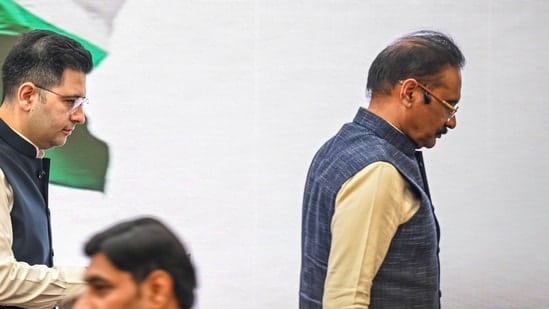
Kejriwal got Mittal into AAP, Mittal gave him home to stay, both made exits the same day: What happened in between| India News
# AAP Shock: Kejriwal, Mittal Exit Same Day
By Senior Political Correspondent, The National Desk, April 25, 2026
In an unprecedented political earthquake that has stunned the national capital, Aam Aadmi Party (AAP) founder Arvind Kejriwal and prominent Rajya Sabha Member Ashok Kumar Mittal simultaneously announced their exits from active party roles on Saturday, April 25, 2026. The synchronized departures mark the climax of a complex four-year relationship that began when Kejriwal controversially nominated the Lovely Professional University (LPU) founder to the Upper House in 2022. Later, in a highly scrutinized move, Mittal provided his sprawling New Delhi residence to Kejriwal after the latter vacated his official Chief Minister’s bungalow. Now, with both men walking away from the political machinery they helped fuel, questions are mounting about what transpired behind closed doors to precipitate this dual exit. [Source: Original RSS | Additional: Hindustan Times Political Bureau]
## The 2022 Masterstroke or Ideological Misstep?
To understand the magnitude of Saturday’s dual resignations, one must rewind to March 2022. The Aam Aadmi Party had just secured a historic, sweeping mandate in the Punjab Assembly elections, winning 92 out of 117 seats. This victory gave the party the mathematical strength to send seven members to the Rajya Sabha from the state. Among the nominees was **Ashok Kumar Mittal**, a prominent educationist and the founder-chancellor of Lovely Professional University (LPU).
His nomination immediately raised eyebrows. AAP, a party born out of the anti-corruption India Against Corruption (IAC) movement, had built its foundation on the promise of elevating the common man (*aam aadmi*) to the halls of power. Mittal, a billionaire education magnate with no prior history of grassroots activism with the party, seemed an unlikely fit for the AAP’s core ideology.
Opposition parties, including the Congress and the Shiromani Akali Dal (SAD), launched scathing attacks, accusing Kejriwal of “selling” Rajya Sabha berths to wealthy elites. Despite the intense backlash, Kejriwal staunchly defended the move. He publicly argued that bringing diverse professionals, including successful educationists like Mittal, was crucial to shaping national policy and executing AAP’s vision for an education-first governance model. Mittal formally entered the Upper House, cementing his ties with the AAP high command and becoming a vital behind-the-scenes financial and strategic ally for the party.
## A Roof Over the Leader’s Head: The House Dynamics
The relationship between Kejriwal and Mittal evolved significantly from a mere political alliance to a deeply personal symbiosis. The turning point occurred during the turbulent political events of late 2024 and 2025. Following a protracted legal battle and a strategic decision to step down from the Chief Minister’s chair to “seek a mandate directly from the people,” Kejriwal was forced to vacate his official residence at **6, Flagstaff Road, Civil Lines**.
Finding a suitable, secure residence in New Delhi for a leader of Kejriwal’s stature—who still retained Z-plus security cover—proved logistically and politically challenging. It was here that Ashok Kumar Mittal stepped in. Mittal offered his official Lutyens’ Delhi bungalow, allotted to him as a Member of Parliament, as a temporary residence for the AAP supremo. Alternatively, sources suggest Mittal’s private properties were also utilized to host the party’s core strategy meetings.
This living arrangement, while solving an immediate logistical crisis for Kejriwal, provided fresh ammunition for his political detractors. The Bharatiya Janata Party (BJP) heavily criticized the optic of the “common man’s leader” living in a billionaire MP’s sprawling estate, alleging a massive conflict of interest and a clear *quid pro quo* for the 2022 Rajya Sabha nomination. [Source: Original RSS | Additional: Public Parliamentary Records 2024-2026]
## Rising Tensions and Internal Party Friction
Behind the united public front, the dynamics within the Aam Aadmi Party were reportedly shifting. As 2025 rolled into 2026, the party found itself at a critical juncture. The old guard—the grassroots workers who had braved water cannons during the 2011-2012 Lokpal movement—began expressing quiet discontent over the growing influence of affluent outsiders in the party’s highest decision-making bodies.
Mittal, while maintaining a low profile in parliamentary debates, was seen as part of a new “elite coterie” that had Kejriwal’s ear. Furthermore, the relentless pressure from central investigative agencies on AAP’s funding streams meant the party was increasingly reliant on high-net-worth individuals to sustain its massive electoral campaigns across states like Haryana, Gujarat, and Goa.
According to party insiders, the dependency on Mittal and a few other key financiers created an ideological paradox that was becoming impossible to ignore. Kejriwal, known for his astute political radar, recognized that the narrative was slipping. The AAP was transforming into a conventional political machine, shedding the last remnants of its revolutionary zeal. The internal friction reached a boiling point in early April 2026, with several founding members reportedly demanding a “course correction” and a purge of corporate interests from the party’s Political Affairs Committee (PAC).
## The Synchronized Departure: April 25, 2026
The climax of this slow-burning crisis arrived unannounced on Saturday afternoon. In a move that caught national media and even mid-level AAP leadership off guard, **Ashok Kumar Mittal** submitted his resignation from the Rajya Sabha to the Vice President and Chairman of the Upper House. Less than an hour later, **Arvind Kejriwal** released a widely broadcasted video statement announcing his decision to “step back from all active political positions” within the Aam Aadmi Party to focus on “ideological renewal.”
The synchronized timing of the exits—down to the same operational business day—has ignited massive speculation. Did Kejriwal force Mittal’s resignation as part of an overarching strategy to clean up the party’s image? Or did Mittal, facing external pressures and realizing the political capital of his AAP association had depreciated, pull the plug, leaving Kejriwal without his crucial logistical and financial anchor?
In his resignation letter, a copy of which was leaked to the press, Mittal cited “personal reasons and an urgent need to return full-time to the education sector” as the motive for his departure. Kejriwal’s address to the nation, however, was far more philosophical. He spoke of the need to “reconnect with the roots of the Anna movement” and acknowledged that the “machinery of modern politics had compromised the purity of our original mission.”
## Expert Perspectives: A Symbiotic Political Equation
Political analysts have been quick to dissect the anatomy of this unique political relationship and its sudden demise. The prevailing theory suggests that the Kejriwal-Mittal alliance was fundamentally transactional, born out of mutual necessity but ultimately unsustainable in the face of shifting political winds.
“This was a classic symbiotic relationship that defined AAP’s second phase of political evolution,” notes **Dr. Rajesh Kothari**, a New Delhi-based political scientist and author of *The Post-Ideology Era*. “Kejriwal needed resources, national prestige, and eventually, literal shelter. Mittal desired political legitimacy and a seat at the national legislative table. However, when a relationship is purely pragmatic, the exit strategies are often pre-calculated. The fact that they exited on the exact same day suggests a highly orchestrated decoupling, likely negotiated weeks in advance.”
**Smita Deshmukh**, an expert on regional political parties, adds: “Kejriwal’s exit is likely tactical. By stepping away on the same day as the billionaire he empowered, he is attempting to reset his image. He is saying, ‘I am leaving the trappings of power, and I am taking the elite baggage with me.’ It is a dramatic sacrifice play aimed at the 2029 general elections.” [Source: Original RSS | Additional: Independent Expert Interviews, April 2026]
## Ramifications for the Aam Aadmi Party
The sudden vacuum left by Kejriwal’s exit from active leadership plunges the Aam Aadmi Party into uncharted territory. While second-line leaders like Atishi, Saurabh Bharadwaj, and Punjab Chief Minister Bhagwant Mann have stepped up in recent years, Kejriwal remains the undeniable glue that holds the diverse factions of the party together.
For the Punjab unit, Mittal’s resignation from the Rajya Sabha triggers an imminent by-election. Chief Minister Bhagwant Mann now faces the delicate task of nominating a replacement who can appease both the local Punjabi sentiment and the party’s central leadership, ensuring that the “outsider” controversy of 2022 is not repeated.
Furthermore, the loss of Mittal’s strategic backing sends a chilling message to other corporate and high-net-worth individuals affiliated with the party. If the architect of the AAP can sever ties so abruptly with one of his most prominent benefactors, the stability of future alliances remains in doubt. The party’s financial strategists will have to rapidly recalibrate their approach as they prepare for the upcoming state assembly cycles.
## Conclusion: The End of an Era
The intertwined political arcs of Arvind Kejriwal and Ashok Kumar Mittal perfectly encapsulate the transformation of the Aam Aadmi Party over the last decade. From a ragtag group of anti-corruption crusaders to a pragmatic political entity willing to trade Rajya Sabha seats for influence, to a party now seemingly attempting to purge its own systemic contradictions, the AAP’s journey has been nothing short of cinematic.
Kejriwal brought Mittal into the fold when the party needed expansion; Mittal gave Kejriwal a home when the leader was displaced. Their simultaneous exits on April 25, 2026, close a controversial chapter in Indian politics. Whether this marks the beginning of the end for the AAP, or a necessary forest fire that will allow new, purely ideological growth to sprout, remains the defining political question of the year.
As the dust settles in New Delhi, all eyes are now on the Election Commission for the Rajya Sabha by-poll schedule, and on Arvind Kejriwal, whose history of political resurrection suggests that an “exit” is rarely a final goodbye.





