
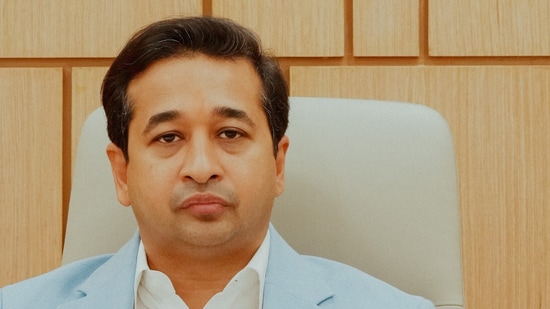
Maharashtra BJP minister Nitesh Rane gets one-month jail for pouring mud on government staff
# BJP Minister Nitesh Rane Gets 1-Month Jail Term
By Senior Political Correspondent, The India Policy Desk, April 28, 2026.
On Monday, a Maharashtra court sentenced sitting BJP minister Nitesh Rane to one month in prison for a 2019 incident in which he and his supporters poured buckets of mud on a National Highways Authority of India (NHAI) deputy engineer. The verdict, delivered over six years after the protest regarding the deplorable, pothole-ridden condition of the Mumbai-Goa highway, marks a significant moment of judicial accountability for elected representatives. Rane’s conviction under charges of obstructing and assaulting a public servant raises pressing questions about his immediate political future and the ethical boundaries of political dissent in India. [Source: Hindustan Times].
## The Court’s Verdict and Immediate Legal Ramifications
The judicial pronouncement against Nitesh Rane, an influential leader from Maharashtra’s Konkan region and a minister in the state cabinet, concludes a highly publicized trial that has lingered in the courts since the pre-pandemic era. The court found Rane guilty under several sections of the Indian Penal Code (IPC), which was the active legal code at the time of the 2019 offense. Specifically, the conviction hinges on IPC Section 353—assault or criminal force to deter a public servant from discharge of his duty—alongside charges of wrongful confinement (Section 342) and unlawful assembly.
While a one-month custodial sentence is relatively brief, its political implications are substantial. Under Section 8(3) of the Representation of the People Act, 1951, a legislator faces automatic disqualification only if sentenced to imprisonment for two years or more. Therefore, Rane will not lose his legislative assembly seat or be legally barred from contesting future elections due to this specific verdict. However, the optics of a sitting cabinet minister facing jail time places immense pressure on the ruling Mahayuti alliance to consider his resignation on moral grounds.
Legal experts note that Rane’s legal team is expected to immediately move the higher courts, likely the Bombay High Court, seeking a suspension of the sentence and bail pending an appeal. Until a stay is granted, the minister remains under the legal obligation to surrender to the authorities. [Source: Hindustan Times | Additional: Indian Legal Public Records].
## Flashback to the 2019 Highway Protest
To understand the gravity of the verdict, one must revisit the dramatic events of July 4, 2019. During the peak of the monsoon season, the Mumbai-Goa Highway (NH-66) was riddled with severe, crater-like potholes, rendering the arterial route practically unmotorable and highly dangerous. Frustration among the locals of the Sindhudurg district had reached a boiling point after several fatal accidents were attributed to the poor road conditions.
Nitesh Rane, then an MLA representing the Kankavli constituency, led a protest march accompanied by a mob of aggressive supporters. The protest took a vigilante turn when the group confronted NHAI Deputy Engineer Prakash Shedekar. In a sequence of events captured on mobile phones that subsequently went viral across national media, Rane and his supporters were seen berating the official.
They proceeded to pour buckets of wet mud and slime over Shedekar, physically overpowering him. The mob then marched the humiliated engineer to a nearby bridge on the highway and tied him to the railing, demanding that he experience firsthand the hazardous conditions commuters faced daily. The blatant public humiliation of a government official performing official duties sparked immediate outrage from civil servants across the state, prompting the police to file a First Information Report (FIR) leading to Rane’s arrest shortly after the incident.
## The Persistent Crisis of the Mumbai-Goa Highway (NH-66)
While the court has rightly penalized the illegal nature of the protest, the incident was rooted in a genuine, decades-long infrastructural failure. The widening and concretization of the Mumbai-Goa Highway into a four-lane corridor has been one of Maharashtra’s most delayed and mismanaged public works projects.
Initiated over a decade ago, the project was meant to transform the 471-kilometer stretch into a high-speed, safe corridor, boosting tourism and trade in the Konkan belt. Instead, it became synonymous with missed deadlines, contractor bankruptcies, environmental clearance hurdles, and perilous driving conditions.
**Timeline of the NH-66 Widening Project Hurdles:**
| Phase / Timeline | Issue / Status | Public Impact |
| :— | :— | :— |
| **2011 – 2015** | Initial land acquisition and project sanctioning. | Massive delays due to local opposition and compensation disputes. |
| **2016 – 2018** | Multiple contractors abandon mid-way work citing financial crises. | Unfinished patches leave the road vulnerable to deep monsoon cratering. |
| **July 2019** | Peak monsoon deterioration in Kankavli. | Potholes cause fatal accidents, triggering the Nitesh Rane mud-pouring incident. |
| **2020 – 2023** | Pandemic-induced labor shortages and reassignment of tenders. | Prolonged commuting times; economic stagnation for Konkan tourism. |
| **2024 – 2026** | Renewed government push and staggered completions. | Portions remain under repair; historical grievances of locals remain high. |
For the constituents of Kankavli and the broader Sindhudurg region, the highway was a matter of life and death. While this context explains the intense public anger that Rane sought to channel, the judiciary has maintained a strict line that administrative failures do not justify vigilantism against on-duty officials. [Source: Hindustan Times | Additional: Public Infrastructure Audits].
## Political Fallout in Maharashtra
The timing of this verdict in April 2026 introduces complex dynamics into Maharashtra’s political ecosystem. As a vocal and aggressive face of the BJP in the state, Nitesh Rane, the son of former Chief Minister Narayan Rane, commands significant influence in the Maratha community and the Konkan belt.
Opposition parties, including the Maha Vikas Aghadi (MVA) coalition comprising the Congress, Uddhav Thackeray’s Shiv Sena (UBT), and Sharad Pawar’s NCP, have seized upon the verdict. They are actively demanding Rane’s immediate dismissal from the state cabinet, arguing that a convicted lawmaker cannot ethically preside over a government portfolio.
“This verdict is an embarrassment for the ruling government, which routinely claims to champion the rule of law,” noted Dr. Vivek Deshmukh, an independent political analyst based in Mumbai. “While a one-month sentence may seem minor, the visual memory of a minister assaulting a public servant is potent. The opposition will utilize this to construct a narrative of arrogance and lawlessness against the BJP-led state government.”
Conversely, some political insiders suggest the BJP may attempt to frame the conviction as a “sacrifice” made by their leader for the welfare of the public. By emphasizing that Rane was fighting for better roads and the safety of his constituents, his supporters are already mobilizing a sympathetic narrative on social media.
## The Boundary Between Protest and Assault
The sentencing brings into sharp focus the often-blurred line between democratic protest and criminal assault in Indian politics. Historically, aggressive demonstrations—ranging from vandalizing toll plazas to manhandling bureaucrats—have been utilized by politicians across the spectrum to project an image of a ‘man of action’ to their voter base.
However, the judiciary has increasingly taken a stern view of such performative aggression. Legal experts point out that allowing elected officials to humiliate state employees destabilizes the fundamental functioning of the bureaucracy.
“The court’s decision establishes a vital deterrent,” states Advocate Meera Chitnis, a constitutional law researcher at the Bombay High Court. “When an elected representative takes the law into their own hands, it sends a dangerous message to the public that violence is an acceptable mechanism for grievance redressal. The state machinery cannot operate if its engineers, doctors, and clerks are living in constant fear of vigilante justice from local politicians.”
The application of IPC Section 353 is specifically designed to protect state functionaries from such interference. The conviction serves as a judicial reminder that parliamentary privilege and public mandate do not grant immunity from the basic tenets of criminal law.
## The Plight of Civil Servants and Institutional Morale
Beyond the political theater, the verdict is being quietly welcomed within bureaucratic circles. Organizations representing state and central government employees have long expressed concerns regarding the vulnerability of field staff. Engineers, health officials, and municipal workers frequently bear the brunt of public anger for systemic failures—such as delayed funding, flawed policies, or bureaucratic red tape—over which they have little individual control.
In the case of the Mumbai-Goa highway, the delays were heavily attributed to systemic land acquisition issues, shifting political mandates, and defaulting contractors, rather than the singular incompetence of a deputy engineer. When politicians target middle-management bureaucrats for systemic failures, it not only diverts attention from high-level policy missteps but also severely damages institutional morale.
Former bureaucrats have emphasized that protecting field officers is critical for infrastructure development. If engineers feel physically unsafe on-site, it becomes increasingly difficult for departments like the NHAI to recruit, deploy, and retain competent professionals in challenging regions. The one-month jail term for a high-profile minister, therefore, acts as a much-needed morale booster for civil servants navigating hostile public environments. [Source: Original RSS | Additional: Bureaucratic Association Statements].
## Conclusion: Accountability and the Road Ahead
The sentencing of Maharashtra Minister Nitesh Rane to one month in prison is more than a conclusion to a bizarre 2019 viral incident; it is a definitive statement on the mechanics of democratic accountability. The verdict simultaneously highlights two undeniable truths: the chronic, agonizing failure of the state to provide basic infrastructure like the Mumbai-Goa highway, and the absolute unacceptability of violence as a political tool to address that failure.
As Rane’s legal counsel prepares to navigate the appellate courts, the BJP faces a calculated decision regarding his tenure in the state cabinet. Will the party prioritize the optics of ethical governance by asking him to step down, or will they defend him as a crusader for local rights who overstepped the line?
For the citizens of Maharashtra, the incident serves as a stark reminder of the long wait for developmental promises to materialize. But for the administrative state, the verdict reaffirms a foundational constitutional promise: no individual, regardless of their political lineage or cabinet rank, stands above the law, and the dignity of the public servant must be upheld even in the face of public fury.





