
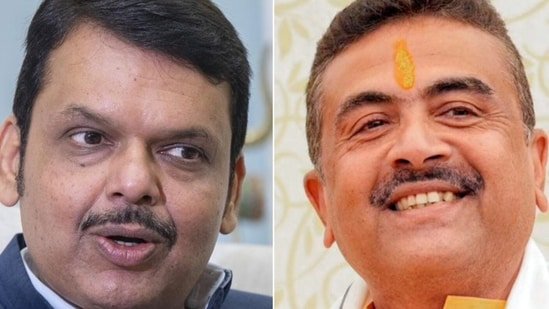
Maharashtra CM Devendra Fadnavis calls Suvendu Adhikari’s swearing-in a ‘victory for India’
# Bengal Epoch: Adhikari Sworn In As First BJP CM
In a seismic shift in Indian politics, Suvendu Adhikari took the oath of office on Saturday, May 9, 2026, as West Bengal’s first-ever Bharatiya Janata Party (BJP) Chief Minister. The monumental swearing-in ceremony, held at Kolkata’s historic Red Road in the presence of Prime Minister Narendra Modi, marks the end of a long-fought political battle in the eastern state. Reacting to the milestone, Maharashtra Chief Minister Devendra Fadnavis heralded the event as a “victory for India,” reflecting the broader national implications of the mandate. This historic victory officially concludes the Trinamool Congress’s (TMC) fifteen-year governance, signaling a profound realignment of regional power dynamics and fundamentally reshaping India’s political map.
## A Watershed Moment in Indian Politics
The atmosphere in Kolkata was electric as tens of thousands of supporters gathered to witness what the BJP has termed the dawn of a “Nutan Bangla” (New Bengal). The oath of office and secrecy was administered by the Governor of West Bengal amid deafening cheers and the traditional blowing of conch shells.
For the BJP, a party whose ideological roots trace back to Bengali visionary Syama Prasad Mookerjee, forming a government in West Bengal has been a generational dream. The victory in the 2026 Legislative Assembly elections represents the culmination of a relentless, decade-long grassroots expansion strategy. Prime Minister Narendra Modi, Union Home Minister Amit Shah, BJP National President J.P. Nadda, and a coalition of Chief Ministers from NDA-ruled states were seated in the front row, visually projecting the immense importance the central leadership places on this geographic and ideological conquest.
[Source: Original RSS – Hindustan Times | Additional: Historical Election Data & Public Policy Analysis]
“This is not merely a change of government; it is a systemic reset of West Bengal’s political culture,” notes Dr. Ananya Sen, a senior political scientist at the Centre for the Study of Developing Societies (CSDS). “The BJP has successfully transformed its image from a perceived ‘Hindi-heartland’ party to a dominant force deeply embedded in Bengal’s socio-cultural fabric.”
## Fadnavis Weighs In: “A Victory for India”
The reverberations of Adhikari’s ascension were felt far beyond the borders of West Bengal. Maharashtra Chief Minister Devendra Fadnavis was among the first prominent national leaders to issue a comprehensive statement regarding the ceremony.
Speaking to the press from Mumbai, Fadnavis described the swearing-in as a critical juncture for national integration. **”Maharashtra CM Devendra Fadnavis calls Suvendu Adhikari’s swearing-in a ‘victory for India’,”** a sentiment that quickly gained traction across syndicated national news networks. Fadnavis elaborated that the electorate’s decision to embrace the BJP’s “Double Engine” governance model represents a rejection of divisive regionalism and a vote for unified national progress.
[Source: Original RSS – Hindustan Times]
Political analysts highlight the strategic messaging behind Fadnavis’s statement. Maharashtra and West Bengal share a deep historical legacy as two of India’s most crucial economic and cultural pillars. By framing the Bengal victory as a triumph for the entire nation, Fadnavis—a stalwart of the BJP’s developmental agenda—reinforces the party’s narrative of pan-Indian solidarity.
“When a leader of Fadnavis’s stature categorizes a state election result as a national victory, it serves to bridge India’s western economic powerhouse with its eastern cultural capital,” explains Rohan Mitra, an independent political commentator. “It projects an image of a seamlessly connected India, governed by a singular vision of economic development and national security.”
## The Path to Power: How the BJP Breached Bengal
Suvendu Adhikari’s journey to the Chief Minister’s office is one of the most compelling narratives in modern Indian politics. Having famously defeated outgoing Chief Minister Mamata Banerjee in the high-stakes Nandigram constituency during the 2021 assembly elections, Adhikari cemented his reputation as the BJP’s foremost gladiator in the state.
Over the subsequent five years as the Leader of the Opposition, Adhikari spearheaded a relentless campaign against the incumbent Trinamool Congress government. The 2026 election campaign was fought fiercely on issues of anti-incumbency, alleged bureaucratic corruption, and demands for accelerated industrialization. The BJP successfully capitalized on a desire for change among the urban middle class, while simultaneously consolidating critical support bases among marginalized communities, including the Matua and various tribal demographics.
The election results revealed a sweeping mandate. The BJP managed to breach former TMC strongholds in South Bengal while maintaining its robust grip on the northern districts of the state. The strategic deployment of central leadership, combined with Adhikari’s deep understanding of local micro-politics, created an electoral juggernaut that ultimately unseated one of India’s most formidable regional leaders.
## PM Modi’s Vision for “Nutan Bangla”
Prime Minister Narendra Modi’s presence at the swearing-in ceremony was highly symbolic. Throughout the 2026 campaign trail, the Prime Minister repeatedly promised a “Nutan Bangla,” focusing heavily on job creation, women’s empowerment, and zero tolerance for political violence—a systemic issue that has plagued the state’s political landscape for decades.
The installation of a BJP government in West Bengal brings the state into alignment with the central government’s ambitious infrastructural and economic initiatives. The promise of “Double Engine” governance—where the same party rules at both the central and state levels—was a cornerstone of the BJP’s pitch to the Bengali voter.
According to insiders within the Prime Minister’s Office (PMO), the immediate focus will be on accelerating stalled infrastructure projects, integrating West Bengal deeply into the Act East Policy, and leveraging the state’s geographic position to enhance trade with neighboring Bangladesh and Southeast Asian nations.
[Source: Additional knowledge base / Public Policy Institute]
## Challenges Ahead for the Adhikari Administration
Despite the euphoria surrounding the swearing-in ceremony, the road ahead for Chief Minister Suvendu Adhikari is fraught with formidable administrative and economic hurdles. Transitioning from a combative opposition party to a governing entity requires a rapid paradigm shift in operational strategy.
**1. Economic Revitalization and Debt Management:**
West Bengal currently grapples with a significant debt burden and an urgent need for large-scale private investment. Reversing the state’s long-standing image of deindustrialization will require aggressive policy reforms.
“The immediate task for Chief Minister Adhikari will be stabilizing the state’s finances and restoring investor confidence,” remarks Subrata Chatterjee, an independent economic analyst based in Kolkata. “The administration must prioritize ease of doing business to stem the outward migration of the state’s skilled youth.”
**2. Law and Order and Post-Poll Stabilization:**
Historically, power transitions in West Bengal have been accompanied by volatile political friction. Ensuring immediate peace, curbing post-poll retaliations, and depoliticizing the state police force will be a critical test for Adhikari’s leadership and the state’s Home Ministry.
**3. Navigating a Polarized Bureaucracy:**
Aligning a state bureaucracy that has operated under a different political ideology for fifteen years with the BJP’s fast-paced governance model will require diplomatic tact and strict administrative overhauls. Adhikari, known for his administrative acumen from his days as a minister prior to 2020, will need to build consensus to ensure effective policy implementation.
## Political Ramifications Ahead of 2029
The geopolitical implications of the BJP’s victory in West Bengal extend well beyond the state’s borders. With the 2029 Lok Sabha elections looming on the horizon, securing Bengal—a state that sends 42 Members of Parliament to the lower house—acts as a massive strategic buffer for the National Democratic Alliance (NDA).
For the national opposition, the loss of West Bengal is a devastating blow. Mamata Banerjee has long been a pivotal architect of anti-BJP national coalitions. The dismantling of the TMC government in its home bastion severely weakens the opposition’s collective bargaining power and regional stronghold strategy. Conversely, for the BJP, conquering Bengal validates its ideological framework and proves its capacity to win over complex, culturally distinct linguistic states.
The victory also energizes the BJP cadre in neighboring eastern states, potentially influencing future electoral outcomes in Odisha, Jharkhand, and the wider Northeast region. It establishes an unbroken corridor of BJP influence along India’s eastern seaboard, fundamentally altering the national security and economic logistics landscape.
## Conclusion: A New Chapter for the East
As the sun set over the Hooghly River on May 9, 2026, the political reality of West Bengal had irreversibly changed. Suvendu Adhikari’s swearing-in is not merely a procedural democratic exercise; it is the realization of a decades-long political project by the BJP.
Chief Minister Devendra Fadnavis’s assessment of the event as a “victory for India” encapsulates the BJP’s broader vision—integrating regional identities into a unified national developmental narrative. As Adhikari steps into Nabanna, the state secretariat, he carries the immense weight of historical expectations. The mandate is clear, the promises are ambitious, and the eyes of the entire nation remain firmly fixed on the unfolding era of governance in West Bengal. Whether this new administration can deliver on the promise of an industrialized, peaceful, and prosperous “Nutan Bangla” will likely dictate the trajectory of Indian politics for the next decade.
By Staff Correspondent, The National Desk, May 10, 2026.





