
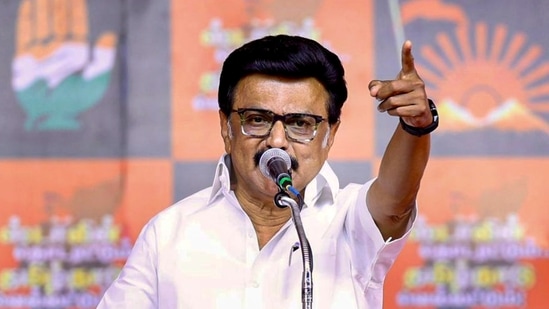
MK Stalin accuses centre of weaponizing women’s reservation against opposition| India News
# Stalin: Women’s Quota Weaponized By Centre
By Senior Political Correspondent, The India Observer, April 12, 2026
On Sunday, April 12, 2026, Tamil Nadu Chief Minister M.K. Stalin launched a scathing attack on the Union government, accusing the Centre of weaponizing the Women’s Reservation Act as a strategic tool to suppress political opposition. Speaking at a public rally in Chennai, Stalin alleged that by tethering the implementation of the 33% legislative quota for women to the imminent and highly contentious delimitation exercise, the ruling establishment is actively attempting to marginalize Southern states. This legislative maneuver, he claimed, penalizes progressive states for their historical success in population control while disproportionately empowering the Centre’s political strongholds in the North under the protective guise of gender justice. [Source: Hindustan Times | Additional: Regional Political Context 2026]
## The Core Accusation: Empowerment or Electoral Engineering?
The controversy stems from the structural mechanisms of the Nari Shakti Vandan Adhiniyam (Women’s Reservation Bill), which was passed with overwhelming bipartisan support in late 2023. While universally praised for its intent to reserve one-third of all seats in the Lok Sabha and state legislative assemblies for women, a critical caveat was embedded in its text: the quota would only be implemented after the publication of the next census and the subsequent redrawing of electoral boundaries—a process known as delimitation.
Chief Minister Stalin argues that this delay was not an administrative necessity, but a calculated political strategy. According to the DMK leader, using women’s empowerment as a prerequisite to unlock a frozen delimitation process essentially holds gender justice hostage to electoral engineering. Stalin asserted that the Centre is fully aware that unfreezing parliamentary seats based on current population metrics will drastically reduce the political leverage of opposition-ruled states in South India.
“Women’s reservation is an undeniable right, one that the DMK has championed for decades. However, the Union government is not using this legislation to empower women; they are using it as a Trojan horse to redraw the electoral map of India to their exclusive advantage,” Stalin noted during his address.
## The Delimitation Dilemma for Southern States
To understand the gravity of Stalin’s accusations, one must examine the demographic trajectory of India over the past fifty years. During the Emergency in 1976, the 42nd Amendment to the Constitution froze the number of Lok Sabha seats at 543, based on the 1971 census. This freeze was extended for another 25 years in 2001 through the 84th Amendment. The primary rationale behind this constitutional freeze was to assure states that successfully implemented family planning and population control policies—primarily in the South—that they would not be penalized with a reduction in their parliamentary representation.
Fast forward to 2026, the year the constitutional freeze technically expires. Southern states like Tamil Nadu, Kerala, Andhra Pradesh, and Karnataka have achieved replacement-level fertility rates or lower. Conversely, populous Northern states like Uttar Pradesh, Bihar, and Madhya Pradesh have seen exponential population growth.
If the Lok Sabha seats are recalibrated solely on contemporary census data, demographic projections suggest that the Hindi heartland could gain dozens of new seats, while the Southern states could stagnate or even lose their proportional share of power in the lower house of Parliament. Stalin’s critique highlights the fear that the Centre is using the moral shield of the Women’s Reservation Act to push through this demographic recalibration without addressing the deep-seated fears of the South. [Source: Hindustan Times | Additional: Constitutional and Demographic Data 2026]
## Strategic Timing and Political Maneuvering
The timing of these statements is critical. As India moves further into 2026, the administrative machinery for the long-delayed decadal Census is gearing up, and the formation of a Delimitation Commission looms large on the horizon. The political opposition views the convergence of these events as an existential threat to regional representation.
Political analysts note that the Centre’s strategy places the opposition in a paradoxical bind. If regional parties oppose the delimitation process, the ruling party can easily frame them as being anti-women, arguing that they are blocking the implementation of the 33% female quota.
Dr. Meenakshi Sundaram, a Chennai-based political scientist and constitutional scholar, observes: “The Union government has crafted a highly sophisticated political trap. By legally intertwining women’s reservation with delimitation, they have shielded the contentious redrawing of constituencies behind an unimpeachable moral cause. Stalin’s aggressive rhetoric is a preemptive strike aimed at decoupling these two issues in the public consciousness before the Delimitation Commission officially begins its work.”
## Fiscal Federalism: The Economic Contribution Argument
Beyond mere parliamentary headcounts, the DMK’s pushback taps into deeply rooted grievances regarding fiscal federalism. Tamil Nadu is one of India’s most industrialized and economically robust states, contributing significantly to the national Gross Domestic Product (GDP) and the central tax pool. However, due to the Finance Commission formulas that frequently prioritize population and income distance, Southern states have long argued that they receive far less in central devolution than they contribute.
Stalin’s recent remarks seamlessly blend the issue of political representation with economic fairness. If delimitation proceeds on the back of the Women’s Reservation Act, Tamil Nadu risks facing a double jeopardy scenario: a continuing decline in its share of central tax revenues coupled with a diminished voice in Parliament to protest that very economic imbalance.
“We are essentially being punished for our progress,” Stalin iterated. “We educated our population, empowered our women organically, controlled our demographics, and built a thriving economy. Now, the very tools of our success are being used to silence us in the corridors of national power.”
## The Centre’s Defense and the Legal Mechanics
In response to such allegations, representatives of the Union government and the ruling party have consistently dismissed the opposition’s fears as baseless fear-mongering. The Centre maintains that linking the quota to delimitation is an absolute legal and logistical necessity, not a political conspiracy.
Legal experts aligned with the Centre point out that arbitrarily assigning 33% of existing seats to women without a systemic overhaul could lead to massive administrative chaos and localized legal challenges. A fresh delimitation is required to identify and rotate reserved constituencies methodically. Furthermore, the Union government argues that expanding the overall size of the Lok Sabha—accommodating the newly built Parliament building’s larger capacity—will ensure that Southern states do not lose their absolute number of MPs, even if their relative proportional power shifts slightly.
However, critics like Stalin counter that maintaining the absolute number of seats is a hollow consolation if the denominator (the total number of seats in Parliament) expands significantly, heavily favoring the North. [Source: Hindustan Times | Additional: Parliamentary Proceedings Context 2026]
## Implications for India’s Federal Structure
The clash between MK Stalin and the Centre over the weaponization of the Women’s Reservation Act is emblematic of a broader, more profound tension straining India’s federal structure. As the deadline for the delimitation freeze expires, the foundational pact between the Union and the States is being tested.
The opposition’s demand is increasingly shifting toward a constitutional guarantee that the proportion of representation between states in the Lok Sabha remains immutable, regardless of internal population dynamics. They propose that the Women’s Reservation Act should be implemented immediately within the existing constituency frameworks, separating the noble cause of gender equity from the geopolitical minefield of delimitation.
**Key Federal Implications:**
* **Constitutional Amendments:** Any move to alter constituency proportions will require significant constitutional amendments, sparking fierce debates in both houses of Parliament.
* **Regional Coalitions:** Southern chief ministers are likely to form a unified block, transcending party lines, to protect their regional sovereignty and political weight.
* **Judicial Intervention:** Legal experts predict that the Supreme Court of India will inevitably be drawn into the fray to adjudicate on the constitutional validity of linking demographic shifts to political representation when it actively penalizes state-led development.
## Conclusion and Future Outlook
MK Stalin’s accusation that the Centre is weaponizing the Women’s Reservation Act marks the beginning of what is expected to be the most consequential political battle of the decade. By highlighting the intersection of gender quotas, demographic realities, and electoral mapping, the Tamil Nadu Chief Minister has drawn a firm line in the sand ahead of the impending delimitation exercise.
The fundamental question facing the world’s largest democracy as it moves toward its next general elections is whether it can achieve adequate representation for women without fundamentally fracturing the fragile regional balance that has held the nation together for over seven decades. The coming months will require delicate constitutional diplomacy from the Centre to prove that its legislative agenda is driven by genuine empowerment rather than a strategic desire to permanently alter India’s electoral geometry in its favor.





