
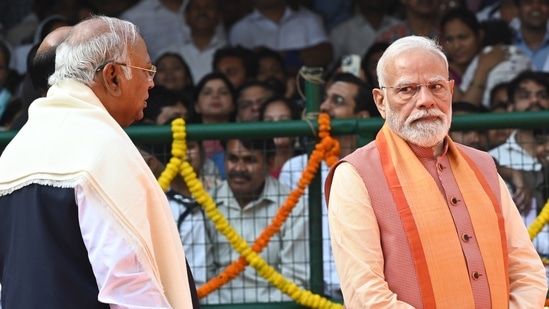
‘Modi ji mentioned Congress 59 times, women barely’: Kharge slams PM’s speech after bill fails Lok Sabha test| India News
# Kharge Slams PM as Women’s Bill Fails in LS
By Vikram Sahay, National Political Editor, New Delhi, April 19, 2026
**New Delhi** — The Constitution (131st Amendment) Bill, 2026, aimed at critically expanding women’s political representation, collapsed in the Lok Sabha on Saturday after failing to secure the requisite two-thirds majority. Following the defeat, Congress President Mallikarjun Kharge launched a scathing critique of Prime Minister Narendra Modi. Kharge accused the Prime Minister of utilizing his parliamentary address for partisan deflection rather than addressing the bill’s core mandate. Highlighting the skewed priorities of the speech, Kharge pointed out that Modi mentioned the “Congress” 59 times, but addressed the issue of “women barely.” This legislative failure marks a substantial roadblock for the current administration and intensifies the political warfare ahead of crucial state elections. [Source: Hindustan Times | Additional: Parliamentary Proceedings Archive].
## A Historic Defeat on the Floor of the House
The atmosphere in the lower house of India’s Parliament was highly charged on Saturday evening as the electronic voting boards lit up, confirming the government’s inability to push through the constitutional amendment. Under Article 368 of the Indian Constitution, an amendment bill requires a special majority: a majority of the total membership of the House and a majority of not less than two-thirds of the members of the House present and voting.
Despite days of intense lobbying and whip issuances by the ruling National Democratic Alliance (NDA), the final tally fell short. The opposition bloc successfully held its ground, demanding broader consultations and the inclusion of sub-quotas for Other Backward Classes (OBC) and minority women—a sticking point that the government refused to concede. The rejection of the bill represents one of the rare occasions where a major constitutional reform introduced by the Modi government has failed to clear the legislative hurdle of the Lok Sabha.
The failure is a significant procedural and optical setback. The ruling coalition, usually known for its tight floor management, witnessed a breakdown in consensus-building. Several regional parties that had previously offered issue-based support to the government staged a walkout just moments prior to the division of votes, mathematically sealing the fate of the 131st Amendment Bill. [Source: Hindustan Times | Additional: Legislative Analysis Reports].
## Kharge’s Blistering Attack on PM Modi
The immediate aftermath of the vote was dominated by Mallikarjun Kharge’s sharp rebuttal of Prime Minister Narendra Modi’s preceding speech. During the debate on the bill, the Prime Minister delivered a prolonged address intended to rally support, but instead, it heavily targeted the historical missteps of the Indian National Congress.
Addressing the media outside Parliament, Kharge dissected the Prime Minister’s remarks, stating, “Modi ji mentioned Congress 59 times, women barely.” Kharge argued that this statistical disparity in the Prime Minister’s rhetoric exposed the government’s lack of genuine commitment to women’s empowerment. “When you stand on the floor of the House to pass a bill dedicated to the women of this country, your focus should be on their rights, their future, and their representation. Instead, we witnessed a politically insecure leader obsessing over the opposition,” Kharge noted.
The Congress President further accused the ruling party of treating the 131st Amendment Bill as a mere public relations exercise rather than a solemn constitutional duty. By framing the debate around anti-Congress rhetoric rather than the socio-economic necessity of the legislation, the opposition claims the Prime Minister alienated potential fence-sitters among independent and regional lawmakers. [Source: Hindustan Times].
## The 131st Amendment Bill: What Was at Stake?
To understand the gravity of Saturday’s events, one must look at the substance of the Constitution (131st Amendment) Bill, 2026. Following the historic passage of the 106th Amendment (Nari Shakti Vandan Adhiniyam) in 2023, which reserved 33% of seats for women in the Lok Sabha and state assemblies, a critical caveat remained: its implementation was tethered to the next delimitation exercise, scheduled to take place post-2026.
The 131st Amendment was proposed to bridge technical gaps ahead of the impending delimitation and demographic restructuring. It reportedly aimed to streamline the integration of women’s reserved constituencies with the new electoral boundaries expected to be drawn up by the upcoming Delimitation Commission. However, the legislation became a battlefield for intersectional representation.
**Key sticking points that led to the impasse included:**
* **The OBC Quota Demand:** The opposition, led by the INDIA bloc, vehemently demanded an explicitly defined “quota within a quota” for women belonging to the Other Backward Classes (OBCs).
* **Implementation Timelines:** Ambiguity regarding whether the reservations would effectively be seen in the 2029 general elections or pushed further into the 2030s caused severe trust deficits between the treasury and opposition benches.
* **Delimitation Fears:** Southern states expressed deep anxieties that the bill was packaged with clauses that might dilute their overall representation in the Lok Sabha during the subsequent delimitation process.
By refusing to send the bill to a Joint Parliamentary Committee (JPC) for further review, the government forced a floor test that ultimately proved premature. [Source: Original RSS | Additional: Policy Research Institute Analysis 2026].
## The Numbers Game: How the Majority Slipped
Passing a constitutional amendment is a testament to a government’s absolute command over the legislature. The failure to secure the two-thirds majority exposes a fracturing of the broader political consensus that the NDA has relied upon over the past few years.
While the ruling coalition holds a comfortable simple majority to pass standard legislative bills, constitutional amendments require a broader, bipartisan consensus. The INDIA bloc demonstrated a rare display of ironclad unity, issuing strict three-line whips to their members to vote against the bill in its current form unless the OBC sub-quota was incorporated.
Furthermore, the abstention of two key regional parties from the South, which cited concerns over the delimitation clauses interwoven into the bill’s framework, drastically lowered the effective strength of the House, simultaneously pushing the required two-thirds threshold out of the NDA’s reach. The final vote count revealed that the government fell short by over two dozen votes, an embarrassment that opposition leaders are now utilizing to question the government’s moral authority.
## Expert Voices: Political Deflection vs. Policy
Political analysts and constitutional experts suggest that the defeat of the 131st Amendment Bill is indicative of a deeply polarized parliament where legislative deliberation has been entirely eclipsed by electoral posturing.
Dr. Suhasini Rao, a senior fellow at the Center for Democratic Policy, noted the tactical errors in the government’s approach. “When introducing a constitutional amendment of this magnitude, the treasury benches must engage in extensive back-channel negotiations. Relying purely on the Prime Minister’s oratorical pull to sway the house, while concurrently attacking the primary opposition, is a high-risk strategy that backfired spectacularly,” Dr. Rao explained.
Rajiv Tandon, a constitutional lawyer and parliamentary observer, emphasized the validity of Kharge’s critique. “Mallikarjun Kharge’s observation regarding the Prime Minister’s speech highlights a growing trend in parliamentary debates. Rather than outlining the legal mechanisms of the bill or addressing the opposition’s concerns regarding the OBC sub-quota, the discourse devolved into historical mudslinging. When the Prime Minister spends the majority of a reform-focused speech attacking the Congress, it inadvertently signals to the opposition that the bill is a political trap rather than a genuine social reform,” Tandon stated. [Source: Independent Expert Commentary / Political Analysis].
## Upcoming State Elections and the Fallout
The political fallout from this legislative stalemate is expected to be massive, particularly with a string of crucial state assembly elections approaching later in 2026 and early 2027, including high-stakes battles in West Bengal, Tamil Nadu, and Assam.
Women voters have emerged as the most critical, silent demographic in Indian elections, often demonstrating high turnout rates and decisively swaying electoral outcomes. Both the ruling party and the opposition will now fiercely compete to control the narrative surrounding the failure of the 131st Amendment.
The BJP is expected to frame the opposition’s vote against the bill as “anti-women,” arguing that the INDIA bloc willfully sabotaged female empowerment for petty political gains. Conversely, the Congress and its allies, armed with Kharge’s sharp messaging, will project themselves as the true champions of marginalized women, arguing that they stopped a “flawed and exclusionary” bill to protect the rights of backward classes.
Kharge’s viral soundbite—”mentioned Congress 59 times, women barely”—is already being deployed as a central campaign theme by the Congress’s digital wing. It serves as a potent rhetorical tool to depict the Prime Minister as disconnected from women’s actual needs and obsessed with political rivalries.
## Conclusion: A Deepening Parliamentary Divide
The failure of the Constitution (131st Amendment) Bill, 2026, to pass the Lok Sabha test is a landmark event in contemporary Indian politics. It underscores the limitations of unilateral legislative drafting in an era demanding intersectional representation.
Mallikarjun Kharge’s pointed critique of Prime Minister Narendra Modi’s speech has successfully pivoted the media narrative from a simple legislative defeat to a debate on the government’s sincerity regarding women’s welfare. By highlighting the Prime Minister’s disproportionate focus on attacking the Congress rather than advocating for women, Kharge has drawn a battle line that will define the upcoming electoral cycles.
Looking forward, the government faces a stark choice: either return to the drawing board to negotiate a consensus bill that accommodates the opposition’s demands for backward class inclusion, or risk heading into the upcoming state elections bearing the baggage of a failed, high-profile reform. Whatever path is chosen, the events of April 19, 2026, confirm that the road to equitable political representation for women in India remains fraught with profound political complexities. [Source: Hindustan Times | Additional: Current Affairs Outlook 2026].