
‘Modi ji mentioned Congress 59 times, women barely’: Kharge slams PM’s speech after bill fails Lok Sabha test| India News
# Kharge Slams PM Over Failed Women’s Bill
**By Vikram Sharma, National Political Desk**
**April 19, 2026**
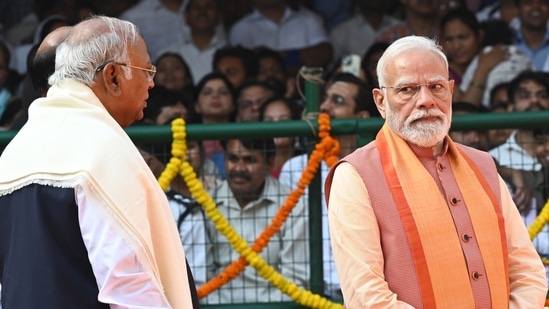
**NEW DELHI** — On Sunday, April 19, 2026, the ambitious Constitution (131st Amendment) Bill, 2026, suffered a major legislative defeat after failing to secure the requisite two-thirds majority in the Lok Sabha. The legislative collapse immediately ignited a fierce political firestorm between the ruling government and the opposition bloc. Leading the charge, Congress President Mallikarjun Kharge launched a scathing critique of Prime Minister Narendra Modi’s parliamentary address, accusing him of prioritizing partisan attacks over legislative substance. Kharge highlighted that the Prime Minister mentioned the opposition Congress party 59 times during his defense of the bill, yet barely focused on the women who were intended to be its primary beneficiaries.
[Source: Hindustan Times | Additional: Parliamentary Proceedings Context]
## A Historic Parliamentary Deadlock
The failure of a Constitutional Amendment Bill on the floor of the Lok Sabha is a rare and significant political event. To pass, the **Constitution (131st Amendment) Bill, 2026**, required a special majority—specifically, a majority of the total membership of the House and a majority of not less than two-thirds of the members present and voting. Despite issuing strict whips to their respective parliamentary members, the ruling alliance fell short of the magic number as the opposition bloc voted against the current draft of the legislation, citing critical structural flaws.
The atmosphere in the Lower House was reportedly tense throughout the debate. While the treasury benches argued that the bill was a historic step forward for gender equality in political and economic spheres, the opposition maintained that the legislation was rushed, lacked essential sub-categorization for marginalized communities, and was introduced purely for optics ahead of a crucial cycle of state assembly elections.
When the electronic voting system tallied the final numbers, the shortfall was evident, leading to an immediate uproar. The defeat underscores the shifting dynamics of the Lok Sabha post-2024, where the ruling coalition’s reliance on consensus building is higher than in the previous two parliamentary terms.
## Kharge’s Scathing Critique of the PM’s Rhetoric
In the immediate aftermath of the bill’s failure, **Congress President Mallikarjun Kharge** addressed the media, directing his ire at Prime Minister Narendra Modi’s impassioned floor speech. The crux of Kharge’s argument was that the Prime Minister utilized his time at the dispatch box not to build a bipartisan consensus for women’s rights, but to settle political scores.
“Modi ji mentioned Congress 59 times, women barely,” Kharge remarked, slamming the Prime Minister’s approach to the critical parliamentary test. [Source: Hindustan Times].
Kharge elaborated that the government’s refusal to accommodate opposition amendments regarding sub-quotas for Other Backward Classes (OBC) and minority women was the true reason for the bill’s failure. According to the Congress leadership, the ruling dispensation engineered the bill’s defeat to victimize themselves electorally, knowing well that the opposition could not support the unamended draft.
“If the Prime Minister was truly committed to the empowerment of India’s daughters, his speech would have focused on their struggles, their aspirations, and the mechanics of this legislation. Instead, the nation was subjected to a repetitive, hour-long diatribe against the Congress party. This proves their intent was political theater, not women’s empowerment,” Kharge asserted to reporters outside Parliament.
## Unpacking the 131st Amendment Bill, 2026
To understand the magnitude of this legislative stalemate, it is crucial to analyze the contents of the **Constitution (131st Amendment) Bill, 2026**. While the historic Nari Shakti Vandan Adhiniyam (106th Amendment Act) of 2023 established a 33% reservation for women in the Lok Sabha and state assemblies, its implementation was fundamentally tied to a future delimitation exercise based on the first census post-2026.
The new 131st Amendment Bill was purportedly drafted to introduce an accelerated framework for localized gender reservations and to expand proportional representation in the Rajya Sabha and legislative councils—areas not covered by the 2023 legislation. Additionally, the bill included clauses regarding workplace representation in government-funded institutions.
However, the opposition bloc drew a red line regarding the **OBC quota within the quota**. Opposition leaders argued that without a mandated caste census to accurately determine sub-categorizations, the blanket reservation would disproportionately benefit affluent, upper-caste women, leaving marginalized communities without adequate representation. The government’s refusal to send the 131st Amendment to a Joint Parliamentary Committee (JPC) for further review ultimately led to the fractured mandate on the floor.
[Source: Contextual Knowledge of Indian Electoral Reforms and Parliamentary Procedures]
## Prime Minister Modi’s Defense and the Blame Game
During the parliamentary debate leading up to the vote, **Prime Minister Narendra Modi** delivered a forceful defense of the legislation, framing the government as the sole champion of “Nari Shakti” (Women’s Power). In the speech heavily criticized by Kharge, Modi traced the historical trajectory of women’s reservation, pointing fingers at previous Congress-led administrations for sitting on the issue for decades.
The Prime Minister accused the opposition of “moving the goalposts” and finding technical excuses to block women’s progress. “Whenever this government takes a monumental step to elevate the mothers and sisters of our nation, the Congress party finds a way to stand as a roadblock,” Modi declared in the lower house.
Government spokespersons later defended the Prime Minister’s speech, stating that exposing the historical hypocrisy of the Congress party was necessary context for the debate. They argued that the opposition’s demand for immediate sub-quotas was a manufactured controversy designed to stall the legislation and deny the ruling party a legislative victory ahead of the upcoming electoral cycle.
## The Battle for the Female Voter Demographic
The political vitriol surrounding the 131st Amendment Bill highlights the undeniable influence of the female voter demographic in modern Indian politics. Over the last decade, women’s voter turnout has consistently matched or exceeded male turnout, effectively transforming them into the most sought-after constituency.
Both national coalitions have structured heavily funded welfare schemes around women. From the ruling party’s *Ujjwala Yojana* and *Lakhpati Didi* initiatives to the opposition’s state-level direct cash transfer guarantees like the *Gruha Lakshmi* scheme in Karnataka, wooing the female voter is a top priority.
The failure of this bill presents a unique messaging challenge for both sides.
* **The Ruling Party’s Narrative:** The government will likely campaign on the premise that they attempted to pass sweeping empowerment laws but were thwarted by an anti-women opposition.
* **The Opposition’s Narrative:** The Congress and its allies will argue that the government is anti-OBC and anti-Dalit for refusing the sub-quotas, framing the Prime Minister’s efforts as insincere political stunts rather than genuine reforms.
## Expert Voices and Political Analysis
Political analysts suggest that the defeat of the 131st Amendment Bill is indicative of a deeply polarized Parliament where consensus-building has entirely broken down.
**Dr. Meenakshi Rao**, a senior political scientist at the Centre for Policy Research, notes the strategic calculations at play. “What we witnessed in the Lok Sabha was less about the specific legalities of the 131st Amendment and more about narrative control,” Rao explained. “Kharge’s observation that the PM mentioned Congress 59 times is statistically telling. It shows that the speech was written for the election rallies of tomorrow, not the parliamentary records of today. Conversely, the opposition was equally determined not to hand the government a historic victory on a silver platter.”
Furthermore, constitutional experts point out that the rigid mechanics of constitutional amendments make them incredibly vulnerable to oppositional blockades in a house where the ruling coalition lacks a brute, unassailable supermajority. “A simple majority can pass ordinary bills, but constitutional changes require statesmanship, back-channel negotiations, and compromise. That bridge of communication appears completely burnt,” added **Rajiv Sen**, a constitutional lawyer and parliamentary observer.
## Looking Ahead: The Future of the Legislation
With the bill failing to pass the Lok Sabha test, its immediate legislative journey is dead in the water. The Constitution does not permit the calling of a joint sitting of both Houses to resolve a deadlock on a Constitutional Amendment Bill, meaning the government cannot bypass the Lok Sabha’s fractured mandate.
The path forward leaves the government with limited options. They can either:
1. **Redraft the Bill:** Incorporate some of the opposition’s demands, such as initiating a framework for a caste census or defining OBC sub-quotas, and reintroduce the bill in a subsequent session.
2. **Weaponize the Defeat:** Abandon the current legislative effort and take the issue directly to the people’s court in the upcoming assembly elections, leveraging the defeat to ask voters for a stronger mandate.
Based on the immediate press conferences and the sharp rhetoric from both Prime Minister Modi and Congress President Mallikarjun Kharge, the latter option seems the most likely. As the dust settles on this historic parliamentary deadlock, one thing remains abundantly clear: the issue of women’s empowerment has transitioned fully from a matter of social justice to the central battleground of India’s partisan warfare. Until political leaders can separate the cause of gender equity from electoral calculus, comprehensive legislative progress may remain stubbornly out of reach.