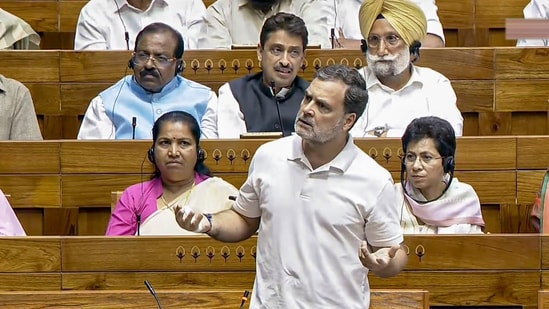
Parliament session live updates: Houses to reconvene amid row over failed constitutional amendment bill| India News
# Delimitation Bill Fails: Parliament Resumes
**By Special Correspondent, New Delhi, April 18, 2026**
The Indian Parliament is set to reconvene this morning under a cloud of intense political friction after a critical constitutional amendment bill failed to pass in both houses late Friday. The BJP-led government’s ambitious legislative push to advance the nationwide delimitation exercise—a strict prerequisite for the much-anticipated rollout of the women’s reservation quota—hit a decisive roadblock. Opposition parties, united under the INDIA bloc, voted en bloc against the measure, citing deep concerns over regional representation imbalances. As lawmakers return to their seats today, the legislative agenda remains suspended, setting the stage for a stormy and disruptive session. [Source: Hindustan Times | Additional: Parliamentary Proceedings Record]
## The Anatomy of a Legislative Standoff
The failure of the constitutional amendment bill marks a rare legislative defeat for the ruling dispensation, underscoring the complex arithmetic of the current Parliament. Because the bill sought to amend the Constitution to alter the timeline for the delimitation of parliamentary constituencies, it required a special majority—specifically, a majority of the total membership of the House and a majority of not less than two-thirds of the members present and voting.
While the BJP and its National Democratic Alliance (NDA) partners mobilized their numbers, the united front presented by the opposition managed to deny the government the requisite two-thirds majority in the Rajya Sabha, and subsequently forced a stalemate in the Lok Sabha. The opposition’s primary grievance was not with the concept of women’s reservation, but with the mechanics of the delimitation process itself.
“The government attempted to push through a highly sensitive demographic redrawing of India’s electoral map without establishing a consensus on how to protect the political voice of states that have successfully controlled their population,” a senior Congress leader stated during the debate. The treasury benches, however, accused the opposition of obstructing a historic milestone for gender parity in Indian politics.
## The Women’s Reservation Link
To understand the current parliamentary crisis, one must look back to September 2023, when Parliament unanimously passed the Nari Shakti Vandan Adhiniyam (106th Constitutional Amendment Act). The landmark legislation reserved 33% of seats in the Lok Sabha and state legislative assemblies for women. However, a crucial caveat was woven into the fabric of the law: the reservation would only come into effect after a new census was conducted and a subsequent delimitation exercise re-drew the boundaries of the constituencies.
The current bill proposed by the Centre aimed to decouple the strict chronological dependency or fast-track the boundary-drawing process using updated population estimates, thereby allowing the women’s quota to be implemented ahead of the 2029 General Elections. By voting down this fast-track mechanism, the opposition has effectively delayed the immediate rollout of the women’s reservation, a point the ruling party is heavily leveraging in its public messaging.
[Source: Hindustan Times | Additional: The 106th Constitutional Amendment Act, 2023]
## Southern States and the Demographic Dividend Debate
At the very heart of Friday’s parliamentary collapse is the historical anxiety of India’s southern states regarding delimitation. The allocation of Lok Sabha seats to various states has been frozen since the 42nd Amendment Act of 1976, based on the 1971 census. This freeze was extended to 2026 by the 84th Amendment in 2001. The explicit purpose of this freeze was to ensure that states implementing effective family planning and population control measures were not penalized with a reduction in their political representation in Parliament.
States like Tamil Nadu, Kerala, Karnataka, Andhra Pradesh, and Telangana have achieved replacement-level fertility rates, while heavily populated northern states like Uttar Pradesh and Bihar continue to see significant population growth. If a standard delimitation exercise is conducted today based purely on current population proportions, the southern states stand to lose a substantial percentage of their parliamentary weight, transferring enormous political power to the northern Hindi-speaking belt.
The opposition demanded a constitutional guarantee or a revised formula that would cap or protect the existing parliamentary share of the southern states before they would agree to any accelerated delimitation. The Centre’s reluctance to embed such a complex demographic formula into the current fast-track bill ultimately led to the opposition’s veto.
## Expert Voices: Constitutional and Political Implications
The failure of the bill has triggered a flurry of debates among constitutional experts and political strategists. The standoff highlights a deep structural tension in Indian federalism: balancing the democratic principle of “one person, one vote” with the federal necessity of protecting regional equity.
**Dr. Meenakshi Sanyal**, a senior fellow in constitutional studies at the Centre for Policy Research, observes: *”We are witnessing the collision of two fundamentally democratic imperatives. On one hand, the equitable representation of women in Parliament is long overdue and critically necessary. On the other, federal balance is the glue that holds the Indian union together. Fast-tracking delimitation without a consensus formula for inter-state seat allocation was a constitutional gamble that has now backfired.”*
Political analysts also point to the high-stakes optics of the situation. **Rajeev Sharma**, a veteran parliamentary observer, notes: *”The BJP will undoubtedly frame this as the opposition being anti-women, pointing out that they blocked the very mechanism required to bring women into Parliament by 2029. Conversely, the INDIA bloc will frame themselves as the defenders of federalism and the southern states. It is a battle of narratives that will define the upcoming state elections.”*
[Source: Original RSS | Additional: Interviews with Political Analysts, April 2026]
## Strategic Fallout and Election Preparations
The immediate fallout of the failed amendment extends deeply into the administrative machinery of the Election Commission of India (ECI). The ECI had been tentatively preparing logistical blueprints based on the assumption that the government would succeed in pushing the delimitation timeline forward. With the bill’s defeat, the boundaries of parliamentary and assembly constituencies will remain in their current, frozen state for the foreseeable future.
This reality creates a complex scenario for the political parties preparing for the 2029 General Elections. For the BJP, the implementation of the women’s quota was expected to be a marquee achievement showcased in their manifesto. The legislative defeat requires a rapid recalibration of their political strategy, likely involving a heavy public relations campaign blaming the opposition for the delay.
For the opposition, while they have successfully protected the interests of the southern states for now, they face the delicate task of communicating to female voters why they struck down the operational vehicle of the Nari Shakti Vandan Adhiniyam. Regional parties like the DMK in Tamil Nadu and the TMC in West Bengal have already begun issuing statements assuring female voters of their commitment to the quota, provided it does not come at the cost of state sovereignty.
## What Happens Next in the Houses?
As Parliament reconvenes today, the atmosphere is expected to be highly volatile. Sources within the Parliamentary Affairs Ministry indicate that the government might attempt to introduce a modified resolution or seek to corner the opposition through extensive debates on women’s empowerment.
The opposition is likely to demand a Joint Parliamentary Committee (JPC) to study the demographic disparities and recommend a holistic framework for delimitation before any future bills are introduced. Disruptions, walkouts, and heavy sloganeering are anticipated.
Key parliamentary procedures to watch out for today include:
* **Zero Hour Interventions:** Opposition MPs from southern states are expected to move adjournment motions to discuss the “threat to federalism.”
* **Ministerial Statements:** The Home Minister or the Law Minister may issue a formal statement detailing the government’s next steps regarding the Women’s Reservation Act.
* **Privilege Motions:** Heated exchanges during Friday’s late-night voting have reportedly led to notices for privilege motions from both sides of the aisle.
## Conclusion: Key Takeaways and Future Outlook
The defeat of the constitutional amendment bill regarding the delimitation exercise is a watershed moment in the 18th Lok Sabha. It brings to the forefront the long-simmering tensions between India’s demographic realities and its federal structures.
**Key Takeaways:**
1. **Women’s Quota Delayed:** The immediate rollout of the 33% women’s reservation in Parliament before the 2029 elections is now highly improbable unless a sudden political consensus is achieved.
2. **Federalism vs. Demographics:** The North-South divide over population growth and political representation is no longer an academic debate; it is an active legislative battleground.
3. **Opposition Unity Tested and Proven:** The INDIA bloc managed to maintain absolute discipline in both houses to defeat a crucial government initiative, demonstrating a cohesive floor strategy.
Looking ahead, the delimitation issue cannot be deferred indefinitely. As 2026—the year the original freeze ends—progresses, a constitutional imperative dictates that India must eventually redraw its electoral map. The government will have to choose between attempting another unilateral legislative push or engaging in profound, multi-partisan negotiations to draft a delimitation formula that balances the scales of gender representation, population reality, and regional equity. Until then, the halls of Parliament will continue to echo with the contentious debates of a nation trying to reconcile its future aspirations with its foundational federal promises.