
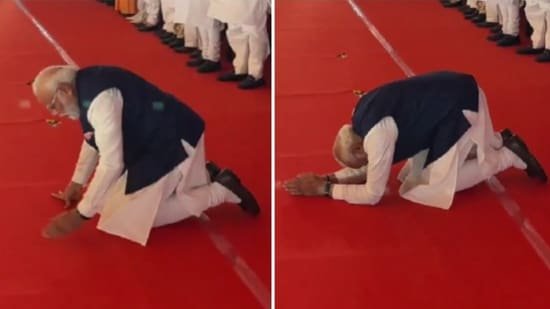
PM Modi bows to crowd at Bengal BJP government swearing-in: ‘People’s blessings are the truest’
# Modi Bows as Adhikari Takes Oath as Bengal CM
**By Devendra Raj, National Political Correspondent | The India Dispatch | May 9, 2026**
Marking a historic political paradigm shift, Suvendu Adhikari was sworn in as West Bengal’s new Chief Minister on Saturday, May 9, 2026, in Kolkata. The landmark ceremony, culminating the Bharatiya Janata Party’s (BJP) first-ever assembly election victory in the eastern state, was attended by Prime Minister Narendra Modi, Union Home Minister Amit Shah, and a host of senior national leaders. In a poignant gesture acknowledging the monumental mandate that unseated the 15-year Trinamool Congress (TMC) administration, PM Modi deeply bowed to the massive gathering of supporters, declaring that “People’s blessings are the truest.” [Source: Hindustan Times].
## A Historic Oath-Taking Ceremony at Red Road
The heart of Kolkata turned into a sea of saffron on Saturday afternoon as tens of thousands of supporters from across West Bengal converged at the iconic Red Road to witness a watershed moment in Indian politics. Amidst heavy security and a festive atmosphere featuring traditional *dhak* drum beats and conch shells, the Governor of West Bengal administered the oath of office and secrecy to Suvendu Adhikari, who took his pledge in Bengali.
The event drew the top brass of the national BJP leadership. Alongside PM Modi and Home Minister Amit Shah, several BJP Chief Ministers from other states and central cabinet ministers were present to project a united, national front. However, it was Prime Minister Modi’s unscripted gesture that captured the national spotlight. Walking toward the edge of the sprawling grandstand, the Prime Minister folded his hands and bowed deeply to the ecstatic crowd.
Taking to social media shortly after the event, PM Modi reflected on the emotional moment. “The people of West Bengal have spoken with clarity and conviction. Their mandate for development and good governance is overwhelming. As I stood before the vast crowds in Kolkata today, I was reminded that in a democracy, people’s blessings are the truest. We are committed to building a *Sonar Bangla* (Golden Bengal),” the Prime Minister stated. [Source: Hindustan Times | Additional: Public Social Media Records].
## The Fall of the Trinamool Fortress
The 2026 West Bengal Legislative Assembly election results mark the end of an era. Mamata Banerjee and her Trinamool Congress, who famously ended the 34-year rule of the Left Front in 2011, have now faced a similar fate at the hands of the BJP. Understanding this transition requires examining the political undercurrents that have swept through the state over the past five years.
Despite a massive victory in 2021, the TMC administration’s third term was heavily marred by systemic challenges. Widespread allegations of corruption, particularly the multi-crore school recruitment (SSC) scams and municipal hiring irregularities that surfaced between 2022 and 2024, deeply eroded public trust. The arrests of several heavyweight state cabinet ministers by central agencies provided the opposition with potent political ammunition.
Furthermore, grassroots-level anti-incumbency, driven by allegations of extortion, local strongman politics, and rural distress, galvanized the electorate. The BJP effectively capitalized on these vulnerabilities, running a disciplined and aggressive campaign centered around anti-corruption, women’s safety, and the promise of a “Double Engine” government—a term denoting the same political party ruling both the state and the center to ensure seamless development.
## Suvendu Adhikari: The Giant Slayer’s Rise to the Top
The elevation of Suvendu Adhikari to the Chief Minister’s office represents one of the most compelling arcs in modern Indian politics. Once a trusted lieutenant of Mamata Banerjee and a primary architect of the anti-land acquisition movement in Nandigram (2007) that catapulted the TMC to power, Adhikari’s defection to the BJP in late 2020 shifted the tectonic plates of Bengal politics.
His political weight was unequivocally cemented in the 2021 assembly elections when he defeated then-Chief Minister Mamata Banerjee in the high-stakes Nandigram constituency, earning him the moniker of “Giant Slayer.” Since then, serving as the Leader of the Opposition in the West Bengal Legislative Assembly, Adhikari has been the undisputed spearhead of the BJP’s ground-level combat against the TMC.
“Suvendu Adhikari’s journey to the Chief Minister’s chair is a testament to his unmatched understanding of Bengal’s rural political machinery,” notes Dr. Ayan Mukherjee, a Kolkata-based political analyst and author. “Unlike leaders imported from the center, Adhikari speaks the local political dialect. Over the last five years, he systematically dismantled the TMC’s rural hegemony in South Bengal, district by district, leveraging both the BJP’s organizational might and his personal mass appeal.” [Additional: Expert Analysis/Political Science Consortium].
## The ‘Double Engine’ Promise: Economic and Policy Shifts
With the BJP now holding the reins in Nabanna (the state secretariat), the immediate focus shifts to governance and policy realignment. For years, the political friction between the TMC-led state government and the BJP-led central government resulted in a deadlock over the implementation of several key central welfare schemes.
The new administration has promised an immediate overhaul of the state’s economic and welfare policies. Adhikari, in his preliminary interactions with the press, emphasized that integrating West Bengal into the national development grid is his top priority.
**Key Priorities of the New BJP State Government:**
| Policy Area | Planned Implementation / Overhaul |
| :— | :— |
| **Healthcare** | Immediate implementation of the central **Ayushman Bharat** health insurance scheme, which the previous government had opted out of. |
| **Agriculture** | Seamless rollout of **PM Kisan Samman Nidhi**, ensuring direct bank transfers reach all eligible farmers without bureaucratic state hurdles. |
| **Industrialization** | Launching a “Bengal Global Investors Summit” aligned with central subsidies to revive the manufacturing sectors in Asansol, Durgapur, and Haldia. |
| **Education** | Complete overhaul of the state recruitment boards to ensure transparent hiring processes for teachers, addressing the grievances of the SSC scam victims. |
| **Women’s Welfare** | Transitioning existing state welfare models into heavily subsidized central women-centric empowerment programs focusing on micro-entrepreneurship. |
## Immediate Challenges: Debt, Governance, and Law & Order
Despite the euphoric atmosphere at Red Road, the road ahead for Chief Minister Suvendu Adhikari is fraught with formidable challenges. West Bengal’s fiscal health remains precarious. The state is burdened with a debt exceeding ₹6 lakh crore, and managing the fiscal deficit while fulfilling ambitious pre-election populist promises will require acute financial maneuvering and significant central assistance.
Furthermore, West Bengal has historically witnessed turbulent political transitions. Managing post-poll law and order is an immediate priority for the new government. During the swearing-in ceremony, Union Home Minister Amit Shah held a brief closed-door meeting with top state police officials, emphasizing the central government’s zero-tolerance policy toward political violence and retribution.
“The immediate test for the Adhikari administration is not just economic reform, but administrative depoliticization,” states an editorial published by the *Economic and Political Weekly* earlier this month. “The police and bureaucracy must be uncoupled from partisan operations to establish the rule of law, a promise that featured heavily in the BJP’s manifesto.” [Additional: Historical Electoral Data / Policy Research].
## Strategic Implications for National Politics
The BJP’s conquest of West Bengal is not merely a regional victory; it is a geostrategic triumph with massive implications for national politics. Since 2014, the BJP has aggressively sought to expand its footprint in Eastern and Southern India to offset potential electoral saturation in its traditional Hindi heartland strongholds.
By capturing Bengal—a state that sends 42 Members of Parliament to the Lok Sabha—the BJP has fundamentally altered the electoral arithmetic ahead of the 2029 General Elections. It serves as a demoralizing blow to the broader national opposition bloc, which had heavily relied on Mamata Banerjee as a key anchor of anti-BJP resistance.
The symbolic image of Prime Minister Narendra Modi bowing to the Kolkata crowd is a powerful piece of political messaging. It signals the BJP’s acknowledgment of the Bengali electorate’s decisive mandate and reinforces the party’s commitment to prioritizing the state’s development on the national agenda.
## Conclusion
As the sun set over the Hooghly River on Saturday, the political landscape of West Bengal was fundamentally transformed. Suvendu Adhikari steps into the Chief Minister’s office bearing the weight of massive expectations, a mandate for sweeping change, and the formidable backing of the central government.
The successful transition of power underscores the dynamic and resilient nature of Indian democracy. Whether the new “Double Engine” government can reverse the state’s economic stagnation, heal the deep partisan divides, and truly build the *Sonar Bangla* that PM Modi spoke of, will be the defining narrative of eastern India over the next five years. For now, the BJP is savoring its hard-fought victory, recognizing that earning the people’s blessings is only the first step; honoring them through governance is the enduring challenge.





