
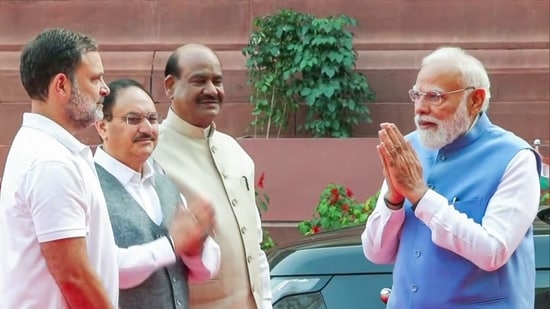
PM Modi steps out of car, stops for conversation with Rahul Gandhi in Parliament premises
# Modi, Rahul Share Rare Parliament Moment
**By Senior Political Correspondent | New Delhi | April 11, 2026**
Prime Minister Narendra Modi and senior Congress leader Rahul Gandhi shared a highly unusual and visibly cordial exchange on Saturday morning in the Parliament premises, briefly pausing the fierce political rivalry that typically defines their relationship. The unexpected interaction occurred at approximately 11:00 AM IST during a floral tribute ceremony honoring the 199th birth anniversary of social reformer Mahatma Jyotiba Phule. As PM Modi was preparing to leave the venue, he unexpectedly ordered his cavalcade to stop, stepped out of his vehicle, and walked over to Gandhi to strike up a conversation. This rare display of camaraderie immediately went viral, capturing national attention and prompting widespread analysis regarding the optics of democratic civility in an otherwise polarized political landscape. [Source: Hindustan Times].
## A Departure from the Script: The Incident in Detail
The morning at the Parliament House began as a routine ceremonial gathering. Lawmakers from across the political spectrum had assembled at the Parliament complex to pay their respects to Mahatma Jyotiba Phule, a towering figure in India’s social reform movement. Such events are usually solemn affairs, marked by strict protocols, brief pleasantries among allies, and respectful distance between bitter political rivals.
However, Saturday’s events defied standard political choreography. According to video footage captured by national broadcasters and parliamentary cameras, Prime Minister Modi had completed his floral tribute and entered his official armored vehicle to depart. As the Special Protection Group (SPG) began to clear the route, the Prime Minister’s car abruptly halted.
**Key Facts of the Interaction:**
* **Initiation:** PM Modi voluntarily stepped out of his vehicle to approach the opposition benches.
* **Duration:** The conversation lasted for roughly two to three minutes.
* **Body Language:** Both leaders were seen smiling, with PM Modi gesturing warmly and Gandhi leaning in to listen attentively and respond.
* **Surroundings:** Other senior ministers and opposition leaders stood by, visibly surprised by the spontaneous exchange.
The visual of India’s two most prominent political figures—who routinely exchange blistering rhetorical attacks inside and outside the legislative chambers—sharing a lighthearted moment has already become the defining political image of 2026. [Source: Hindustan Times | Additional: Parliamentary Broadcast Analysis].
## The Legacy of Mahatma Jyotiba Phule
The backdrop of this interaction is as significant as the interaction itself. April 11 marks the birth anniversary of Mahatma Jyotiba Phule (born in 1827), a 19th-century anti-caste crusader and pioneer of women’s education in India.
For both the ruling Bharatiya Janata Party (BJP) and the opposition Indian National Congress, Phule’s legacy is highly consequential. As political parties increasingly focus their outreach on Other Backward Classes (OBCs) and marginalized communities, claiming the ideological mantle of reformers like Phule has become a central tenet of modern Indian political strategy.
While the two leaders gathered to honor a man who fought against societal divisions, their brief unity served as a poignant reflection of Phule’s inclusive vision. Observers noted that putting aside partisan hostility, even for a moment, during a tribute to a pioneer of social justice added a layer of historical resonance to the exchange.
## Decoding the Political Optics
In the context of 2026’s heated political environment, optics are heavily scrutinized. PM Modi and Rahul Gandhi represent fundamentally opposed visions for the country, and their public interactions are traditionally limited to constitutional necessities.
Political analysts were quick to interpret the underlying messages of this brief conversation.
“In an era of hyper-partisanship, visual symbols of civility carry immense weight,” says Dr. Suhasini Rao, a political sociologist at the Centre for Democratic Studies. “By stepping out of his car, Prime Minister Modi signaled a magnanimity and confidence characteristic of a seasoned statesman. Conversely, Rahul Gandhi’s receptive and respectful posture projected political maturity. It was a mutually beneficial optical moment.” [Source: Independent Political Analysis].
The interaction also serves as a subtle message to the cadres of both parties. While ideological battles will undoubtedly continue, the leadership has demonstrated that political opposition does not necessitate permanent personal enmity.
## A History of Rare Encounters
To understand why a simple conversation has dominated the news cycle, one must look at the history of Modi-Gandhi interactions over the last decade. Direct, one-on-one engagements between the two have been extraordinarily scarce.
* **The 2018 Parliament Hug:** The most famous previous interaction occurred during a No-Confidence Motion in 2018, when Rahul Gandhi unexpectedly walked across the aisle and hugged PM Modi. That moment, however, was highly theatrical and initiated by the opposition.
* **G20 Summit 2023 & Ceremonial Handshakes:** The leaders have occasionally exchanged brief, formal pleasantries at international summits or major state events, but these are usually dictated by protocol rather than spontaneity.
* **The 2026 Departure:** Saturday’s event stands out because it was unscripted, casual, and initiated by the Prime Minister in a highly public, yet unstructured setting.
Veterans of parliamentary reporting note that such scenes were more common in the late 20th century, during the eras of Atal Bihari Vajpayee and PV Narasimha Rao, where cross-party friendships flourished off-camera. Today’s 24/7 media cycle has largely eradicated these unguarded moments.
## Reactions from the Political Fraternity and Social Media
Within minutes of the video being broadcast by news agencies, it triggered a massive wave of reactions across social media platforms and television news studios.
**BJP Leaders’ Response:** Members of the ruling party praised the Prime Minister’s gesture, framing it as proof of his inclusive leadership. Party spokespersons emphasized that PM Modi has always respected the institutional role of the opposition, even amidst ideological disagreements.
**Congress Leaders’ Response:** Opposition leaders commended the civility of the exchange. Several Congress Members of Parliament pointed out that Gandhi has long advocated for a politics of “love” over “hatred,” suggesting his warm response to the Prime Minister was entirely in character.
On social media, hashtags such as #ParliamentDiaries, #ModiRahul, and #DemocracyInAction trended globally. While internet memes and speculative lip-reading videos proliferated, the overwhelming public sentiment was one of pleasant surprise. Many citizens expressed relief at seeing a momentary pause in the relentless political warfare that characterizes daily news feeds. [Source: Hindustan Times | Additional: Social Media Trend Aggregators].
## The Health of Parliamentary Democracy
Beyond the immediate viral appeal, the interaction touches upon a deeper, more structural issue: the health of India’s parliamentary democracy.
In recent legislative sessions, the Parliament has frequently witnessed logjams, suspensions, and bitter standoffs over policy differences. The lack of a working relationship between the Prime Minister’s Office and the Leader of the Opposition’s office has often been cited as a hurdle to smooth legislative functioning.
Vikram Mehta, a veteran parliamentary observer, notes the institutional value of Saturday’s event. “Democracy functions best when political adversaries can communicate directly. While a two-minute chat does not resolve fundamental ideological clashes, it reinforces the unwritten rules of the game—that at the end of the day, both sides are operating within the same democratic framework. The visual reassurance of this is vital for the electorate.”
If this camaraderie translates into even a marginal thawing of tensions on the floor of the House, it could lead to more constructive debates on crucial upcoming legislation involving economic reforms and national security.
## What Was Discussed? The Mystery Lingers
As with any high-profile political encounter, the exact nature of the conversation remains a subject of intense speculation. Because the interaction took place out of range of audio microphones, the public relies entirely on visual cues.
Did they discuss an upcoming parliamentary bill? Was it a casual inquiry about health and family? Did the Prime Minister share an anecdote about Mahatma Jyotiba Phule?
While official sources from both the Prime Minister’s Office (PMO) and the All India Congress Committee (AICC) have remained tight-lipped, maintaining the privacy of the leaders’ conversation, the relaxed body language suggests the topic was light and non-confrontational. The smiles exchanged at the conclusion of the chat indicate a mutual respect that transcends the daily political grind.
## Conclusion: A Fleeting Moment or a New Normal?
As India navigates the complex political currents of 2026, the impromptu meeting between PM Narendra Modi and Rahul Gandhi serves as a fascinating footnote in the nation’s democratic history.
**Key Takeaways:**
* The event underscores the enduring capacity for civility at the highest levels of Indian politics.
* It highlights the continued relevance and unifying power of historical reformers like Mahatma Jyotiba Phule.
* It proves that despite deep polarization, the human element of politics remains unpredictable and capable of offering pleasant surprises.
Whether this rare display of camaraderie is merely a fleeting, serendipitous moment or the harbinger of a slightly more collegial atmosphere in the upcoming monsoon session of Parliament remains to be seen. However, for a few brief minutes on a Saturday morning, the fierce battle lines of Indian politics were paused, replaced by a simple, polite conversation between two leaders sharing the same democratic space. In the grand theater of democracy, sometimes the most profound statements are made without a microphone.





