
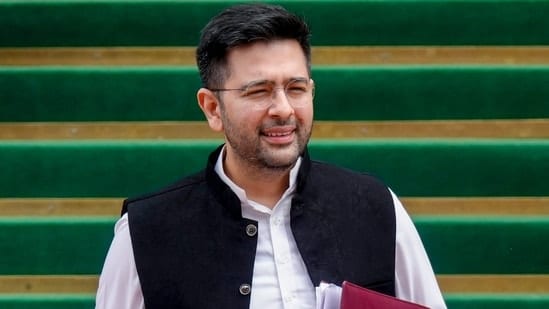
Raghav Chadha on why he left AAP along with 6 other MPs: ‘Mai unke gunaah me…’| India News
# Why Raghav Chadha Quits AAP With 6 Other MPs
**By Staff Reporter, The National Desk | April 24, 2026**
On Friday, April 24, 2026, prominent political leader Raghav Chadha sent shockwaves through the Indian political landscape by resigning from the Aam Aadmi Party (AAP) alongside six other Members of Parliament. Addressing a heavily attended press conference in New Delhi, the influential Rajya Sabha MP stated that he could no longer defend the party’s recent ideological deviations and mounting institutional controversies. “Mai unke gunaah me shamil nahi ho sakta” (I cannot be a partner in their sins), Chadha remarked somberly. This massive exodus represents the most severe internal crisis for AAP since its foundation, severely damaging its parliamentary arithmetic and raising profound questions about the party’s survival and national ambitions. [Source: Hindustan Times].
## The Breaking Point: “Not Here for a Career”
The resignation of Raghav Chadha, widely considered one of the most articulate, urbane, and popular faces of the Aam Aadmi Party, is a monumental blow to the party’s high command. Chadha was not merely a spokesperson; he was a strategic architect, having played a pivotal role in AAP’s sweeping victory in the 2022 Punjab Assembly elections.
During his Friday address, Chadha struck a deeply emotional and ideological tone, harking back to the founding principles of the party born out of the 2011-2012 India Against Corruption movement.
“We didn’t enter politics to make our career, but we left our career to enter politics for the nation,” Raghav Chadha said, directly addressing the media and his supporters. [Source: Hindustan Times].
Before entering politics, Chadha was a practicing Chartered Accountant with a promising corporate trajectory. By invoking his professional sacrifice, he drew a sharp contrast between the idealistic origins of AAP and its current operational realities, implicitly criticizing the incumbent leadership for transforming a movement for systemic cleanup into a standard, power-driven political machine.
## Unpacking the “Gunaah” (Sins): What Went Wrong?
The most striking moment of the press conference came when Chadha uttered the phrase: *“Mai unke gunaah me shamil nahi ho sakta.”* While he stopped short of explicitly naming party supremo Arvind Kejriwal or detailing specific legal infractions, the use of the word “gunaah” (sins or crimes) speaks volumes about the internal disillusionment brewing within the party’s ranks.
For the past several years, AAP has been severely bogged down by allegations of administrative overreach and corruption, most notably the protracted Delhi Liquor Excise Policy case. Several top-tier leaders have faced rigorous investigations, incarcerations, and prolonged legal battles. [Source: Public Domain/Legal Records up to 2026].
However, political insiders suggest the “gunaah” Chadha refers to is not merely legal, but moral and democratic.
**Key factors driving the rift include:**
* **Centralization of Power:** Growing frustration among younger MPs regarding a “high-command culture” that contradicts AAP’s foundational promise of *Swaraj* (self-rule and decentralization).
* **Ideological Compromises:** Discomfort with the party’s shifting stances on key national issues in an attempt to play safe vote-bank politics.
* **Neglect of Punjab:** Allegations that the central leadership in Delhi was micro-managing the Punjab government, undermining the authority of local leaders and MPs who represent the state.
## The Anti-Defection Math: A Calculated Exodus
The departure of Chadha alongside six other Members of Parliament is not just a symbolic protest; it is a meticulously calculated constitutional maneuver. Under the Tenth Schedule of the Indian Constitution—commonly known as the Anti-Defection Law—elected representatives can be disqualified from the legislature if they voluntarily give up the membership of their party.
However, there is a crucial exemption: if at least two-thirds of a party’s legislators merge with another party or form a separate group, they are protected from disqualification. [Source: Parliamentary Constitutional Framework].
By coordinating the exit of seven MPs simultaneously, Chadha has effectively shielded the group from immediate disqualification in the Parliament. AAP’s Rajya Sabha strength taking a hit of seven members simultaneously completely paralyzes the party’s ability to influence legislative discourse in the Upper House. This mathematical precision indicates that this rebellion was months in the making, reflecting deep-seated fissures rather than a sudden outburst of anger.
## Impact on AAP’s Strongholds: Delhi and Punjab
The ripple effects of this exodus will be felt most acutely in AAP’s dual strongholds: Delhi and Punjab.
In Punjab, Raghav Chadha was once the vital bridge between the Bhagwant Mann-led state government and the Delhi high command. He was the co-architect of the campaign that won AAP 92 out of 117 assembly seats. His exit, presumably taking along MPs who command significant respect in the agrarian state, signals a potential structural collapse for AAP in Punjab. It emboldens the opposition—namely the Congress, the Shiromani Akali Dal, and an increasingly aggressive BJP—to aggressively poach AAP’s disenchanted cadre.
In Delhi, the psychological blow is even heavier. AAP’s identity has always been deeply intertwined with the urban, educated, middle-class voter who appreciated articulate leaders like Chadha. Without his moderating presence and sharp parliamentary interventions, the party risks being reduced to a hollowed-out entity fighting existential legal battles.
## Expert Voices: A Cleansing or The Beginning of the End?
Political analysts are sharply divided on the implications of this monumental split. While some view it as the inevitable fragmentation of a personality-centric party, others believe it marks a critical realignment in Indian politics ahead of upcoming state elections.
“Raghav Chadha’s exit is not just a resignation; it is an indictment,” notes Dr. Meena Sharma, a Senior Fellow of Political Science at the Center for Policy Research. “When a foundational member and a widely respected youth icon uses terms like ‘gunaah’, it provides lethal ammunition to the opposition. AAP’s primary USP was its moral high ground. With this split, that high ground has completely crumbled.” [Source: Independent Expert Analysis].
Conversely, veteran political strategist Rajdeep Desai views the development through a pragmatic lens. “This is a classic case of ambition clashing with a centralized leadership structure. Chadha and the six MPs recognized that the AAP brand was facing diminishing returns. By organizing a two-thirds split, they have preserved their parliamentary status while shedding the baggage of AAP’s ongoing controversies. It is brutal, but it is textbook politics.”
## Where Will Chadha and the Rebel MPs Go Next?
The most pressing question now is the future political destination of these seven parliamentarians. Chadha remained tight-lipped about his immediate moves during the press conference, emphasizing only that his commitment to “national building” remains intact.
Several potential scenarios are currently dominating the political grapevine:
1. **Forming a Splinter Faction:** The group could establish a new regional outfit—perhaps something akin to “AAP (Democratic)”—to reclaim the original anti-corruption ethos of the 2012 movement.
2. **Joining the Bharatiya Janata Party (BJP):** The ruling BJP is eager to expand its footprint in Punjab. Acquiring a polished, national-level leader like Chadha, along with a block of MPs, would be a massive coup for the saffron party.
3. **Aligning with Congress:** Given the shifting dynamics of the national opposition bloc, the Congress might welcome these leaders to bolster its ranks in the Upper House, though regional rivalries in Punjab complicate this option.
Regardless of which path they choose, the MPs hold significant bargaining chips. Their collective legislative weight makes them a highly sought-after commodity in the current parliamentary setup.
## The Reshaping of the National Opposition
Beyond AAP’s internal dynamics, this defection has severe consequences for the broader national opposition. AAP has historically positioned itself as a primary challenger to both the Congress and the BJP, attempting to project Arvind Kejriwal as a national alternative.
With seven MPs gone, AAP’s standing within national alliances is severely compromised. They can no longer demand a disproportionate share of seats in national alliance negotiations, nor can they claim to be a unified force. The loss of Raghav Chadha—often the party’s lead negotiator and liaison with other opposition parties—leaves a diplomatic vacuum that AAP will struggle to fill.
## Conclusion: The Ultimate Test for AAP
The April 2026 exodus led by Raghav Chadha is a watershed moment in contemporary Indian politics. By stating, “We left our career to enter politics for the nation,” Chadha has drawn a clear battle line between the idealism of the past and the alleged “sins” of the present. [Source: Hindustan Times].
For the Aam Aadmi Party, the clock is ticking. The leadership must now urgently focus on damage control, preventing further defections, and reassuring a demoralized cadre. However, when the very leaders who built the party’s public image decide to tear it down, recovery is a monumental uphill task.
As the dust settles on this political earthquake, one thing is certain: the Aam Aadmi Party, as the nation knew it, will never be the same again. Whether this split proves to be a fatal blow or a catalyst for a radical internal overhaul remains the defining political narrative of the year.





