
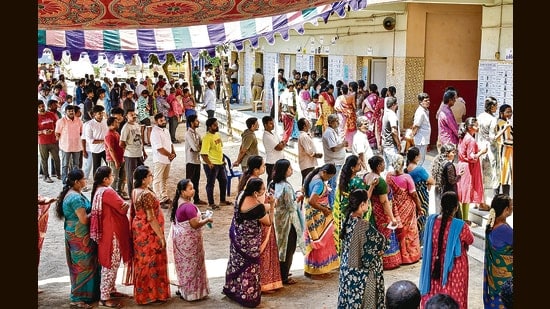
Record turnouts mark Bengal Phase-1, Tamil Nadu voting| India News
# Record 2026 Turnout Marks Bengal and TN Polls
**By Special Political Correspondent, National Elections Desk | April 25, 2026**
On April 24, 2026, Indian democracy witnessed a monumental milestone as millions of citizens in West Bengal and Tamil Nadu exercised their democratic rights, resulting in historic voter turnouts. Tamil Nadu, conducting single-phase elections for all 234 assembly seats, registered an impressive 85.11% turnout by 11 p.m. Simultaneously, West Bengal’s high-stakes Phase 1 polling concluded with an unprecedented 92.35% participation. Driven by intense grassroots campaigning, welfare scheme debates, and heightened political polarization, this massive electoral exercise underscores an increasingly engaged electorate actively shaping the nation’s democratic future. [Source: Hindustan Times].
## Tamil Nadu’s Democratic Surge: Breaking Historical Barriers
The southern state of Tamil Nadu has long been a bastion of vibrant political engagement, but the numbers recorded in the 2026 assembly elections have shattered previous benchmarks. With all **234 constituencies** going to the polls in a massive single-phase operation, the Election Commission of India (ECI) reported a staggering **85.11%** voter turnout at the close of final tabulations late Friday night. To put this into perspective, the state recorded a 73.58% turnout in the 2021 assembly elections, making this nearly a 12-percentage-point leap.
This historic participation is the result of a fiercely contested multi-cornered battle. The ruling Dravida Munnetra Kazhagam (DMK) alliance, the primary opposition All India Anna Dravida Munnetra Kazhagam (AIADMK), an aggressive push by the Bharatiya Janata Party (BJP), and the persistent grassroots campaigns of the Naam Tamilar Katchi (NTK) have all contributed to an electrified political atmosphere.
Political analysts suggest that the immense turnout reflects a highly polarized electorate deeply invested in the state’s socio-economic trajectory. The debate over the continuation and expansion of welfare economics—colloquially known as the “Dravidian Model”—has been central to the campaigns. Issues such as language rights, federalism, industrial investment, and the management of state resources have clearly resonated deeply with the common voter, prompting millions to brave the sweltering April heat to cast their ballots.
## West Bengal’s Phase 1: Unprecedented Electoral Fervor
If Tamil Nadu’s turnout was historic, the figures emerging from West Bengal’s Phase 1 voting are nothing short of extraordinary. The initial phase, which covered critical districts often viewed as political bellwethers, witnessed an astounding **92.35%** voter turnout. West Bengal has traditionally seen high electoral participation, generally hovering around the 80-84% mark, but breaching the 92% threshold signals an unparalleled level of voter mobilization. [Source: Historical ECI Data Analysis].
The political landscape in West Bengal remains a high-stakes battleground. The ruling Trinamool Congress (TMC), seeking to consolidate its power, is locked in a fierce, existential struggle against the principal opposition, the BJP, alongside the Left-Congress alliance attempting to reclaim its lost political territory.
Phase 1 campaigns in Bengal were marked by intensive door-to-door canvassing, high-decibel rallies, and sharp rhetoric surrounding issues of state pride, anti-incumbency, corruption allegations, and women’s welfare. The sheer volume of voters at polling booths from the early hours of the morning indicates that political parties successfully mobilized their core bases to an absolute maximum. Furthermore, the massive presence of Central Armed Police Forces (CAPF) appears to have instilled a strong sense of security, encouraging voters from vulnerable communities to step out without fear of intimidation.
## Key Demographic Drivers: Women and the Youth Vote
A granular look at the polling data suggests that specific demographic segments played a pivotal role in driving up these numbers. Across both Tamil Nadu and West Bengal, the participation of women and first-time youth voters was visibly overwhelming.
**The Rise of the Female Electorate**
In recent years, women have transitioned from being passive participants to becoming the most critical voting bloc in Indian elections. Both states have implemented highly successful direct cash transfer schemes targeted specifically at women. In Tamil Nadu, the *Kalaignar Magalir Urimai Thittam* (providing monthly financial assistance to women heads of families) has been a massive talking point. Similarly, in West Bengal, the *Lakshmir Bhandar* scheme has been a cornerstone of the TMC’s welfare outreach. The desire to either protect these benefits or demand better implementations drove millions of women to the polling booths.
**The Youth Factor**
India’s demographic dividend is heavily concentrated in the 18-29 age bracket. In the 2026 elections, first-time voters turned out in record numbers. Driven by concerns over employment, educational infrastructure, and digital freedom, the youth electorate in both Chennai’s IT corridors and Kolkata’s university districts showed up with a demand for actionable development rather than mere ideological rhetoric.
### Comparative Voter Turnout Table (2021 vs. 2026)
| State / Phase | 2021 Turnout (%) | 2026 Turnout (%) | Percentage Change |
| :— | :— | :— | :— |
| **Tamil Nadu (All 234 Seats)** | 73.58% | **85.11%** | + 11.53% |
| **West Bengal (Phase 1)** | 84.63% | **92.35%** | + 7.72% |
*(Data reflects final polling station estimates inclusive of postal ballots registered by 11 p.m. on polling day).*
## Expert Perspectives: Analyzing the Electoral Avalanche
Psephologists and political scientists are currently dissecting these staggering numbers, debating whether massive turnouts historically favor incumbents or signal an overwhelming wave of anti-incumbency.
“Traditionally, a sudden spike in voter turnout of over 10 percent is viewed as a protest vote against the ruling establishment,” notes Dr. Arvind Swaminathan, a senior political analyst based in Chennai. “However, the dynamics have evolved. In a highly saturated welfare state like Tamil Nadu, an 85% turnout could equally represent pro-incumbency mobilization, where beneficiaries are aggressively turning out to defend their economic lifelines against perceived threats.”
In the context of West Bengal, Dr. Sharmila Bose, a sociologist and political commentator at the Center for Eastern Indian Studies, offers a different perspective. “A 92.35% turnout in Phase 1 of Bengal is indicative of trench warfare in electoral politics. It means there are virtually no ‘undecided’ voters left. Every single household has been mapped, engaged, and physically brought to the booth by party machineries. It speaks volumes about the hyper-politicization of Bengali society and the high stakes both the TMC and BJP have placed on this region.”
## The Role of the Election Commission and Technological Innovations
Conducting an election for tens of millions of people in a single day is a logistical marvel, and the Election Commission of India (ECI) introduced several crucial measures that facilitated this record turnout.
First, combating the severe April heatwave was a primary concern. The ECI mandated the provision of shaded waiting areas, adequate drinking water facilities, and oral rehydration salts (ORS) at every polling booth. Additionally, voting hours were extended in several heat-affected constituencies to allow citizens to vote during the cooler evening hours.
Technological integration also played a massive role in ensuring voter confidence. The deployment of VVPAT (Voter Verifiable Paper Audit Trail) machines across 100% of the booths, combined with live webcasting from over 65% of the sensitive polling stations, ensured transparency. In West Bengal, where pre-poll violence has historically been a deterrent, the strategic deployment of thousands of Central Armed Police Forces (CAPF) personnel created a secure perimeter, enabling citizens to vote in a peaceful environment.
## National Ramifications of State Verdicts
While these are state legislative elections, the political outcomes in Tamil Nadu and West Bengal hold profound national implications as India moves deeper into the 2026 political cycle.
Together, these two states are cultural and economic powerhouses that fiercely guard their regional identities against national homogenization. The results here will dictate the balance of power in the Rajya Sabha (the Upper House of India’s Parliament) over the next few years. Furthermore, a decisive victory for the regional heavyweights (DMK in TN, TMC in Bengal) will embolden the national opposition bloc, providing them with the ideological and financial momentum required to challenge the central government.
Conversely, if the BJP manages to significantly increase its seat share or vote percentage in these states—particularly by breaching the formidable Dravidian fortress in the south or toppling the TMC in the east—it will represent a tectonic shift in modern Indian political history.
## Conclusion: The Road to Counting Day
The record-breaking voter turnouts of **85.11% in Tamil Nadu** and **92.35% in West Bengal’s Phase 1** are a testament to the robust health of Indian democracy. They reflect a citizenry that, despite cynicism and systemic challenges, deeply believes in the power of the ballot box to effect change.
As the EVMs are sealed and transported to high-security strongrooms, an anxious wait begins for political leaders and citizens alike. While West Bengal will continue to witness intense political maneuvering through its remaining electoral phases, Tamil Nadu’s political fate is now securely locked.
When the votes are finally counted, the results will not just declare Chief Ministers for two crucial states; they will provide a definitive mandate on welfare politics, regional identity, and the evolving nature of India’s democratic conscience. Until then, the staggering turnout numbers will remain the primary talking point across the nation, setting an incredibly high bar for civic participation globally.





