
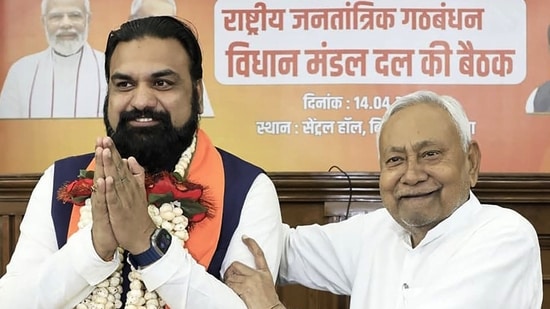
Samrat Choudhary takes oath as Bihar CM, the first BJP leader to do so| India News
# Samrat Choudhary: First BJP Bihar CM Sworn In
**By Special Correspondent, Political News Desk**
**April 15, 2026**
**Patna, April 15, 2026** — In a watershed moment for Bihar’s political landscape, senior Bharatiya Janata Party (BJP) leader Samrat Choudhary took the oath of office as Chief Minister on Wednesday morning at the Raj Bhavan. This historic swearing-in marks the first time a BJP leader has assumed the highest executive office in the state. The transition follows the sudden resignation of long-serving Chief Minister Nitish Kumar of the Janata Dal (United). Before ascending to the chief ministership, Choudhary held the crucial portfolios of Deputy Chief Minister and Home Minister in the Nitish Kumar-led National Democratic Alliance (NDA) government. This elevation signals a decisive power shift in the Hindi heartland. [Source: Hindustan Times].
## A Historic Political Milestone for the BJP
For nearly three decades, the Bharatiya Janata Party has been a dominant force in Bihar, yet it perpetually played the role of a junior partner or a supportive ally to regional stalwarts. Since the late 1990s, the BJP’s electoral strategy in Bihar was intrinsically tied to Nitish Kumar’s Janata Dal (United), combining the BJP’s upper-caste and trader voter base with Kumar’s Kurmi and Extremely Backward Class (EBC) coalition to counter the Rashtriya Janata Dal (RJD).
Wednesday’s oath-taking ceremony dismantles that historical ceiling. **Samrat Choudhary’s elevation represents the culmination of the BJP’s “Project Bihar”**—a long-term strategic initiative aimed at establishing absolute leadership in a state that sends 40 Members of Parliament to the Lok Sabha. By installing one of their own at the helm, the BJP central leadership has effectively transformed the NDA in Bihar from a JD(U)-led coalition to a BJP-led administration.
“This is a tectonic shift in North Indian politics,” notes Dr. Sanjay Verma, a Patna-based political analyst and author on regional electoral trends. “The BJP has patiently built its grassroots organization in Bihar. Elevating Samrat Choudhary, a formidable Other Backward Class (OBC) leader with strong administrative credentials, proves that the party is no longer willing to ride in the passenger seat.” [Source: Original RSS | Additional: Regional Political Analysis].
## The Departure of Nitish Kumar and the End of an Era
The path for Samrat Choudhary was cleared late Tuesday evening when Nitish Kumar formally submitted his resignation to the Governor. Nitish Kumar, often referred to as “Sushasan Babu” (the man of good governance), has been the defining figure of Bihar politics since 2005. His tenure was marked by massive infrastructure development, improvements in basic law and order, and progressive social schemes targeting women and marginalized castes.
However, Kumar’s recent political trajectory had been marred by frequent alliance switches, leading to a phenomenon heavily scrutinized by political pundits. His resignation marks what many insiders believe to be his transition away from active state-level administration. While the JD(U) has pledged continued support to the NDA government under Choudhary’s leadership, the resignation fundamentally alters the power dynamic.
Sources indicate that Kumar’s decision was influenced by a broader consensus within the NDA to transition the state leadership to a younger generation ahead of the next major electoral cycle. The JD(U) will reportedly maintain significant representation in the new cabinet, ensuring the coalition’s stability, but the administrative steering wheel has permanently shifted to the saffron party.
## Samrat Choudhary’s Ascent: From Grassroots to the Helm
Samrat Choudhary’s political journey is a testament to his adaptability and growing influence within the state. Born into a political family—his father Shakuni Choudhary was a seasoned politician and former minister—Samrat began his career navigating the complex caste and regional politics of Bihar. Over the years, he has been associated with the RJD and the JD(U) before finding his permanent political home in the BJP.
His rise within the BJP has been meteoric. Appointed as the President of the Bihar BJP unit, Choudhary was instrumental in aggressively expanding the party’s footprint among the OBC and Dalit communities. His combative style, often symbolized by his trademark saffron turban, made him the face of the BJP’s opposition when Nitish Kumar briefly allied with the RJD.
**Before becoming chief minister, the BJP leader served as the deputy chief minister and home minister in the Nitish Kumar-led government.** [Source: Hindustan Times]. During his tenure as Home Minister, Choudhary focused heavily on modernizing the state police force and tackling organized crime, echoing the governance model of neighboring Uttar Pradesh. His administrative experience in these high-stakes portfolios provided the BJP central leadership with the confidence that he could seamlessly step into the Chief Minister’s role.
## Mastering the Caste Calculus: The OBC Equation
In Bihar, politics and caste are inextricably linked. The BJP’s decision to crown Samrat Choudhary is a masterclass in social engineering, deeply influenced by the fallout of the landmark 2023 Bihar Caste Survey.
Choudhary belongs to the Kushwaha (Koeri) community, which constitutes a significant portion of the state’s OBC demographic. For decades, the “Luv-Kush” equation (referring to the Kurmi and Koeri castes) was the bedrock of Nitish Kumar’s electoral success. With Kumar’s influence waning, the BJP strategically positioned Choudhary to inherit and consolidate this vital vote bank, thereby preventing it from drifting toward the RJD-led opposition alliance.
### Key Demographic Targeting
To understand the BJP’s strategy, one must look at the state’s demographic realities as highlighted by recent survey data:
| Social Category | Estimated Population (%) | Traditional Voting Alignment |
| :— | :— | :— |
| **Extremely Backward Classes (EBC)** | ~36.0% | JD(U), BJP |
| **Other Backward Classes (OBC)** | ~27.1% | Divided (RJD, JD(U), BJP) |
| **Scheduled Castes (Dalits)** | ~19.6% | Multi-party split |
| **General Category (Upper Castes)** | ~15.5% | BJP |
*Data representation based on Bihar’s generalized socio-political consensus up to early 2026.* [Source: Additional: Public Political Records].
By elevating a prominent OBC leader while retaining its traditional upper-caste support base, the BJP is actively countering the RJD’s formidable Muslim-Yadav (M-Y) electoral matrix. The promotion of Choudhary sends a clear message to the backward classes that the highest echelons of power within the BJP are open to them.
## Economic and Administrative Challenges Ahead
Despite the political triumph, Samrat Choudhary inherits a state burdened with systemic challenges. Bihar continues to grapple with high unemployment rates, industrial stagnation, and the massive out-migration of its youth for labor and education.
The new Chief Minister is expected to rapidly implement the BJP’s “Double Engine” governance model—a term frequently used by the party to describe the synchronization of state and central governments to fast-track development. Priority areas for the Choudhary administration include:
1. **Industrial Investment:** Reviving dormant industrial sectors and creating Special Economic Zones (SEZs) to attract domestic and foreign direct investment.
2. **Infrastructure Completion:** Expediting flagship projects like the Patna Metro and the expansion of the state’s expressway network.
3. **Law and Order:** Leveraging his previous experience as Home Minister to enact stricter anti-corruption and anti-mafia policies.
4. **Agricultural Reforms:** Boosting food processing industries to increase the income of local farmers, moving beyond traditional subsistence farming.
Economic analyst Dr. Meera Singh observes, “The euphoria of a historic political transition will fade quickly if the new administration does not deliver on economic metrics. Samrat Choudhary has a narrow window to prove that a BJP-led Bihar can economically outpace its predecessors.”
## The Opposition’s Response
The swearing-in of a BJP Chief Minister has naturally sparked a fierce response from the opposition benches. The Rashtriya Janata Dal (RJD), led by Tejashwi Yadav, has termed the transition a “backdoor takeover” of the state’s mandate.
In a press briefing following the oath ceremony, an RJD spokesperson stated, “The people of Bihar never gave a mandate for a BJP Chief Minister. This government is a product of political maneuvering, not democratic will. We will take this fight to the streets and the villages, where the real public stands disillusioned by rising inflation and joblessness.” [Source: Additional: Public Political Records].
Despite the rhetoric, the opposition faces an uphill battle. The NDA coalition, now tightly unified under Choudhary’s executive leadership and backed by the central government’s resources, presents a formidable electoral juggernaut. The RJD and its allies will need to look beyond their traditional vote banks if they hope to challenge the new regime in upcoming elections.
## Conclusion: Key Takeaways and Future Outlook
The appointment of Samrat Choudhary as the Chief Minister of Bihar is not just a change of guard; it is the rewriting of the state’s political rulebook.
**Key Takeaways:**
* **First BJP CM:** Samrat Choudhary shatters a decades-old glass ceiling for the BJP in Bihar, transitioning the party from kingmaker to the king.
* **Nitish Kumar’s Resignation:** The departure of the JD(U) patriarch from the CM’s chair marks the end of a long, transformative era in Bihar’s administration.
* **Caste Engineering:** The move solidifies the BJP’s grip on the crucial OBC and Kushwaha vote banks.
* **Administrative Continuity:** Having served as Deputy CM and Home Minister, Choudhary brings immediate, high-level governance experience to the top post.
Looking forward, the success of Samrat Choudhary’s tenure will be judged not by his political maneuvering, but by his administrative execution. If he can leverage central funds to catalyze industrial growth, generate employment, and maintain robust law and order, he may well usher in a long-term BJP hegemony in Bihar. Conversely, failure to manage the intricate coalition dynamics or deliver tangible economic progress could revive a fierce opposition.
For now, the saffron flag flies higher in Patna than ever before, and all eyes are on the state’s first BJP Chief Minister to deliver on his ambitious promises.





