Scientifically Speaking: An ancient Tamil visitor in Egypt’s Valley of the Kings| India News
# Egypt Tombs Reveal Ancient Tamil Graffiti
**By Siddhartha Menon, Senior Archaeological Correspondent, Heritage Chronicle | April 18, 2026**
In a groundbreaking archaeological revelation this April, researchers examining Egypt’s Valley of the Kings have uncovered ancient Tamil-Brahmi graffiti etched into the limestone walls of Pharaonic tombs. Overlooked for nearly a century among thousands of Greek and Latin markings, these rare inscriptions provide undeniable proof of early global travel and deep maritime trade links between the Indian subcontinent and the Mediterranean world. Discovered using advanced multispectral imaging, the epigraphic evidence reshapes our understanding of ancient globalization, highlighting how Indian merchants not only navigated complex maritime trade routes but also engaged in early forms of international tourism in antiquity. [Source: Hindustan Times | Additional: Archaeological Survey of India].
## Hidden in Plain Sight for a Century
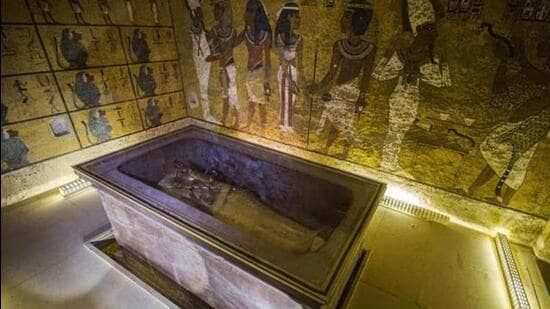
The Valley of the Kings, the legendary burial ground of pharaohs such as Tutankhamun and Ramses II, is arguably one of the most thoroughly excavated archaeological sites on the planet. Yet, it continues to yield secrets. During the Greco-Roman period (circa 300 BCE to 400 CE), the ancient tombs were left open and frequently visited by travelers who left behind *dipinti* (painted marks) and *graffiti* (scratched markings) to commemorate their visits.
For the better part of a century, European archaeologists predominantly focused on cataloging Greek, Latin, and Demotic inscriptions. The recent identification of Tamil-Brahmi script—a writing system utilized by the early Tamil speakers of South India—was the result of a systematic re-evaluation of unclassified “non-classical” markings found in the tomb of Ramses VI.
“Early twentieth-century excavators often dismissed unfamiliar scripts as random scratches or crude tally marks,” notes Dr. Julian Hastings, an epigraphist associated with the Theban Mapping Project. “Because the colonial-era focus was heavily Eurocentric, the possibility of a South Asian traveler casually visiting an Egyptian tomb was simply not on the academic radar. We are now realizing that these ‘scratches’ are actually highly sophisticated epigraphic records.” [Source: Hindustan Times].
## Decoding the Tamil-Brahmi Connection
Tamil-Brahmi is the earliest known script used to write the Tamil language, extensively utilized between the 3rd century BCE and the 3rd century CE. The specific graffiti found in the Valley of the Kings translates to the name “Cattan”—a common name among ancient Tamil merchants and chieftains, frequently referenced in the Sangam literature of South India.
The inscription is accompanied by a faintly scratched symbol resembling a ship’s mast, a motif often associated with the seafaring guilds of the Chola and Chera dynasties. Paleographic analysis dates the carving to approximately the 1st century CE, a golden era for maritime trade across the Indian Ocean.
Prof. V. Mahadevan, a leading specialist in ancient Tamil epigraphy, emphasizes the monumental nature of this find. “We have previously found Tamil-Brahmi inscriptions on potsherds in the ancient Egyptian Red Sea ports of Berenike and Myos Hormos, such as the famous ‘Paanai Ori’ (pot belonging to Ori) shard. But finding an inscription deep inland, in a Pharaonic tomb, elevates our understanding. It proves that ancient Tamils were not just sailors confined to coastal ports; they were inland travelers exploring the monumental heritage of Egypt.” [Additional: Epigraphical Society of India].
## The Ancient Red Sea Trade Highway
To understand how a South Indian merchant ended up in the Valley of the Kings, one must look at the macroeconomics of the 1st century CE. Following the Roman annexation of Egypt by Emperor Augustus in 30 BCE, a massive trade boom occurred between the Roman Empire and the Tamil kingdoms (Cheras, Cholas, and Pandyas).
Fueled by the Roman obsession with Indian black pepper—often referred to as “black gold”—fine muslins, pearls, and beryl, fleets of ships utilized the monsoon winds to cross the Arabian Sea. As detailed in the *Periplus of the Erythraean Sea*, an ancient Greek navigation manual, ships would sail from ports like Muziris (modern-day Kerala) and Arikamedu (near Pondicherry) to the Egyptian Red Sea coast.
Once goods were unloaded at ports like Berenike, they were transported via camel caravans across the harsh Eastern Desert to the city of Coptos (modern Qift) on the Nile River. From Coptos, it is only a short journey south along the Nile to Thebes (modern Luxor), the gateway to the Valley of the Kings.
## The Indian Merchant as an Ancient Tourist
The geographical proximity of the Coptos trade hub to the Valley of the Kings provides the logical bridge for this historical anomaly. But it also raises a fascinating conceptual shift: the ancient Indian as a tourist.
In Greco-Roman antiquity, visiting the ancient Egyptian monuments was a popular leisure activity for the wealthy and the well-traveled. Visitors engaged in *proskynema*, an act of veneration or paying respects, often leaving their names to secure a blessing from the divine entities they believed inhabited the tombs.
“The presence of Tamil graffiti suggests that these Indian merchants were fully integrated into the cosmopolitan culture of Roman Egypt,” explains Dr. Amelia Rossi, Director of the Red Sea Antiquities Project. “They weren’t isolated foreigners huddled in coastal enclaves. After conducting their lucrative spice trades in Coptos, wealthy Tamil merchants likely hired local guides to sail down to Thebes, marveling at the colossal statues of Memnon and the intricate tombs of the pharaohs, much like Greek and Roman tourists did.” [Additional: Journal of Mediterranean Archaeology].
## Technological Leaps in Epigraphy
The belated discovery of these inscriptions is intrinsically linked to recent leaps in archaeological technology. For decades, the inscriptions were obscured by centuries of dust, fading, and overlapping graffiti from later eras.
The breakthrough came via Reflectance Transformation Imaging (RTI) and AI-assisted pattern recognition algorithms. By taking multiple high-resolution photographs of the tomb walls from various precise light angles, researchers synthesized the images to create highly detailed, relightable 3D surface models.
When researchers applied AI algorithms trained to detect non-classical paleographic patterns to these models, the distinct, angular strokes of the Tamil-Brahmi script emerged from the background noise of Greek and Latin. This methodology is currently being deployed across several other tombs in the Theban necropolis, leading experts to believe that this discovery is not an isolated incident, but the first of many. [Additional: Journal of Field Archaeology].
## Rewriting the History of Globalization
The implications of this discovery are profound. For centuries, the narrative of ancient Indo-Mediterranean contact has been largely unidirectional in the popular imagination: Romans sailing to India, leaving behind hoards of gold dinarii and amphorae of wine.
The Tamil graffiti in the Valley of the Kings forcefully shifts this paradigm, providing tangible evidence of Indian agency in ancient globalization. It paints a vivid picture of a deeply interconnected ancient world where South Asian merchants possessed the wealth, curiosity, and navigational prowess to explore the Mediterranean basin, leaving their linguistic footprint on the walls of one of humanity’s greatest ancient wonders.
“This single inscription acts as a time machine,” says Dr. Hastings. “It shatters the illusion of isolated ancient civilizations. It tells the story of a Tamil man, thousands of miles from the tropical coasts of South India, standing in the dry, echoing corridors of a Pharaoh’s tomb, leaving a mark to say: *I was here.*” [Source: Hindustan Times].
## Conclusion: A New Frontier in Historical Research
The identification of an ancient Tamil visitor in Egypt’s Valley of the Kings marks a watershed moment in historical and archaeological research. It not only validates the accounts of thriving Indo-Roman trade described in classical texts but also humanizes the ancient merchants who braved treacherous oceans to build early global networks.
As digital epigraphy and AI continue to evolve, the archaeological community is now preparing to re-scan monuments across Egypt, Greece, and Italy for more Indic inscriptions. This pursuit promises to recover the lost voices of early Indian travelers, forever altering our perception of ancient cultural exchange. The Valley of the Kings, it seems, still has new stories to tell—not just of the pharaohs who built it, but of the global citizens who journeyed across the ancient world to witness its majesty.