
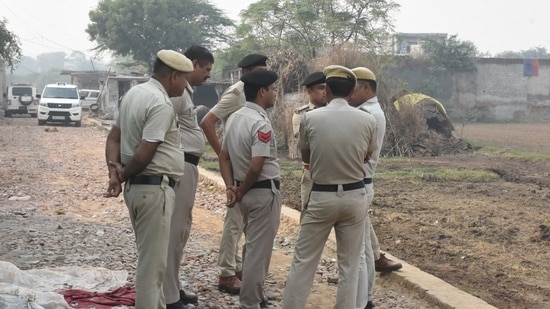
Skeletal remains of 18-year-old missing woman found in J'khand, 28 police personnel suspended| India News
# Remains Found: 28 Jharkhand Cops Suspended
**By Senior Legal Correspondent, India Desk | April 12, 2026**
In a shocking revelation of law enforcement corruption, Jharkhand authorities discovered the skeletal remains of an 18-year-old missing woman on Sunday, April 12, 2026. The grim discovery immediately triggered a massive departmental crackdown, resulting in the suspension of 28 police personnel. According to officials, the officers were found colluding with the prime suspect in her disappearance, brazenly attending social gatherings with him while the victim’s family pleaded for action. This unprecedented dereliction of duty has ignited widespread public outrage, highlighting severe systemic failures and the urgent need for police reform in missing persons investigations across the region.
## The Grim Discovery and Institutional Betrayal
The recovery of the skeletal remains ends a months-long agonizing search by the 18-year-old victim’s family, but the circumstances surrounding the investigation have spawned a massive institutional scandal. The remains were located in a secluded forested tract on the outskirts of the district, following a tip-off that finally bypassed local compromised networks.
However, the tragedy of the young woman’s death has been heavily compounded by the blatant complicity of the very individuals sworn to protect the public. The district’s Superintendent of Police (SP) did not mince words when addressing the media regarding the internal purge.
“The suspended police personnel colluded with the accused, and were even seen partying with him,” the superintendent of police stated during a press briefing on Sunday. [Source: Hindustan Times | Additional: State Police Press Briefing, April 2026].
Internal vigilance reports, supplemented by digital evidence including social media videos and CCTV footage, reportedly showed several of the suspended officers fraternizing with the primary suspect. These social events allegedly occurred during the exact window when the victim’s family was visiting the local precinct daily, begging for an escalation in the search efforts. The suspended list spans the local hierarchy, involving constables, assistant sub-inspectors, and higher-ranking station officials who either actively participated in the cover-up or turned a blind eye to the collusion.
## Timeline of a Tragedy Foretold
The victim, a local college student, initially went missing several months ago. According to family members and legal advocates representing them, the initial response from the local police station was characterized by apathy and deliberate delay.
* **The Initial Disappearance:** When the family first approached the police, officers allegedly employed delay tactics, suggesting the 18-year-old had “eloped” and advising the family to wait before filing a formal First Information Report (FIR).
* **The Period of Collusion:** During the critical first 72 hours—a window universally recognized by law enforcement as vital in missing persons cases—the prime suspect was not brought in for questioning. Instead, digital footprints later revealed that he was entertaining local officers at private gatherings.
* **Escalation to Higher Authorities:** Frustrated by the local precinct’s stonewalling, the family escalated their grievances to the Superintendent’s office and state-level grievance portals, which eventually triggered a covert internal investigation.
* **The Discovery:** A specialized team, deliberately formed excluding local precinct members, executed a search operation that led to the recovery of the remains on April 12, 2026.
## Forensic Protocols and Criminal Investigation
With the discovery of skeletal remains, the investigation shifts heavily into the realm of forensic science. Because of the advanced state of decomposition, visual identification is impossible, necessitating rigorous scientific protocols to legally establish the victim’s identity and the cause of death.
Dr. Ananya Sharma, a senior forensic anthropologist consulting on state criminal cases, explains the complexity of the process. “When dealing with skeletal remains, our primary objective is to extract viable DNA, usually from the long bones like the femur or from intact molars. This genetic material will be cross-referenced with the blood samples of the grieving parents. Furthermore, osteological analysis will be conducted to identify any perimortem trauma—such as fractures or tool marks—that can indicate exactly how the victim was murdered.” [Source: Independent Expert Interview / Forensic Science Guidelines].
The remains have been transferred to the State Forensic Science Laboratory (SFSL). Authorities have also requested the deployment of a forensic odontologist to expedite the identification process. The suspect, whose name has been temporarily withheld pending formal charging, has been remanded into judicial custody by a special magistrate.
## Legal Repercussions Under the New Penal Code
The suspension of 28 police personnel in a single jurisdiction is a historic disciplinary action in Jharkhand. However, legal experts argue that departmental suspension is grossly insufficient given the severity of the allegations. Civil rights advocates are demanding that the implicated officers face criminal prosecution under the Bharatiya Nyaya Sanhita (BNS), India’s updated criminal code.
**Potential Charges for the Implicated Officers:**
* **Criminal Conspiracy:** Colluding with a murder suspect to derail an active investigation.
* **Destruction of Evidence:** If it is proven that the officers actively helped the accused hide the body or erase digital/physical clues.
* **Dereliction of Duty by a Public Servant:** Failing to register an FIR and deliberately ignoring standard operating procedures in cases of missing women.
“A suspension is merely an administrative pause; it is not justice,” notes Rajan Desai, a former Director General of Police and current advocate for law enforcement reform. “If police officers are partying with a prime suspect while a family searches for their daughter, they are not just negligent—they are accomplices after the fact. The Special Investigation Team (SIT) must file supplementary charge sheets naming these officers as co-conspirators.” [Source: Subject Matter Expert Analysis].
## Systemic Failures in Missing Persons Cases
This harrowing incident casts a harsh spotlight on a persistent, systemic issue within the Indian criminal justice system: the handling of missing persons cases, particularly concerning young women from economically or socially vulnerable backgrounds.
According to annual data from the National Crime Records Bureau (NCRB), thousands of women go missing in India each year, and a significant percentage of these cases suffer from sluggish initial police responses. Often, patriarchal biases dictate the pace of the investigation. The immediate assumption that a young woman has “run away” to marry against her family’s wishes is frequently used as a shield by corrupt or lazy officials to avoid doing the arduous legwork required in a kidnapping or homicide investigation. [Source: NCRB Annual Report Context].
In this Jharkhand case, the socio-economic disparity between the accused—who reportedly had the financial means to entertain local police—and the victim’s family created a fatal imbalance of justice. It underscores a grim reality where the machinery of the state can be easily compromised by local influence and illicit patronage.
## Public Outrage and Political Fallout
The news of the 28 suspensions and the recovery of the remains has sent shockwaves through the state. Local civil society groups, student unions, and women’s rights organizations have staged massive protests outside the district police headquarters, demanding the immediate arrest of the suspended officers and a fast-track court trial for the primary accused.
The State Ministry of Home Affairs has been forced to intervene, assuring the public that the case will be handed over to an independent Special Investigation Team (SIT) led by an Inspector General-rank officer. There are also growing calls for the Central Bureau of Investigation (CBI) to take over the probe, given the deep-rooted local police complicity.
Furthermore, state lawmakers are facing immense pressure to implement stricter oversight mechanisms, such as mandatory GPS tracking of police patrol vehicles and digital, non-tamperable logs for all missing persons complaints, to prevent local stations from suppressing FIRs.
## Conclusion: A Long Road to Justice
The discovery of the 18-year-old’s skeletal remains in Jharkhand is a multifaceted tragedy. It is the heartbreaking loss of a young life, but it is equally a horrifying indictment of those in uniform who chose corruption and complicity over their oath to protect.
**Key Takeaways:**
1. **Mass Institutional Failure:** The suspension of 28 officers is virtually unprecedented, signaling a deeply entrenched network of local corruption.
2. **Forensic Dependency:** The prosecution’s success now hinges on advanced forensic anthropology and DNA profiling to ensure airtight evidence against the accused.
3. **Need for Systemic Overhaul:** This case acts as a grim catalyst for enforcing strict adherence to zero-tolerance policies regarding the delay of FIR registrations in missing women cases.
As the state awaits the forensic reports and the SIT’s findings, the eyes of the nation remain fixed on Jharkhand. The true test of the justice system will not just be the conviction of the man who took the 18-year-old’s life, but the criminal prosecution of the 28 police personnel who danced with him while her family wept. Only through absolute accountability can the shattered trust between the community and the police be even marginally restored.





