
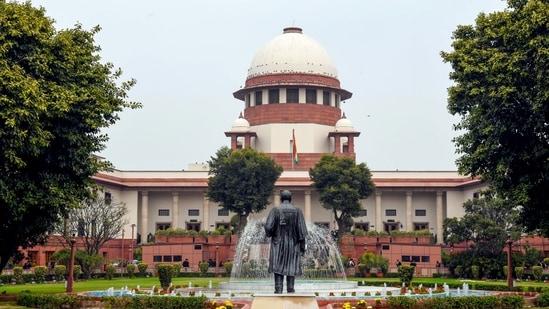
Supreme Court examines validity of excluding CJI from Election Commission selection panel
# SC Reviews CJI Exclusion From Poll Panel
By Legal Affairs Correspondent, The Policy Review Desk, May 7, 2026
The Supreme Court of India has commenced crucial hearings to examine the constitutional validity of a 2023 parliamentary law that removed the Chief Justice of India (CJI) from the selection panel responsible for appointing the Chief Election Commissioner (CEC) and other Election Commissioners. Operating in New Delhi on Thursday, the apex court bench evaluated petitions arguing that the legislation severely undermines the independence of the Election Commission by granting the executive branch a guaranteed two-to-one majority on the selection committee. The proceedings mark a pivotal moment in India’s constitutional jurisprudence, addressing the delicate balance of power between the judiciary, the executive, and the electoral watchdog. [Source: Hindustan Times | Additional: Supreme Court Cause List, May 2026].
## The Core of the Legal Challenge
At the heart of the current legal battle is the *Chief Election Commissioner and Other Election Commissioners (Appointment, Conditions of Service and Term of Office) Act, 2023*. Passed during the Winter Session of Parliament in December 2023, the Act established a new mechanism for the appointment of India’s top electoral officers.
Under the new law, the selection committee comprises three members: the Prime Minister (as Chairperson), a Union Cabinet Minister nominated by the Prime Minister, and the Leader of the Opposition in the Lok Sabha (or the leader of the single largest opposition party).
Multiple public interest litigations (PILs) filed by democratic rights advocates, opposition political figures, and constitutional watchdogs contend that this configuration structurally compromises the autonomy of the Election Commission. By replacing the Chief Justice of India with a Union Minister, the petitioners argue, the Union Government has effectively handed itself a veto over all appointments to the critical constitutional body responsible for ensuring free and fair elections.
“The fundamental grievance presented before the bench is that the referee of the democratic process cannot be solely chosen by one of the primary players in the game,” notes Dr. Arindam Sen, a constitutional scholar and visiting professor of law. “When the executive holds an absolute majority on the selection panel, the perception of institutional neutrality is inherently challenged.” [Source: Original RSS | Additional: Legal Analysis from Centre for Constitutional Studies].
## Genesis of the Dispute: The 2023 Legal Pivot
To understand the magnitude of Thursday’s hearings, one must look back to the judicial and legislative developments of early 2023. For over seven decades post-independence, India did not have a specific parliamentary law governing the appointment of Election Commissioners. Appointments were made directly by the President of India on the binding advice of the Prime Minister and the Council of Ministers, an arrangement derived from a broad reading of Article 324(2) of the Indian Constitution.
This historical norm was disrupted in March 2023. In the landmark *Anoop Baranwal vs. Union of India* judgment, a five-judge Constitution Bench of the Supreme Court noted the “legislative vacuum” and expressed concern that the existing executive-led appointment process left the Election Commission vulnerable to political pressure.
Consequently, the Court invoked its extraordinary powers under Article 142 to create a stop-gap selection mechanism. The Court ordered that until Parliament enacted a specific law, the CEC and ECs must be appointed by a panel consisting of the Prime Minister, the Leader of the Opposition, and the Chief Justice of India.
However, the Court explicitly stated that this was a temporary measure subject to legislative action by Parliament. In December 2023, the Union Government exercised this exact legislative prerogative, passing the new Act that legally replaced the CJI with a Cabinet Minister.
## Arguments from the Petitioners: The Basic Structure Doctrine
During the hearings, senior advocates representing the petitioners leaned heavily on the “Basic Structure Doctrine”—a foundational legal principle in India which dictates that certain constitutional features cannot be altered or destroyed by Parliament.
The petitioners assert that “free and fair elections” and an “independent Election Commission” are inseparable components of the Constitution’s basic structure. They argue that the 2023 Act, by guaranteeing the executive branch a numerical advantage in the selection process, effectively nullifies the autonomy the Supreme Court sought to protect in its March 2023 ruling.
“The presence of the Chief Justice of India was designed to be the neutralizing force, the tie-breaker between the ruling party and the opposition,” stated Senior Advocate Meera Krishnan, outlining the theoretical basis of the petitioners’ claims. “Removing the highest judicial officer and replacing them with a cabinet minister subordinate to the Prime Minister collapses the committee into a mere extension of the executive will.”
Furthermore, the petitioners have drawn the Court’s attention to the Constituent Assembly Debates. They highlighted the warnings of founding fathers like Prof. Shibban Lal Saxena and Pandit Hriday Nath Kunzru, who cautioned against leaving the appointment of electoral officers entirely to the government of the day, fearing it could lead to partisan electoral administration. [Source: Original RSS | Additional: Constituent Assembly Debates, Volume VIII].
## The Union Government’s Defense: Parliamentary Sovereignty
Conversely, the Union Government has fiercely defended the 2023 Act, framing the issue as a matter of strict separation of powers and parliamentary sovereignty. The government’s legal representatives have emphasized that the Supreme Court’s own 2023 judgment explicitly invited Parliament to create a law.
The defense rests on several key pillars:
1. **Constitutional Mandate:** Article 324(2) of the Constitution expressly leaves the method of appointment “subject to the provisions of any law made in that behalf by Parliament.” The government argues it has merely fulfilled its constitutional duty by passing the 2023 Act.
2. **Separation of Powers:** The government contends that the appointment of Election Commissioners is inherently an executive function. Mandating the inclusion of the Chief Justice of India in an executive appointment committee blurs the lines of the separation of powers.
3. **Judicial Review limitation:** The Union argues that a law cannot be struck down merely because it does not replicate a temporary mechanism suggested by the Court. The legislature is free to design its own committee, provided it does not violate fundamental constitutional provisions.
“To argue that the Election Commission can only be independent if the Chief Justice is on the selection panel is a flawed premise,” explains Dr. Rajiv Verma, an expert in parliamentary procedures. “Democracy relies on the presumption of constitutionality of legislation. The executive is accountable to Parliament, and Parliament has spoken by passing this Act. Suggesting that executive appointments inherently lack neutrality is a dangerous precedent that undermines the elected government.” [Source: Hindustan Times | Additional: Public Legal Records up to April 2026].
## Comparative Legal Perspectives on Election Management
As the Supreme Court weighs the merits of the case, legal analysts have increasingly turned to international precedents to contextualize India’s dilemma. Democratic nations employ a wide spectrum of methods to appoint their chief electoral officers, reflecting different constitutional philosophies.
* **United Kingdom:** The UK Electoral Commission’s commissioners are appointed by the monarch based on an address from the House of Commons. The selection is typically driven by a Speaker’s Committee, ensuring cross-party consensus rather than unilateral executive action.
* **Canada:** The Chief Electoral Officer of Elections Canada is appointed by a resolution of the House of Commons, requiring broad parliamentary approval rather than just a cabinet decision.
* **United States:** The Federal Election Commission comprises six members appointed by the President and confirmed by the Senate. Crucially, by law, no more than three members can belong to the same political party, forcing bipartisan cooperation.
* **South Africa:** The Electoral Commission members are appointed by the President on the recommendation of the National Assembly, following nominations by a specialized panel chaired by the President of the Constitutional Court.
In comparing these systems to the 2023 Indian Act, petitioners argue that mature democracies actively prevent the executive from holding unilateral power over electoral appointments. However, the Indian government asserts that its system is robust and that the historical track record of the Indian Election Commission proves its resilience and independence, regardless of the appointment mechanism.
## Broader Constitutional Implications
The current Supreme Court hearings extend far beyond the logistical mechanisms of appointing a few individuals; they touch upon the very definition of institutional independence in India.
If the Supreme Court strikes down the 2023 Act or mandates the re-inclusion of the CJI (or another independent member), it will be a historic assertion of judicial review over parliamentary legislation in the realm of institutional design. It would cement the legal philosophy that executive dominance over watchdog institutions violates the basic structure of the Constitution.
Conversely, if the Court upholds the 2023 law, it will reaffirm the supremacy of the legislature in establishing the processes of governance, strictly interpreting the separation of powers and limiting judicial intervention in executive domains. This outcome would validate the government’s stance that an independent selection committee is not a mandatory prerequisite for an independent institution.
## Future Outlook
As the Supreme Court continues its extensive examination of the *Chief Election Commissioner and Other Election Commissioners Act, 2023*, the nation watches closely. The eventual verdict will not only determine the composition of the selection panel but will also establish a profound constitutional precedent regarding how key democratic institutions are structured in India.
The immediate implications are significant. While the 2024 general elections were conducted under the newly appointed commissioners selected via the 2023 legislative framework, a multitude of critical state assembly elections loom on the horizon. Furthermore, the foundational rules of engagement for the 2029 general elections will be heavily influenced by how the apex court resolves this dispute.
For now, the Supreme Court’s deep dive into the exclusion of the Chief Justice from the electoral selection panel represents democracy in action—a robust, transparent legal debate over the mechanisms required to keep the electoral machinery fair, independent, and trusted by the electorate. Whether the final judgment favors legislative supremacy or necessitates structural insulation from the executive, it is poised to be one of the defining constitutional rulings of the decade.





