
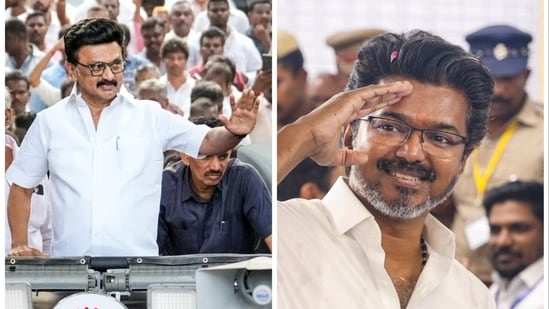
'Will wait for Vijay's TVK to form govt in Tamil Nadu and watch for 6 months': Outgoing CM Stalin
# Stalin Lets TVK Form Govt, Will Wait 6 Months
**By Special Correspondent, India Political Digest, May 7, 2026**
In an unprecedented turn of events in Tamil Nadu’s political landscape, outgoing Chief Minister M.K. Stalin announced on Thursday that his party, the Dravida Munnetra Kazhagam (DMK), will not attempt to form a coalition government, despite a fractured mandate. Instead, Stalin stated he will allow actor-turned-politician Thalapathy Vijay’s Tamilaga Vettri Kazhagam (TVK) to stake its claim. TVK pulled off a stunning performance in its electoral debut, securing 108 seats in the 234-member state assembly—falling just 10 seats short of the 118-seat majority mark. Conceding the mandate, Stalin remarked that the DMK will respect the people’s verdict, sit in the opposition, and “watch for 6 months” to evaluate the new administration’s governance. [Source: Hindustan Times | Additional: Election Commission Data Updates].
## A Seismic Shift in Dravidian Politics
The May 2026 assembly elections will be recorded as a watershed moment in the modern political history of Tamil Nadu. For over five decades, the southern state has been governed by a formidable duopoly: the DMK and the All India Anna Dravida Munnetra Kazhagam (AIADMK). The spectacular entry of Vijay’s TVK has fundamentally disrupted this binary system, capturing the imagination of first-time voters, youth demographics, and a significant portion of the rural electorate demanding an alternative to traditional power structures.
TVK’s performance—winning 108 seats on its very first outing—surpasses the historical debuts of other regional cinematic giants who pivoted to politics. Observers note that while M.G. Ramachandran (MGR) and N.T. Rama Rao (NTR) achieved massive victories in the 1970s and 1980s, doing so in the highly entrenched, social media-driven political environment of 2026 is an extraordinary feat. Vijay’s campaign, which heavily focused on anti-corruption, administrative transparency, educational reform, and employment generation, clearly resonated across both the Kongu belt and the southern districts.
## Decoding Stalin’s Strategic Restraint
Outgoing Chief Minister M.K. Stalin’s declaration that he will “watch for 6 months” before making any aggressive political maneuvers is being interpreted by analysts as a masterclass in strategic patience. By immediately resigning and refusing to engage in “resort politics” or aggressive horse-trading to cobble together a majority, Stalin achieves multiple political objectives.
Firstly, he respects the undeniable momentum and public sympathy currently resting with Vijay. Attempting to artificially block TVK from forming the government when they are the single largest party would likely trigger massive public backlash and paint the DMK as anti-democratic.
Secondly, governance is vastly different from campaigning. By allowing TVK to take the reins, Stalin is forcing the newly minted politicians to confront the stark realities of administration, fiscal management, and bureaucratic navigation. The six-month timeframe is particularly significant. It encompasses the honeymoon period of the new government, the presentation of their first state budget, and their initial attempts to fulfill ambitious manifesto promises.
“Stalin is laying a strategic trap disguised as a graceful exit,” explains Dr. R. Karthikeyan, a political analyst based in Chennai. “If TVK excels, the DMK remains a responsible opposition. But if the inexperienced TVK cabinet stumbles over administrative hurdles or fails to manage the state’s complex fiscal deficit, the DMK will be perfectly positioned to capitalize on anti-incumbency without getting their hands dirty during the transition phase.” [Source: Hindustan Times | Additional: Expert Political Analysis].
## The Numbers Game: Crossing the Majority Mark
While TVK has emerged as the single largest party, it still requires the support of at least 10 additional Members of the Legislative Assembly (MLAs) to reach the magic number of 118 required to form the government.
**2026 Tamil Nadu Assembly Election Results (Projections):**
| Party / Alliance | Seats Won | Vote Share (%) |
| :— | :— | :— |
| TVK (Tamilaga Vettri Kazhagam) | 108 | 36.5% |
| DMK Alliance | 68 | 29.2% |
| AIADMK Alliance | 42 | 21.4% |
| Independents & Others | 16 | 12.9% |
| **Total** | **234** | **100%** |
With 16 seats resting in the hands of smaller regional parties and independent candidates, TVK’s leadership is currently engaged in intense negotiations. Political insiders report that several independent MLAs, recognizing the overwhelming public mandate favoring Thalapathy Vijay, have already sent letters of unconditional support to the Governor. It is widely expected that TVK will comfortably prove its majority on the floor of the house within the stipulated timeframe without needing to engineer defections from the major opposition blocs.
## Formidable Challenges Awaiting the New Administration
Once the oath of office is administered, Thalapathy Vijay and his cabinet will inherit a state machinery fraught with both immense potential and significant challenges. Tamil Nadu is one of India’s most industrialized and economically critical states, contributing substantially to the national GDP. However, sustaining this growth trajectory requires experienced handling.
**1. Fiscal Deficit and State Debt:**
The foremost challenge for the TVK government will be managing the state’s outstanding debt, which has steadily increased over the past decade. Fulfilling the populist welfare schemes promised during the TVK election rallies—without exacerbating the fiscal deficit—will require surgical economic planning. The state must balance its revenue generation through industrial taxation and excise with the heavy expenditures of social justice programs.
**2. Bureaucratic Friction:**
Transitioning from a popular mass leader to an effective Chief Administrator requires navigating a complex bureaucracy. TVK features a high number of first-time MLAs who lack prior legislative or executive experience. Earning the confidence of senior IAS and IPS officers, and ensuring that government policies are translated into grassroots action, will be a steep learning curve.
**3. Infrastructure and Industrial Investments:**
The outgoing DMK government placed a strong emphasis on attracting foreign direct investment (FDI), particularly in the electric vehicle (EV), semiconductor, and renewable energy sectors. The TVK government must project stability to global investors. Any perception of policy paralysis or administrative chaos could result in multinational corporations redirecting their investments to neighboring competitive states like Karnataka or Telangana.
## Expert Perspectives on the Road Ahead
Political and constitutional experts are closely watching how the constitutional machinery will adapt to this novel situation. According to constitutional expert S. Vasudevan, “The Governor’s role will be largely ceremonial in the coming weeks, as the mandate clearly points toward TVK as the primary claimant. The real test is the upcoming budget session. Passing money bills and formulating the state budget will require TVK to demonstrate that their economic acumen matches their electoral popularity.” [Source: Hindustan Times | Additional: Public Policy Commentary].
Furthermore, sociologists point out that Vijay’s success stems from a carefully cultivated image that bridges various demographic divides. Unlike specialized regional parties that rely on specific caste or linguistic vote banks, TVK’s voter base is highly heterogeneous, held together primarily by the charismatic appeal of its leader. Maintaining this broad-based coalition when difficult, potentially unpopular policy decisions have to be made will test Vijay’s political mettle.
## The Opposition’s Blueprint
Stalin’s decision to transition gracefully into the role of the Leader of the Opposition sets the stage for a highly dynamic legislative assembly. The DMK, with its formidable cadre base and deeply entrenched organizational structure, remains a potent force. By avoiding the stigma of being labeled ‘power-hungry’, Stalin has preserved his party’s dignity in defeat.
For the AIADMK, which has now been pushed to the third position, the election results mandate profound introspection. The traditional Dravidian major parties will likely spend the next six months reorganizing their grassroots networks, analyzing booth-level data to understand the exact nature of the TVK wave, and waiting for the new administration to commit its first unforced error.
## Conclusion: A Six-Month Probation Period
Tamil Nadu stands on the precipice of a brand-new political epoch. The dramatic entry of Thalapathy Vijay’s TVK has undeniably rewritten the rules of engagement in the southern political theater. By securing 108 seats, the party has proven that cinematic charisma, when paired with organized grassroots campaigning and a resonance with youth aspirations, can still topple established political giants.
However, as outgoing Chief Minister M.K. Stalin aptly insinuated, winning an election is merely the prologue; governing a state of over 72 million people is the actual narrative. The next six months will serve as an unyielding probation period for TVK. The people of Tamil Nadu, along with a highly watchful opposition, will be observing whether Thalapathy Vijay can successfully transform from a cinematic savior into a seasoned, effective statesman capable of navigating the complex socio-economic realities of one of India’s most crucial states.





