
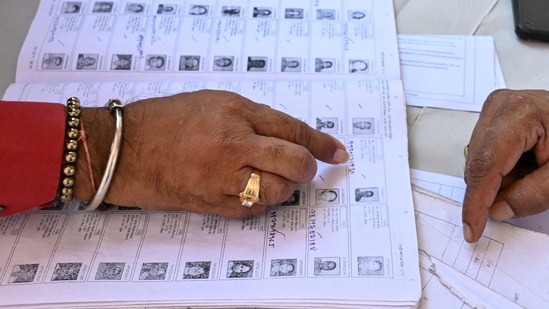
Supreme Court says voting, contesting polls not fundamental rights: ‘It’s well settled'| India News
# SC: Voting Is Not Fundamental Right
**New Delhi, April 11, 2026** — In a definitive reaffirmation of Indian electoral jurisprudence, the Supreme Court of India ruled on Saturday that the rights to vote and to contest elections are not fundamental rights guaranteed by the Constitution, but rather statutory rights defined and limited by legislative boundaries. A division bench comprising Justices BV Nagarathna and R Mahadevan unequivocally stated that these democratic privileges exist exclusively to the extent provided by the law.
The apex court’s observations dismiss recent legal efforts aimed at elevating electoral participation to the inviolable status of fundamental rights under Part III of the Constitution. By reiterating that the contours of electoral rights are shaped entirely by parliament, the Court has drawn a strict line between democratic ideals and legal pragmatism. [Source: Hindustan Times | Additional: Supreme Court Roster and Legal Precedents].
## The Core Ruling and Legal Rationale
The bench’s ruling came during the hearing of a petition challenging specific disqualification criteria established by the Election Commission of India. In its oral observations and subsequent written order, the Supreme Court noted that the phrase “it is well settled” applies strictly to the nature of electoral rights in India.
Justices Nagarathna and Mahadevan highlighted that unlike the freedom of speech and expression (Article 19) or the right to life and personal liberty (Article 21), the right to vote is not a natural or fundamental right. Instead, it is a creature of statute—specifically, the Representation of the People Act (RPA), 1951.
“The rights to elect, to be elected, and to dispute an election are statutory creations. They are bound by the limitations and conditions imposed by the legislature,” the bench observed. This legal doctrine ensures that Parliament retains the ultimate authority to dictate the qualifications, disqualifications, and administrative processes governing elections, without facing relentless constitutional challenges under Article 32.
## Tracing the Jurisprudence: A Settled Debate
The assertion that voting is a statutory right is not a novel legal concept; rather, it is the bedrock upon which India’s electoral machinery has operated since independence. The Supreme Court’s April 2026 ruling is part of an unbroken chain of precedents dating back over seven decades.
In the landmark case of ***NP Ponnuswami v. Returning Officer (1952)***, a six-judge Constitution bench established that the right to vote or stand as a candidate is not a civil right, but a creature of statute or special law, subject to the limitations of that law.
This was famously solidified in ***Jyoti Basu v. Debi Ghosal (1982)***, where the Supreme Court articulated the principle with absolute clarity: *”A right to elect, fundamental though it is to democracy, is, anomalously enough, neither a fundamental right nor a Common Law Right. It is pure and simple, a statutory right. So is the right to be elected. So is the right to dispute an election.”*
Later, in ***Kuldip Nayar v. Union of India (2006)***, the Court examined the amendments to the Rajya Sabha election process and once again concluded that the right to vote is a statutory right that the legislature can modify, regulate, or even restrict based on logical legal frameworks.
## The Intersection of Article 326 and Statutory Law
A common point of confusion among the general public—and the basis for many petitions—is the existence of **Article 326 of the Constitution**. This article guarantees that elections to the House of the People (Lok Sabha) and State Legislative Assemblies shall be held on the basis of universal adult suffrage.
However, constitutional scholars distinguish between a broad constitutional directive and an enforceable individual fundamental right. Article 326 directs the state to create an electoral roll based on adult suffrage (granting voting eligibility to citizens over 18), but it simultaneously empowers the legislature to formulate laws regarding disqualification on grounds of non-residence, unsoundness of mind, crime, or corrupt/illegal practices.
Therefore, while the *concept* of universal adult suffrage is constitutional, the actual *mechanism, exercise, and enforcement* of the right to cast a ballot are purely statutory.
## The Representation of the People Act, 1951
To understand the implications of the Supreme Court’s ruling, one must look at the primary statute governing elections in India: The Representation of the People Act (RPA), 1951.
**Section 62 of the RPA** outlines the right to vote. Because it is a statutory right, Section 62(5) explicitly strips the right to vote from any person who is confined in a prison (whether under a sentence of imprisonment or transportation) or is in the lawful custody of the police.
If voting were a fundamental right under Part III of the Constitution, such a blanket disenfranchisement of undertrials (who are legally presumed innocent until proven guilty) would likely violate the fundamental rights to equality (Article 14) and personal liberty (Article 21). Because voting is merely statutory, the state is within its legal authority to restrict prisoners from participating in elections.
Similarly, **Section 8 of the RPA** deals with the disqualification of representatives upon conviction for certain offences. The statutory nature of the right to contest allows the legislature to instantly disqualify a lawmaker sentenced to two or more years in prison—a crucial tool for maintaining the decriminalization of politics.
## Expert Perspectives and Legal Analysis
Constitutional experts and legal observers have largely supported the Supreme Court’s reiteration, noting the practical necessity of keeping electoral rights statutory.
“Elevating the right to vote to a fundamental right would open the floodgates for constitutional litigation during the middle of electoral processes,” explained Dr. Vikram Salve, a senior constitutional lawyer based in New Delhi. “Every minor discrepancy in voter registration, booth allocation, or candidate disqualification would be fast-tracked to the Supreme Court as an Article 32 writ petition, effectively paralyzing the Election Commission’s ability to conduct timely polls.”
Conversely, electoral reform advocates argue that while the statutory classification is legally sound, it places a heavy burden on Parliament to continually update the laws to protect vulnerable voters.
“The fact that voting is statutory means it can be restricted by a simple majority in Parliament, rather than requiring a constitutional amendment,” noted Meera Chandran, director of the non-partisan Centre for Electoral Integrity. “This makes it highly dependent on the political will of the ruling class. We must ensure that the Representation of the People Act is continually amended to expand voter enfranchisement, such as allowing remote voting for domestic migrants, rather than restricting it.”
## The Nuance: Right to Information vs. Right to Vote
While the act of voting is not a fundamental right, the Supreme Court has previously carved out a fascinating legal nuance regarding voter rights. In judgments such as the *Union of India v. Association for Democratic Reforms (2002)* and the *PUCL (NOTA) judgment (2013)*, the Court ruled that a voter’s right to *know* the antecedents (criminal history, educational qualifications, and assets) of a candidate is a fundamental right.
This right to information is derived from **Article 19(1)(a)**—the freedom of speech and expression. The rationale is that a voter cannot freely express their democratic choice if they are kept in the dark about who they are voting for. Therefore, Indian electoral law exists in a unique hybrid state: the physical right to cast a ballot is a statutory privilege, but the right to make an informed choice is a fundamental constitutional guarantee.
## Statutory vs. Fundamental Rights: A Structural Breakdown
To clarify the Supreme Court’s April 2026 stance, here is a comparative look at how statutory electoral rights differ from fundamental rights in the Indian legal framework:
| Feature | Fundamental Rights (Part III) | Statutory Electoral Rights (RPA 1951) |
| :— | :— | :— |
| **Source of Power** | The Constitution of India (Articles 12-35) | Parliament-enacted laws (RPA 1950, 1951) |
| **Enforceability** | Directly enforceable by the Supreme Court (Art 32) and High Courts (Art 226) | Enforceable through statutory mechanisms like Election Petitions |
| **Amendability** | Requires a Constitutional Amendment (Special Majority); limited by the Basic Structure Doctrine | Can be amended by a simple parliamentary majority |
| **Restrictions** | Subject to strict “reasonable restrictions” outlined in the Constitution | Legislature has broad power to define qualifications and disqualifications |
| **Examples** | Right to Equality, Freedom of Speech, Protection of Life | Right to register as a voter, right to contest a legislative seat |
## Implications for the Future of Elections
The explicit reiteration by Justices BV Nagarathna and R Mahadevan serves as a reminder to political entities, candidates, and citizens that the rules of the electoral game are defined by the legislature.
For candidates contesting polls, this reinforces the reality that they must adhere strictly to the compliance frameworks of the Election Commission and the RPA. A failure to disclose assets properly or a conviction in a criminal case will result in immediate disqualification, and courts will interpret these disqualifications as a breach of statute rather than an infringement on human rights.
For voters, the judgment is a call to civic vigilance. Because the right to vote is maintained through legislation, citizens must engage actively with the democratic process to ensure that Parliament drafts laws that are inclusive and transparent.
## Conclusion
The Supreme Court’s April 11, 2026, observation that voting and contesting elections are not fundamental rights is a continuation of established legal precedent. By tethering electoral rights to the Representation of the People Act, the judiciary has preserved the delicate balance of separation of powers, leaving the administration of democracy firmly in the hands of the legislature and the Election Commission.
While the ruling may seem technically restrictive to the layperson, it underscores the structural design of Indian democracy: a system where constitutional ideals of universal suffrage are actualized through carefully crafted, legally binding statutes. Going forward, any systemic changes to voter eligibility, absentee voting, or candidate qualifications will have to be achieved on the floor of Parliament, not in the halls of the Supreme Court.
***
By Senior Legal Correspondent, Legal News India, April 11, 2026.





