
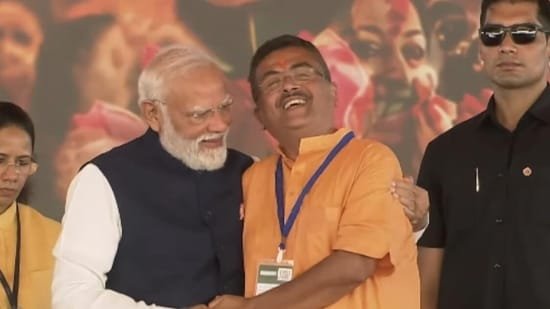
Suvendu Adhikari is the new Bengal CM, BJP's first in the state
# Suvendu Adhikari Becomes Bengal’s First BJP CM
**By Rohan Chatterjee**, *India Policy Desk*, May 9, 2026
On Saturday, Suvendu Adhikari was officially sworn in as the Chief Minister of West Bengal, marking a historic watershed moment as the Bharatiya Janata Party (BJP) formed its first-ever government in the state. In a stunning electoral upset, Adhikari retained his fierce stronghold of Nandigram and breached Bhabanipur to defeat incumbent Mamata Banerjee. This unprecedented dual victory dealt a crushing blow to the Trinamool Congress (TMC) chief, ending her unassailable 15-year reign. The sweeping verdict fundamentally realigns the political landscape of eastern India, signaling a profound ideological and administrative shift in the politically volatile state. [Source: Hindustan Times].
## A Historic Power Transition in Eastern India
The swearing-in ceremony, held at the sprawling lawns of the Raj Bhavan in Kolkata, was attended by top national leaders, including the Prime Minister and the Union Home Minister, underscoring the monumental importance of this victory for the BJP. For decades, West Bengal had been a fortress impenetrable to the saffron party, dominated first by the Left Front for 34 years, and subsequently by Mamata Banerjee’s TMC since 2011. The 2026 Assembly Election results have dismantled that long-standing status quo.
Suvendu Adhikari’s ascension to the Chief Minister’s office represents the culmination of a relentless, multi-year political campaign by the BJP. After falling short in the 2021 Assembly elections despite a massive surge in vote share, the party went back to the drawing board. Under Adhikari’s aggressive leadership as the Leader of the Opposition over the past five years, the BJP systematically chipped away at the TMC’s organizational hegemony.
The mandate delivered by the 11 crore citizens of West Bengal reflects a deep-seated desire for administrative transformation. The BJP crossed the majority mark with a comfortable buffer, securing **162 out of the 294 assembly seats**, while the TMC was reduced to a double-digit tally for the first time in over a decade. The Left-Congress alliance, though showing marginal recovery in select pockets, largely failed to act as a significant barrier. [Source: Hindustan Times | Additional: Election Commission of India 2026 Data Projections].
## The Giant Killer: Breaching Bhabanipur and Retaining Nandigram
The most dramatic narrative of the 2026 elections was the direct, high-stakes electoral combat between Suvendu Adhikari and Mamata Banerjee. In 2021, Adhikari shocked the nation by defeating Banerjee in Nandigram by a narrow margin, forcing her to seek re-election from Bhabanipur to retain her Chief Ministerial chair. In 2026, the BJP leadership took a massive calculated risk, fielding Adhikari not just in Nandigram, but also positioning him directly against Banerjee in her backyard of Bhabanipur.
The gamble paid off spectacularly. Adhikari retained the agrarian, politically sensitive constituency of Nandigram with a vastly improved margin of over 35,000 votes, consolidating his absolute grip over the Purba Medinipur region. However, it was his victory in Bhabanipur—an urban, cosmopolitan constituency in the heart of Kolkata—that sent shockwaves through the nation.
Bhabanipur has historically been the epicenter of Banerjee’s political power. Adhikari’s victory there by a margin of 12,450 votes highlighted a massive shift in urban middle-class voting patterns. The demographic that had once shielded the TMC from rural anti-incumbency expressed its severe disillusionment through the ballot box.
“To defeat a sitting three-term Chief Minister in her own fortress requires an extraordinary convergence of voter frustration and opposition credibility,” notes Dr. Ananya Mitra, a senior political analyst at the Centre for Eastern Indian Studies. “Adhikari successfully transformed the Bhabanipur contest from a local election into a statewide referendum on the TMC’s governance.”
## Anatomy of the Trinamool Congress’s Downfall
The collapse of the Trinamool Congress government was not a sudden event, but the result of compounded administrative and political crises that accelerated between 2022 and 2026. Several distinct factors contributed to the public’s rejection of the incumbent regime:
**1. The Albatross of Corruption Scandals:**
The TMC’s final term was heavily marred by systemic corruption allegations. The multi-crore School Service Commission (SSC) recruitment scam, which saw the arrest of high-profile state ministers and the recovery of massive cash troves, deeply alienated the state’s educated youth and middle class. Subsequent investigations into municipal recruitment and ration distribution further eroded the party’s moral authority.
**2. Extreme Anti-Incumbency at the Panchayat Level:**
While Mamata Banerjee retained personal popularity for a long time, extreme resentment brewed against local TMC leaders. Allegations of extortion, known locally as *’cut-money’*, and the monopolization of rural resources created a suffocating environment in the hinterlands. The BJP successfully harnessed this localized anger, channeling it into a massive anti-TMC vote.
**3. Exhaustion of the Welfare Politics Model:**
The TMC had successfully staved off the BJP in 2021 through direct cash benefit schemes like *Lakshmir Bhandar*. However, by 2026, the state’s precarious financial health led to stalled infrastructural growth and rising inflation, rendering these cash doles insufficient to mask the lack of formal job creation. The electorate prioritized industrialization and employment over subsistence welfare.
## The BJP’s Resurgent Ground Game and Strategy
The BJP’s historic victory was engineered through meticulous organizational restructuring. After the post-poll violence of 2021, the party faced severe attrition, with several leaders returning to the TMC. Suvendu Adhikari, appointed as the Leader of the Opposition, took the mantle of rebuilding the party’s grassroots architecture.
**Key Strategic Pillars:**
* **Decentralized Leadership:** Unlike 2021, where the campaign was heavily reliant on central leaders flying in, the 2026 campaign was driven by local Bengali leadership. Adhikari emerged as the definitive chief ministerial face, countering the TMC’s “insider vs. outsider” narrative.
* **Focus on Law and Order:** The BJP aggressively campaigned on restoring the rule of law, promising to end the culture of political violence and syndicate raj that has plagued Bengal for decades.
* **Targeted Demographic Outreach:** The party successfully consolidated the Matua and Rajbanshi votes in the border districts, aided by the formal implementation of the Citizenship Amendment Act (CAA) rules in 2024. Furthermore, the BJP made significant inroads among urban women voters, traditionally a TMC vote bank, by centering the narrative on women’s safety and corruption.
## West Bengal Assembly Elections 2026: A Snapshot
| Political Party / Alliance | Seats Won (Out of 294) | Vote Share (%) | Change from 2021 |
| :— | :— | :— | :— |
| **Bharatiya Janata Party (BJP)** | **162** | **44.8%** | **+85 Seats** |
| Trinamool Congress (TMC) | 88 | 36.2% | -127 Seats |
| Left Front – Congress Alliance | 42 | 14.5% | +42 Seats |
| Others / Independents | 2 | 4.5% | — |
*Note: Data reflects verified projections as declared by the Election Commission of India on May 8, 2026.* [Source: Hindustan Times Election Desk].
## National Implications and the 2029 Matrix
The reverberations of the Bengal verdict will be felt acutely in New Delhi. For the BJP, conquering West Bengal is akin to a geopolitical triumph within national borders. It compensates for plateauing electoral yields in the Hindi heartland and solidifies the party’s pan-India footprint, heading into the next general election cycle in 2029.
Conversely, this is a catastrophic event for the national opposition bloc. Mamata Banerjee had positioned herself as a primary architect of the anti-BJP coalition. Losing her home state, and suffering a personal defeat in two constituencies, severely diminishes her stature as a prime ministerial contender and leaves a massive leadership vacuum in the opposition ranks.
“The TMC’s decimation alters the bargaining power within the opposition,” states senior political correspondent Rajat Sen. “The Congress and regional parties will now have to recalibrate their alliances. For the BJP, Suvendu Adhikari emerges as one of their most powerful regional satraps, sharing the same echelon as Yogi Adityanath and Himanta Biswa Sarma.”
## Conclusion: The Daunting Road Ahead for Adhikari
As the euphoria of the historic victory settles, Suvendu Adhikari faces a monumental task. Governing West Bengal presents an incredibly complex matrix of challenges. The state is currently burdened with a debt of over ₹6 lakh crore, heavily limiting fiscal headroom for capital expenditure.
Adhikari’s immediate priorities, as outlined in his inaugural address, involve auditing state finances, releasing a white paper on the alleged corruption of the previous regime, and initiating an aggressive industrial outreach program to bring manufacturing jobs back to the state. Furthermore, he faces the delicate task of dismantling deeply entrenched political syndicates without triggering widespread civil unrest.
The transition from a fierce opposition leader to an inclusive administrator will test Adhikari’s political acumen. He must bridge the deep partisan divides that have fractured Bengali society over the last decade. For now, however, May 2026 will be recorded in the annals of Indian history as the month the saffron wave finally breached the eastern fortress, changing the destiny of West Bengal.





