
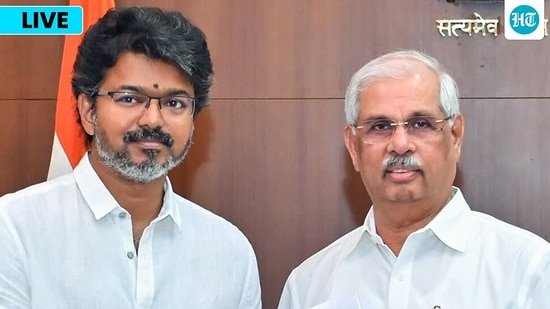
Tamil Nadu CM oath ceremony LIVE: Vijay to visit VCK HQ today as suspense over TVK's power bid enters Day 4
# TN Govt Suspense: Vijay Meets VCK for Majority
By Special Correspondent, The India Observer, May 09, 2026
**Chennai, May 9, 2026:** The political impasse in Tamil Nadu has entered its fourth consecutive day as actor-turned-politician Joseph Vijay’s Tamilaga Vettri Kazhagam (TVK) edges agonizingly close to forming the state government. In the 234-member Tamil Nadu Legislative Assembly, a party or coalition requires exactly 118 seats to cross the halfway mark and claim a simple majority. Currently, the TVK-led alliance stands at a tantalizing 117 Members of the Legislative Assembly (MLAs). To bridge this critical one-seat deficit, Vijay is scheduled to visit the Viduthalai Chiruthaigal Katchi (VCK) headquarters today, seeking a post-poll pact. This cliffhanger marks a historic potential end to the five-decade dominance of traditional Dravidian parties, pending today’s pivotal negotiations [Source: Hindustan Times].
## The Magic Number: Chasing 118 in a Divided House
The 2026 Tamil Nadu Assembly elections have produced one of the most fractured mandates in the state’s modern history, fundamentally altering its political geography. The TVK, contesting its first-ever assembly election, secured an unprecedented 105 seats independently, sweeping the northern and western belts while making significant inroads in the southern districts. Allied with the Communist Party of India (CPI), which secured 7 seats, and a coalition of smaller regional outfits contributing 5 seats, the TVK alliance’s total tally currently rests at 117 [Source: Public Election Commission Data].
Conversely, the opposition benches are heavily splintered but formidable in their collective numbers. The outgoing Dravida Munnetra Kazhagam (DMK) managed to retain 60 seats, while the All India Anna Dravida Munnetra Kazhagam (AIADMK) secured 50. The Bharatiya Janata Party (BJP) secured 2 seats, and the Viduthalai Chiruthaigal Katchi (VCK) emerged victorious in 5 constituencies.
Because the TVK coalition is exactly one seat short of the 118-seat threshold needed to form a government, the 5 seats held by the VCK have become the most valuable real estate in Tamil Nadu politics. The suspense surrounding government formation hinges entirely on whether the VCK will extend unconditional support, demand a coalition government, or abstain from the floor test altogether.
## The Decisive Meeting at VCK Headquarters
In a move that underscores the urgency of the situation, TVK founder Joseph Vijay is slated to visit the VCK headquarters in Ashok Nagar, Chennai, later today. Political observers note that it is highly unusual for a Chief Ministerial candidate of the single-largest party to personally visit the headquarters of a smaller regional party, signaling Vijay’s pragmatic approach and his determination to break the political deadlock.
Thousands of TVK and VCK cadres have already begun gathering near the Ashok Nagar office, prompting the Greater Chennai Police to deploy heavy security, including Rapid Action Force (RAF) personnel, to maintain order.
The VCK, led by Thol. Thirumavalavan, historically aligned with the DMK-led Secular Progressive Alliance. However, the party contested the 2026 elections independently following disagreements over seat-sharing during the pre-poll phase. This independence has now positioned Thirumavalavan as the ultimate kingmaker. Sources close to the VCK leadership suggest that the party is unlikely to offer unconditional support and may demand significant concessions, potentially including cabinet berths focused on social welfare and education, or even the Deputy Chief Minister post.
## Day 4 of Political Paralysis
As the suspense enters its fourth day, the administrative machinery in Fort St. George—the seat of the Tamil Nadu government—remains in a state of suspended animation. Bureaucrats and department heads are awaiting clarity before initiating new projects or releasing funds for ongoing welfare schemes.
At Raj Bhavan, the Governor has maintained a constitutionally prudent silence. Under the established guidelines of the Sarkaria Commission and subsequent Supreme Court rulings, the Governor is bound to invite the leader of the single-largest party or pre-poll alliance to form the government. However, because the TVK alliance officially possesses 117 letters of support, falling one short of a majority, the Governor has granted the parties a brief window to solidify their numbers before calling for a formal swearing-in ceremony and subsequent floor test.
Legal experts point out that if Vijay fails to secure VCK’s support, the state could face a constitutional crisis. “If the TVK stakes a claim with 117 MLAs, they will be given a mandate to prove their majority on the floor of the house within a stipulated timeframe, usually 7 to 14 days,” explains Dr. V. Ramanathan, a Chennai-based political scientist and constitutional law expert. “The danger is the potential for horse-trading, which the anti-defection law aims to prevent, but which remains a reality in fractured mandates.”
## Breaking the Duopoly: TVK’s Journey to the Brink of Power
The fact that TVK is on the verge of forming the government is a watershed moment in Indian politics. Since 1967, Tamil Nadu has been exclusively ruled by either the DMK or the AIADMK. Vijay, who officially launched his party in February 2024, explicitly targeted this duopoly, framing his political narrative around “secular social justice,” anti-corruption, and administrative efficiency [Source: Public Political Records 2024-2026].
During his first major state-level conference in Vikravandi in late 2024, Vijay laid down the ideological framework of his party, borrowing from the tenets of Periyar E. V. Ramasamy, K. Kamaraj, and B. R. Ambedkar, while simultaneously distancing himself from the established Dravidian parties. His grassroots mobilization over the past two years heavily leveraged his massive fan base, converting fan clubs into disciplined political cadres.
The 2026 election results indicate a massive generational shift. Exit polls and post-poll data reveal that first-time voters, women, and urban youth overwhelmingly backed the TVK, disillusioned by the incumbency of the DMK and the internal fragmentation of the AIADMK.
## Ideological Synergy: Can TVK and VCK Work Together?
The prospective alliance between the TVK and the VCK is not merely a marriage of convenience; it holds substantial ideological weight. The VCK is Tamil Nadu’s most prominent Dalit political organization, deeply committed to the annihilation of caste and the empowerment of marginalized communities.
Vijay’s repeated emphasis on Ambedkarite principles during his campaign trail provides a natural ideological bridge between the two parties. In his election manifesto, Vijay promised proportional representation in government contracts, stricter enforcement of the SC/ST (Prevention of Atrocities) Act, and massive educational subsidies for first-generation learners—all key demands that the VCK has historically championed.
“An alliance between TVK and VCK could fundamentally realign the social engineering of Tamil Nadu,” notes Dr. Ramanathan. “While the traditional Dravidian parties relied on a consolidation of intermediate castes, a TVK-VCK-CPI coalition represents a distinct socio-political block comprising the youth, marginalized communities, and left-leaning secular voters. If they finalize this pact, it won’t just be about forming a government; it will be about establishing a new political equilibrium.”
## Economic and Administrative Implications
The ongoing political uncertainty has not gone unnoticed by the markets and the industrial sector. Tamil Nadu is India’s second-largest state economy and a critical hub for automotive, textile, and electronics manufacturing. Both domestic conglomerates and foreign direct investors are closely monitoring the situation in Chennai.
Industry leaders have expressed a desperate need for a stable government. The outgoing administration had signed numerous Memorandums of Understanding (MoUs) during the Global Investors Meet, many of which require swift executive action to materialize into operational factories and job creation.
Should the TVK form the government with VCK support, the immediate challenge for Vijay will be transitioning from a charismatic outsider to a grounded administrator. Managing a coalition government requires intense negotiation skills and compromises, traits that run counter to the decisive, single-leader image projected during the campaign. Furthermore, the state’s public debt, which hovered around alarming levels pre-election, will require deft financial management—a portfolio that will demand an experienced and steady hand in the new cabinet.
## Future Scenarios and the Floor Test Dynamics
As the clock ticks on Day 4, there are three primary scenarios that could unfold following today’s high-stakes meeting:
**Scenario 1: Active Coalition**
The VCK agrees to join the government in exchange for cabinet positions. They submit letters of support to the Governor, taking the TVK alliance tally to a comfortable 122 seats (well past the 118 mark). Vijay is sworn in as Chief Minister within 48 hours and easily clears the subsequent floor test.
**Scenario 2: Outside Support**
The VCK provides “issue-based outside support.” They do not join the cabinet but vote in favor of the TVK during the floor test and subsequent confidence motions. This allows Vijay to form a minority government, though it leaves his administration perpetually vulnerable to VCK’s political leverage.
**Scenario 3: Strategic Abstention**
If negotiations fail, the VCK could choose to abstain from the floor test. Interestingly, parliamentary mathematics means this still favors the TVK. If the 5 VCK MLAs abstain, the effective strength of the house drops from 234 to 229. The new majority mark would be 115. With 117 MLAs, the TVK would still win the trust vote and form the government, albeit a highly precarious one.
## Conclusion
The political landscape of Tamil Nadu is holding its breath. The outcome of today’s meeting at the VCK headquarters will do more than just decide the immediate formation of a government; it will dictate the trajectory of Tamil Nadu politics for the next decade.
Joseph Vijay stands on the precipice of achieving what veteran actors like Sivaji Ganesan and Vijayakanth attempted but could not fully realize: capturing the ultimate seat of power in Fort St. George. As the TVK seeks to secure its crucial 118th vote, the citizens of Tamil Nadu remain glued to their screens, waiting to see if a new era of coalition politics will dawn over the southern state.





