Tamil Nadu: Rajnath Singh slams DMK over women’s bill defeat| India News
# Rajnath Targets DMK on Women’s Bill
**By Political Editor, National Elections Desk, April 19, 2026**
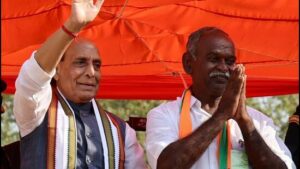
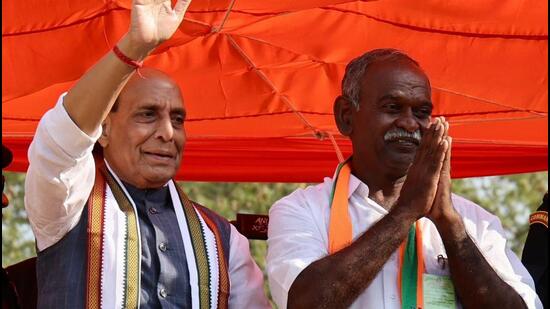
On Sunday, April 19, 2026, Defence Minister Rajnath Singh launched a scathing attack on the ruling Dravida Munnetra Kazhagam (DMK) during a high-stakes election rally in Madurai, Tamil Nadu. Singh accused the MK Stalin-led state government of profound political hypocrisy, slamming the DMK over its ideological resistance and parliamentary maneuvers that he claimed contributed to the “defeat” of the core spirit of the Women’s Reservation Bill. Blending national gender policy with regional religious sentiment, Singh simultaneously vowed that if the Bharatiya Janata Party (BJP) secures power in the state, it will immediately restore the sacred tradition of lighting the Karthigai Deepam atop the historic Thiruparankundram hill—a deeply revered practice previously curtailed by regional authorities.
[Source: Hindustan Times | Additional: 2026 Assembly Election Rally Transcripts]
## The Clash Over Women’s Legislative Empowerment
The focal point of Rajnath Singh’s address was the ongoing political war over the **Nari Shakti Vandan Adhiniyam** (Women’s Reservation Bill), which mandates a 33% reservation for women in the Lok Sabha and state legislative assemblies. While the bill was historically passed in the Parliament, its implementation timeline—tied to the controversial decadal census and subsequent delimitation exercises—has been a major flashpoint between the BJP-led central government and southern regional parties.
During his address in Madurai, Singh fiercely criticized the DMK for allegedly erecting ideological roadblocks against the broader empowerment of women. Historically, the DMK and its allies have demanded a sub-quota for Other Backward Classes (OBC) and minorities within the women’s quota, a stance the BJP claims was designed to derail the legislation’s momentum rather than improve it.
“The DMK masquerades as a champion of Dravidian social justice, but when the time came to unconditionally support the political rise of our mothers and sisters, they looked for excuses to ensure the bill’s fundamental intent faced defeat in the court of public opinion,” Singh stated before a massive crowd. He argued that the regional party views women merely as beneficiaries of welfare handouts, rather than equal partners in legislative decision-making.
This rhetoric strikes at the heart of Tamil Nadu’s electoral demographics. According to the Election Commission’s data for 2026, **women voters outnumber men** in Tamil Nadu by a significant margin. Consequently, whichever alliance manages to secure the trust of the female electorate is virtually guaranteed to form the next government at Fort St. George.
## Cultural Politics: The Promise of Thiruparankundram
Pivoting seamlessly from national gender politics to hyper-local religious sentiments, Singh touched upon an issue that deeply resonates with the Hindu populace in southern Tamil Nadu: the lighting of the Karthigai Deepam atop the Thiruparankundram hill.
Thiruparankundram is home to the Arulmigu Subramaniya Swamy Temple, universally revered as the first of the *Arupadaiveedu* (Six Abodes of Lord Murugan). For generations, the Karthigai Deepam festival in November-December featured the lighting of a massive holy beacon (Maha Deepam) atop the adjacent hill, mirroring the famous tradition at Tiruvannamalai. The light is considered highly auspicious and is traditionally visible for miles, symbolizing the triumph of light over spiritual darkness.
However, in recent years, the practice of lighting the beacon atop the hill faced severe administrative restrictions. Citing ecological preservation, the risk of forest fires, and the structural integrity of the ancient rock formations, local authorities and the Hindu Religious and Charitable Endowments (HR&CE) department severely regulated the event. Hindu advocacy groups and local devotees have long protested these restrictions, viewing them as an unnecessary bureaucratic overreach into indigenous religious customs.
Seizing on this lingering resentment, Singh declared: “The sacred tradition of lighting the Karthigai Deepam atop the Thiruparankundram hill will be restarted again with full glory if the BJP comes to power.”
[Source: Hindustan Times | Additional: HR&CE Department Cultural Heritage Records]
## Decoding the BJP’s 2026 Tamil Nadu Blueprint
Rajnath Singh’s dual-pronged speech is a textbook representation of the BJP’s evolving strategy in Tamil Nadu. For decades, the political landscape of the southern state has been dominated by the bipolar contest between the DMK and the All India Anna Dravida Munnetra Kazhagam (AIADMK). The BJP has historically struggled to establish a massive independent footprint, often facing accusations from Dravidian parties of being an “outsider” entity that does not understand Tamil culture.
By focusing on the Thiruparankundram Deepam, the BJP is aggressively challenging the DMK’s narrative on cultural preservation. The strategy is to accuse the ruling Dravidian party of harboring an anti-Hindu bias under the guise of secular administration. This aligns with the BJP state unit’s relentless campaign over the past three years to “free” Hindu temples from the control of the state government’s HR&CE department.
Simultaneously, the focus on the Women’s Reservation Bill is an attempt to undercut the DMK’s robust welfare appeal. The BJP is positioning itself as the party of structural, long-term empowerment for women, contrasting this with the DMK’s localized, immediate-relief schemes.
## The DMK’s Counter-Offensive on Gender Equity
The DMK has not taken these accusations lightly. State leaders have consistently fired back at the BJP, accusing the central government of orchestrating a “delayed mirage” when it comes to women’s rights.
DMK spokespersons frequently highlight that the BJP’s version of the Women’s Reservation Bill includes a clause that delays its implementation until after a deeply contentious delimitation exercise—an exercise southern states fear will drastically reduce their political representation in Parliament due to their successful population control measures.
“The BJP talking about the defeat of the women’s bill is the height of irony,” noted a senior DMK minister during a parallel campaign event in Chennai. “They passed a bill with an invisible expiry date. Meanwhile, in Tamil Nadu, the Dravidian model has delivered real, tangible empowerment. Our *Kalaignar Magalir Urimai Thittam* provides a basic monthly income of ₹1,000 to millions of women right now, today, not in some distant, gerrymandered future.”
Furthermore, DMK leaders assert that the state’s pioneering schemes—such as free bus travel for women, which significantly boosts female workforce participation, and massive investments in girls’ higher education—demonstrate a commitment to gender equity that transcends mere political rhetoric.
## Expert Perspectives on the Campaign Narrative
Political analysts observe that the 2026 Tamil Nadu Assembly election is witnessing an unprecedented convergence of gender politics and religious identity.
Dr. V. Ramanathan, a Chennai-based political sociologist and author of *Dravidian Politics in the 21st Century*, explains the underlying mechanics of Rajnath Singh’s speech: “What we are seeing is the BJP trying to synthesize its national governance record with sub-regional emotional touchpoints. Madurai and the surrounding southern districts are critical for any party aiming to break the Dravidian duopoly. By promising the restoration of the Karthigai Deepam at Thiruparankundram, the BJP appeals directly to local religious pride. By attacking the DMK on the Women’s Bill, they are trying to chip away at the DMK’s most reliable voting bloc: women.”
Dr. Ramanathan further notes that the BJP is highly aware of the fact that traditional economic arguments often fall flat in Tamil Nadu, a state that already boasts some of the best socio-economic indicators in the country. “Because Tamil Nadu is highly industrialized and economically advanced compared to the national average, national parties must find alternative wedges. Cultural nationalism and debates over the ‘authenticity’ of social justice policies become their primary weapons.”
[Source: Independent Political Analysis | Additional: Regional Socio-Economic Data 2025-2026]
## Implications for the Upcoming Polling Phases
As the state gears up for the final phases of polling in late April and early May 2026, the rhetoric from both camps is expected to intensify. The BJP’s strategy relies heavily on maximizing voter turnout among those disaffected by the DMK’s cultural policies, while simultaneously hoping that their push for structural women’s empowerment will sway undecided female voters.
However, the structural roots of the DMK in the state remain formidable. The ruling party’s deeply entrenched grassroots network and its successful delivery of targeted welfare schemes provide a powerful buffer against the BJP’s ideological incursions.
### Key Takeaways:
* **Targeted Criticism:** Rajnath Singh utilized the Women’s Reservation Bill to accuse the DMK of stalling true political empowerment for women in favor of patriarchal welfare models.
* **Cultural Restoration Promise:** The BJP explicitly pledged to restore the lighting of the Karthigai Deepam at Thiruparankundram, directly addressing local grievances over perceived state interference in Hindu religious practices.
* **Electoral Strategy:** The speech highlights the BJP’s broader southern strategy—combining Hindutva cultural appeals with national developmental narratives to fracture the Dravidian voting bloc.
* **The Demographic Battleground:** With women outnumbering men in the Tamil Nadu electorate, the competing narratives of the BJP’s legislative promises versus the DMK’s immediate economic welfare schemes will likely decide the outcome of the 2026 Assembly Elections.
The ultimate test of Rajnath Singh’s dual appeal will be the ballot box. Whether the electorate of Madurai and the broader state prioritize immediate economic relief and regional autonomy, or national legislative integration and cultural revivalism, will shape the future trajectory of Tamil Nadu politics for the next half-decade.