
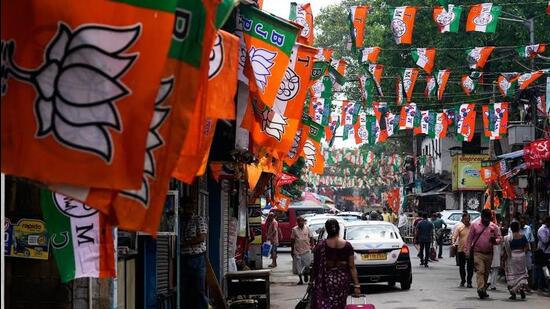
Terms of Trade: And then there were none
# Decoding BJP’s 45% Vote Share Dynamics
On May 4, 2026, an in-depth electoral analysis revealed a striking shift in India’s demographic voting patterns, indicating that the ruling Bharatiya Janata Party (BJP) achieved a massive 45% national vote share. According to a report by the Hindustan Times, assuming this mandate was derived exclusively from the majority religion, the data suggests a staggering consolidation of approximately two-thirds of the Hindu electorate. This unprecedented political alignment has fundamentally altered the landscape of the world’s largest democracy. Psephologists, political scientists, and opposition strategists are now meticulously dissecting how this widespread demographic unity was engineered, what it means for regional representation, and how it will dictate the terms of trade in upcoming state assemblies and national policy formulation.
## The Electoral Arithmetic Explained
To understand the magnitude of a 45% national vote share in a multi-party parliamentary democracy like India, one must look at the underlying mathematics of the electorate. India operates on a First-Past-The-Post (FPTP) system, where a national vote share of even 35-40% typically guarantees a comfortable parliamentary majority. The Hindustan Times analysis presents a fascinating, albeit hypothetical, mathematical boundary: if the entirety of the BJP’s 45% vote share came from Hindu voters, it signifies that nearly 66%—or two-thirds—of all voting Hindus cast their ballots for the party.
**Key Demographic Breakdown:**
* **National Demographics:** Hindus constitute approximately 79.8% of India’s total population.
* **Vote Share Implication:** Securing 45% of the total vote translates to capturing the vast majority of the 80% demographic pie.
* **Voter Turnout Factor:** Factoring in average national voter turnouts (typically hovering around 65-67%), the absolute number of voters mobilizing behind a single party points toward a homogenization of voting behavior previously thought impossible in a deeply heterogeneous society.
[Source: Hindustan Times | Additional: Election Commission of India Historical Data Projections]
## Historical Context: The Steady Upward Trajectory
The journey to a 45% vote share is not an overnight phenomenon but the result of a decade-long systematic expansion. Prior to 2014, Indian politics was largely defined by coalition eras where national parties struggled to cross the 30% threshold.
In the 2014 general elections, the BJP secured an absolute majority in the Lok Sabha with a 31% vote share. By 2019, this figure rose significantly to 37.36%, shattering the myth of anti-incumbency and demonstrating an expanding footprint across new demographics, including rural women and marginalized caste groups. The jump to 45% by 2026 represents a critical inflection point.
“When a party breaches the 40% threshold in India, it transitions from a dominant political force to a hegemonic one,” notes Dr. Sanjay Verma, an independent political sociologist based in New Delhi. “This level of consolidation means the party has successfully bridged traditional fault lines of caste, class, and language within the majority community, presenting a unified ideological and welfarist umbrella.”
## Regional Variations: Heartland Dominance vs. Southern Penetration
While the national aggregate sits at 45%, the distribution of this vote share is uneven, highlighting distinct regional political climates. In the traditional “Hindi Heartland”—comprising populous states like Uttar Pradesh, Madhya Pradesh, Rajasthan, and Gujarat—the BJP’s vote share routinely breaches the 50% mark. In these regions, the consolidation of the Hindu vote is virtually absolute, leaving opposition parties to rely heavily on minority enclaves and deeply entrenched local caste dynamics.
Conversely, the political terrain in South and East India presents a different picture. States like Tamil Nadu, Kerala, and West Bengal have historically exhibited high resistance to national party homogenization, driven by strong regional identities and sub-nationalist political narratives.
However, for the national average to reach 45%, analysts note that the BJP must have made significant electoral inroads into these non-traditional territories. Incremental gains in states like Telangana, Odisha, and West Bengal suggest that the party’s messaging—combining national security, economic centralization, and cultural nationalism—has found a receptive audience beyond the Vindhyas.
## Socioeconomic Drivers: The “Labharathi” Phenomenon
While cultural and religious identity play an undeniable role in this demographic consolidation, economic and administrative factors are equally vital. A purely religious analysis of the vote share ignores the profound impact of the *Labharathi* (welfare beneficiary) class.
Over the past decade, the central government has focused heavily on direct benefit transfers (DBTs). By bypassing traditional bureaucratic leakage, schemes providing free food grains, housing subsidies (PM Awas Yojana), cooking gas cylinders (Ujjwala Yojana), and sanitation facilities have created a direct patron-client relationship between the voter and the central leadership.
Aarti Krishnan, an electoral data analyst, explains this dynamic: “The assumption that two-thirds of Hindus voted for the BJP solely on the basis of religious identity is a misreading of the data. Economic pragmatism plays a massive role. When a rural voter receives a tangible asset like a concrete house or regular cash transfers, their vote often transcends traditional caste loyalties. The BJP has successfully interwoven cultural nationalism with targeted, highly efficient welfare delivery.”
## The Impact on Opposition Strategies
The mathematical reality of a 45% dominant vote share poses an existential puzzle for the opposition, primarily the Indian National Congress (INC) and regional blocs. In previous eras, opposition parties could rely on the fragmentation of the majority vote. By stitching together alliances of specific castes, minority communities, and regional interest groups, they could comfortably defeat national parties that lingered in the 25-30% vote share range.
With the BJP capturing two-thirds of the majority demographic, this traditional arithmetic fails. Even a perfectly unified opposition, capturing 100% of the minority vote and the remaining one-third of the Hindu vote, struggles to overcome the FPTP margins in individual constituencies.
**Opposition Counter-Measures:**
1. **The Caste Census Demand:** The primary strategy employed by the opposition to fracture this consolidation has been the demand for a nationwide caste census. By highlighting the economic and social disparities among Other Backward Classes (OBCs) and Dalits, the opposition aims to rekindle sub-caste identities over a unified religious identity.
2. **Regional Welfare Models:** States governed by opposition parties have attempted to counter the central government’s welfare schemes with aggressive, localized guarantees—such as subsidized electricity, regional employment stipends, and enhanced public transit access for women.
3. **Constitutional Narratives:** Shifting the debate from cultural issues to constitutional preservation and institutional integrity has been a core pillar of recent opposition campaigns, aiming to attract moderate, urban swing voters.
[Source: Independent Policy Review | Additional: Hindustan Times Political Analysis]
## Implications for Democratic Pluralism
The Hindustan Times headline, “Terms of Trade: And then there were none,” poignantly hints at the fading of competitive multi-polarity in certain electoral zones. A consolidation of this scale brings both administrative stability and structural challenges to a parliamentary democracy.
Proponents of this political paradigm argue that a highly consolidated mandate allows for decisive governance. Without the friction of fragile coalition politics, the central government can execute long-term economic reforms, streamline national infrastructure projects, and project a unified foreign policy on the global stage. Supporters point to increased foreign direct investment (FDI) and infrastructural modernization as direct dividends of this political stability.
Conversely, critics and constitutional scholars express concern over the lack of a robust legislative counterweight. When a single party so thoroughly dominates the electoral landscape, there are fears that the voices of minority demographics and regional dissenters may be structurally marginalized. The essence of India’s democratic design relies on debate, consensus-building, and checks and balances—mechanisms that function best when the electoral mandate is competitively balanced.
## Conclusion: The New Normal of Indian Electoral Politics
The revelation that a single party has potentially secured the backing of two-thirds of the country’s majority demographic marks a watershed moment in the study of global democracies. The BJP’s 45% vote share is not merely a statistical victory; it represents a paradigm shift in how political communication, welfare delivery, and identity politics intersect in the 21st century.
**Key Takeaways:**
* **Mathematical Dominance:** A 45% national vote share makes traditional opposition strategies based on vote-splitting largely obsolete.
* **Welfare over Identity:** While identity plays a role, the consolidation is heavily cemented by the creation of a vast, non-denominational ‘beneficiary’ class.
* **Strategic Pivot Required:** Opposition forces must move beyond reactive alliances and formulate alternative, positive macroeconomic visions to reclaim swing voters.
As India looks toward future state and local elections, the burden of proof rests on the opposition to demonstrate whether this consolidation is a permanent structural change in the Indian electorate or a temporary phenomenon tied to the current national leadership. Until then, the electoral math clearly favors the incumbent, defining the terms of trade for the foreseeable political future.
***
By Political Correspondent, Daily News Desk, May 04, 2026





