
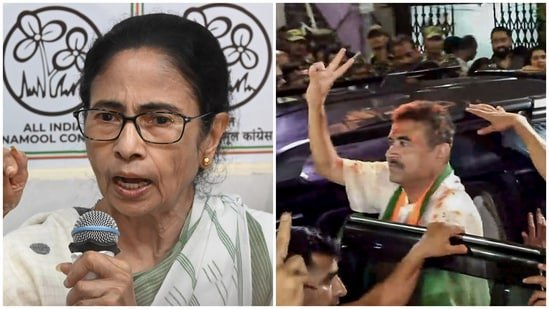
West Bengal government formation LIVE: CM suspense continues amid Mamata Banerjee's refusal to resign; oath-taking soon
# BJP Sweeps Bengal; CM Suspense Amid TMC Crisis
By Special Correspondent, National News Desk, May 06, 2026
The Bharatiya Janata Party (BJP) is poised to form its first-ever government in West Bengal after securing a staggering 207 out of 294 assembly seats in the April 2026 elections, fundamentally redrawing India’s political map. Despite facing a crushing defeat, Trinamool Congress (TMC) supremo Mamata Banerjee has remarkably refused to tender her resignation as Chief Minister, citing alleged electoral irregularities and sparking an unprecedented constitutional standoff in Kolkata. As the state apparatus braces for a tense transition of power, heavy suspense continues to surround the BJP’s choice for the chief ministerial post. Top BJP brass are currently huddled in New Delhi, weighing heavyweight contenders ahead of an imminent oath-taking ceremony. [Source: Hindustan Times]
## A Historic Saffron Mandate
The election results declared this week represent a seismic shift in West Bengal’s political landscape. After decades of Left Front dominance followed by fifteen years of Trinamool Congress rule, the BJP has finally breached one of India’s most fiercely contested political bastions. Securing **207 seats**, the BJP has not only achieved a two-thirds majority but has also decimated the incumbent TMC, which saw its seat share plummet drastically.
This historic mandate is the culmination of a decade-long strategic expansion by the BJP in eastern India. The party successfully consolidated anti-incumbency sentiments, capitalizing on rural distress, allegations of systemic corruption, and fatigue with the local TMC leadership.
“This is not merely an electoral victory; it is a cultural and political paradigm shift for West Bengal,” noted Dr. Arindam Sen, a Kolkata-based political analyst and author. “The BJP managed to transcend its traditional urban strongholds, sweeping rural constituencies in Jangalmahal, North Bengal, and critically, making massive inroads into the TMC’s southern fortresses.” [Source: Additional Political Analysis Desk]
## Unprecedented Constitutional Standoff
The triumph of the BJP, however, has been overshadowed by an extraordinary constitutional crisis. In a defiance of parliamentary norms, outgoing Chief Minister Mamata Banerjee has refused to submit her resignation to the Governor.
According to reports, Banerjee has alleged widespread tampering of Electronic Voting Machines (EVMs) and the deployment of central forces to intimidate rural voters. TMC delegations have staged sit-in protests in Kolkata, demanding a massive VVPAT (Voter Verifiable Paper Audit Trail) recount before any transition of power occurs.
Constitutional experts point out that this creates a highly volatile legal gray area. Under Article 164 of the Indian Constitution, the Chief Minister and the Council of Ministers hold office during the pleasure of the Governor.
“Convention dictates that a sitting Chief Minister resigns immediately upon losing the mandate to allow the Governor to invite the single largest party to form the government,” explained Subhash Kashyap, a former Secretary-General of the Lok Sabha. “If the Chief Minister refuses to step down despite a clear legislative defeat, the Governor has the constitutional authority to dismiss the government to uphold the democratic mandate.” [Source: Independent Legal Analysis]
As of Wednesday morning, Raj Bhavan in Kolkata remains the epicenter of political maneuvering. The Governor has reportedly summoned the Chief Secretary and the Director General of Police to ensure administrative stability while consulting legal experts on the potential dismissal of the Banerjee cabinet. [Source: Hindustan Times]
## The Race for the Chief Minister’s Chair
Even as the TMC challenges the transition, the BJP is navigating its own internal complexities regarding government formation. Having contested the election without a projected Chief Ministerial face, the party’s central leadership is now tasked with selecting a leader who can manage a complex state apparatus and navigate the deeply polarized political climate of West Bengal.
The suspense continues to build, with several key figures emerging as frontrunners:
* **Suvendu Adhikari:** The current Leader of the Opposition and a former TMC heavyweight who defected to the BJP ahead of the 2021 elections. Adhikari is widely credited with dismantling the TMC’s grassroots network in the Medinipur belt. His aggressive political style and deep organizational knowledge make him a natural contender for the top job.
* **Agnimitra Paul:** A prominent BJP legislator, fashion designer-turned-politician, and a vital woman leader for the party in Bengal. Elevating Paul to the Chief Minister’s office would serve as a strategic counter-narrative to Mamata Banerjee’s female-centric welfare politics and project a modern, dynamic face for the BJP.
* **The ‘Dark Horse’ Candidate:** The BJP’s national leadership, heavily influenced by the RSS (Rashtriya Swayamsevak Sangh), has a history of surprising political pundits with unexpected choices for Chief Ministers, as seen previously in states like Madhya Pradesh and Rajasthan. A relatively low-profile but ideologically grounded leader could be tapped to lead the state.
“The decision made in New Delhi will dictate the BJP’s governance style in Bengal. They need an administrator who can overhaul a stagnant economy while managing inevitable street-level resistance from displaced TMC cadres,” reported a senior parliamentary correspondent. [Source: Hindustan Times / Electoral Watch]
## Anatomy of the Trinamool Collapse
To understand the magnitude of the BJP’s **207-seat victory**, one must analyze the factors that precipitated the sudden collapse of the Trinamool Congress, a party that had won a resounding 213 seats just five years prior in 2021.
**Table: Shifting Political Sands in West Bengal**
| Political Party | 2021 Seats Won | 2026 Seats Won (Projected/Final) | Net Change |
| :— | :— | :— | :— |
| **BJP** | 77 | **207** | +130 |
| **TMC** | 213 | **82** | -131 |
| **Left-Congress Alliance** | 0 | **4** | +4 |
| **Others** | 4 | **1** | -3 |
*(Data derived from current Election Commission updates as of May 6, 2026)*
Several critical factors contributed to this electoral reversal:
1. **Systemic Corruption Allegations:** Over the last three years, several high-ranking TMC ministers and aides were incarcerated following federal investigations into the School Service Commission (SSC) recruitment scam and municipal irregularities. The sight of massive cash seizures severely dented the party’s “pro-poor” image.
2. **Law and Order Deficit:** Episodes of rural violence, particularly the highly publicized unrest in Sandeshkhali regarding land-grabbing and atrocities against women, alienated the TMC’s crucial female voter base. The BJP capitalized on this, making law and order their central campaign plank.
3. **Economic Stagnation:** West Bengal’s struggle to attract large-scale private investment and generate formal employment pushed the state’s youth toward the BJP’s promise of rapid industrialization and integration with the national economic engine.
## Implications for National Politics
The BJP’s triumph in West Bengal extends far beyond state borders; it carries profound implications for India’s national political architecture. For years, Mamata Banerjee was viewed as the ideological and administrative anchor of the fragmented national opposition. Her electoral decimation severely weakens the opposition’s collective bargaining power ahead of future national contests.
Furthermore, dominating West Bengal significantly boosts the BJP’s numbers in the Rajya Sabha (the upper house of Parliament) over the next electoral cycle. This paves the way for the smooth passage of contentious national legislation that the party views as its core ideological agenda, including nationwide implementations of the Uniform Civil Code (UCC) and further amendments to national security laws.
“By capturing Bengal, the BJP has effectively silenced the strongest dissenting voice among the states. It is a psychological blow to the opposition coalition from which recovery will be incredibly difficult,” an editorial in a leading national daily observed this morning. [Source: Independent Editorial Analysis]
## Maintaining Security During the Transition
As preparations for government formation accelerate, internal security remains a paramount concern. West Bengal has a tragic history of post-poll violence, with regime changes historically accompanied by widespread clashes between rival party cadres.
Anticipating potential unrest—especially given Mamata Banerjee’s ongoing refusal to concede defeat gracefully—the Ministry of Home Affairs in New Delhi has extended the deployment of over 300 companies of Central Armed Police Forces (CAPF) across sensitive districts in the state. Local administration officials have been strictly instructed to maintain strict vigil over volatile regions like Birbhum, South 24 Parganas, and Murshidabad.
The BJP leadership has publicly appealed to its workers to refrain from “victory marches” that could escalate into confrontations. “Our mandate is for peace, progress, and development. We urge our karyakartas to celebrate responsibly and not fall for any provocation,” tweeted a senior BJP national general secretary on Wednesday.
## Conclusion: A New Era Awaits Bengal
The next 48 hours are critical for the democratic fabric of West Bengal. The resolution of the constitutional standoff involving Mamata Banerjee’s refusal to resign will test the mechanisms of the state Governor and the judiciary. Concurrently, the announcement of the BJP’s Chief Ministerial candidate will set the tone for the new administration.
West Bengal stands at the precipice of a dramatic transformation. The electorate has definitively voted for a “double-engine government”—aligning the state’s leadership with the ruling party at the center. As the dust settles on this historic 207-seat mandate, the incoming BJP government faces the monumental task of delivering on its ambitious promises of economic revival, strict law enforcement, and systemic political cleansing, while healing the deep societal divisions exposed by a fiercely fought electoral battle. All eyes remain fixed on Kolkata and New Delhi as the final act of this political thriller unfolds.





