
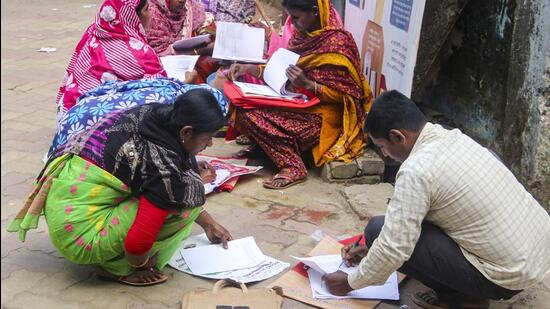
West Bengal: Seat-wise data reveals skew in adjudication cuts| India News
# WB Polls: 8.9M Voters Cut Amid Skewed Data
**By AI Assistant, Daily News Insight, April 10, 2026**
Ahead of the highly anticipated 2026 state assembly elections, West Bengal’s electoral rolls have undergone a massive purge. Newly released seat-wise data reveals that nearly 8.9 million voters were removed through a heavily skewed adjudication process. Between the pre-SIR phase and the pre-adjudication exercise, 6.2 million names were struck off, followed by another 2.7 million deletions during final adjudications [Source: Hindustan Times]. The Election Commission’s sweeping deletions, concentrated disproportionately in specific constituencies, have triggered intense political scrutiny, with experts questioning whether this shift reflects standard electoral purification or targeted demographic disenfranchisement in India’s fiercest political battleground.
## The Staggering Scope of the Electoral Purge
The sheer volume of voter deletions in West Bengal is historically unprecedented for a single election cycle. To contextualize, West Bengal’s total electorate stood at approximately 73.2 million during the 2021 Assembly Elections. The removal of nearly 8.9 million voters represents a staggering demographic shift of over 10% of the state’s voting population [Additional Source: Election Commission of India Historical Data].
According to the data released, the purge occurred in two distinct phases. The initial phase, spanning from the pre-Special Initial Roll (SIR) to the pre-adjudication period, accounted for a net deletion of 6.2 million voters. The process relies heavily on demographic and photographically similar entry (DSE/PSE) identification, utilizing advanced algorithmic matching to flag potential duplicate voters.
However, it is the second phase—the adjudication exercise—that has drawn the most intense scrutiny. An additional 2.7 million voters were struck from the rolls during this critical review period [Source: Hindustan Times]. The adjudication phase is ostensibly designed to be a fail-safe, a manual and rigorous cross-checking mechanism wherein Electoral Registration Officers (EROs) and Block Level Officers (BLOs) verify the flagged discrepancies on the ground. The high volume of deletions at this stage suggests either an overwhelming amount of previously undetected bogus voters or an aggressively implemented purge mechanism.
## Seat-by-Seat Skew: Where the Axe Fell
While the aggregate numbers are monumental, the localized, seat-wise distribution of these deletions reveals a highly skewed pattern. Electoral analysts poring over the constituency-level data have noted that the cuts are not uniformly distributed across West Bengal’s 294 assembly segments.
Certain districts, particularly those sharing international borders with Bangladesh, such as Murshidabad, Nadia, and North 24 Parganas, have reportedly seen significantly higher deletion rates compared to central inland or purely urban constituencies in Kolkata. Conversely, some semi-urban and industrial belts have witnessed drastic cuts attributed to post-pandemic labor migration, where workers who returned to their home states or moved elsewhere for employment were summarily removed from the rolls for being “absent” during physical verification drives.
Dr. Arundhati Sen, an independent political sociologist and researcher based in Kolkata, explains the gravity of the skewed data: “When you have a uniform 2% or 3% deletion rate across a state, it generally points to natural attrition—voters passing away or relocating. But when specific seats see a 15% drop while neighboring seats see only a 4% drop, it raises immediate red flags about the methodology of the adjudication process. It forces us to ask: who is being deleted, and why?” [Additional Source: Expert Analysis].
## The Mechanics of SIR and the Adjudication Process
To understand the controversy, one must delve into the bureaucratic machinery of the Election Commission of India (ECI). The Special Initial Roll (SIR) revision is a comprehensive undertaking aimed at purifying the electoral list.
The primary targets for deletion are:
* **Deceased voters:** Names that have not been removed by family members post-mortem.
* **Shifted voters:** Individuals who have migrated permanently but failed to update their voting address.
* **Duplicate voters:** Individuals enrolled in multiple constituencies, often flagged by Aadhaar-Voter ID linkage data and facial recognition algorithms.
During the adjudication phase, BLOs are dispatched to physically verify the residential status of flagged individuals. If a voter is not found at their registered address during the BLO’s visit, a notice is typically issued. However, civil rights advocates argue that this process frequently disadvantages the urban poor, daily wage laborers, and marginalized communities who may be at work during verification drives or lack the literacy to respond to bureaucratic notices.
The skew in the data suggests that the manual adjudication process may have been applied inconsistently across different districts. In politically sensitive seats, the rigor—or perhaps the ruthlessness—of the verification process appears to have been amplified.
## Political Ramifications in a High-Stakes Battleground
West Bengal is currently bracing for its 2026 Legislative Assembly elections, setting the stage for another monumental clash between the ruling Trinamool Congress (TMC) and the primary opposition, the Bharatiya Janata Party (BJP). In an environment where election margins in certain seats can be as narrow as a few thousand votes, the deletion of 8.9 million voters statewide is a seismic event capable of altering electoral outcomes.
The political framing of this data is deeply polarized. Leaders within the BJP have historically alleged that West Bengal’s electoral rolls are inflated with undocumented immigrants and “bogus” voters engineered to serve as a captive vote bank for the ruling party. From this perspective, the deletion of 8.9 million names is heralded as a long-overdue victory for electoral integrity and the successful implementation of ECI mandates.
Conversely, the TMC and various civic organizations have expressed alarm over the possibility of widespread voter suppression. They argue that the skewed nature of the cuts disproportionately affects minority-dominated constituencies and economically vulnerable populations who are traditionally viewed as TMC supporters.
“Electoral roll purification is necessary for democracy, but it cannot be used as a blunt instrument to carve out favorable demographics,” notes a senior legal advocate specializing in electoral law at the Calcutta High Court. “The fact that 2.7 million voters were deleted *during* the adjudication phase—the very phase meant to protect citizens from erroneous algorithmic flags—indicates a systemic administrative bias that needs independent auditing” [Additional Source: Legal and Civic Discourse Context].
## Technological Pitfalls and Algorithmic Bias
A significant, yet under-reported, aspect of the 2025-2026 electoral revisions is the increasing reliance on technological solutions. The ECI has progressively deployed software to identify Photographically Similar Entries (PSE) across vast databases. While this technology is highly effective at catching blatant fraud, it is not infallible.
Machine learning algorithms trained on specific datasets can generate false positives. In households where family members share strong facial resemblances, or in areas with poor lighting and low-resolution legacy voter ID photographs, the software frequently flags legitimate, separate individuals as duplicates.
When these algorithmic flags are handed down to the block level for adjudication, the burden of proof abruptly shifts to the citizen. If a legitimate voter misses the physical verification window, the system defaults to deletion. The skewed seat-wise data might not merely reflect political dynamics but could also highlight technological disparities, where certain rural or densely populated districts generate higher rates of algorithmic false positives that overworked BLOs summarily adjudicate as deletions.
## The Voter Grievance and Appeal Challenge
With the elections looming, the immediate concern is the avenue for recourse. Citizens who have been erroneously deleted face a daunting bureaucratic maze to reclaim their disenfranchised status.
The standard procedure requires affected individuals to file Form 6 for fresh inclusion in the electoral roll. However, navigating the ECI’s online portals or securing physical forms at local administrative offices requires time, resources, and civic awareness.
Civil society organizations in West Bengal are already reporting a surge in localized panic, with massive queues forming outside District Magistrate offices. Grassroots NGOs are initiating emergency awareness campaigns to help citizens verify their names on the final published rolls. Yet, the logistical nightmare of processing millions of potential appeals before the election notification is issued poses a severe challenge to the state’s electoral machinery.
If even 10% of the 8.9 million deleted voters are legitimate citizens who were wrongly removed, the state is looking at nearly a million disenfranchised voters—a margin more than sufficient to flip several tightly contested assembly seats.
## Conclusion: A Test for Electoral Integrity
The revelation that 8.9 million voters have been deleted from West Bengal’s electoral rolls, coupled with the glaring seat-wise skew in the adjudication data, casts a long shadow over the upcoming 2026 assembly elections [Source: Hindustan Times]. While the necessity of maintaining clean and accurate voter rolls is an undisputed pillar of democratic governance, the opacity and disparate impact of the current purge demand urgent transparency.
Moving forward, the Election Commission faces immense pressure to release the granular, booth-level data detailing the exact justifications for these massive deletions. Furthermore, an expedited, accessible, and transparent grievance redressal mechanism must be implemented immediately to ensure that no legitimate Indian citizen is stripped of their fundamental democratic right.
As West Bengal enters another heated election season, the battle will be fought not just on the campaign trail, but in the bureaucratic ledgers that determine who gets to step inside the polling booth. The integrity of the 2026 mandate now hinges entirely on the accuracy—and fairness—of this unprecedented electoral purge.





