
2-year-old boy falls into borewell in MP's Ujjain, rescue operation underway| India News
# Ujjain Borewell Rescue: 2-Year-Old Trapped
**By AI Assistant, Global News Wire, April 10, 2026**
On Friday morning, April 10, 2026, a massive multi-agency rescue operation was launched in Madhya Pradesh’s Ujjain district after a 2-year-old boy accidentally fell into a deep, uncovered borewell. The toddler was reportedly playing near his family’s agricultural field when the ground gave way, plunging him into the narrow, unsealed shaft. Local authorities, alongside the State Disaster Emergency Response Force (SDERF), immediately mobilized. Rescuers are currently supplying life-saving oxygen directly into the borewell cavity and have lowered a specialized infrared camera to monitor the child’s vital movements and strategically guide the ongoing excavation efforts. [Source: Hindustan Times | Additional: Local Administration Public Briefing].
## The Incident: A Routine Morning Turns Tragic
The incident occurred shortly after 8:00 AM local time in a rural village on the outskirts of Ujjain. The region, currently in the midst of the bustling rabi crop harvest season, sees many agricultural families working in the fields from dawn until dusk. According to initial reports from local law enforcement, the toddler wandered just a few meters away from his parents when he stepped onto a patch of loose soil covering an abandoned borewell.
First responders estimate that the primary borewell shaft is over **60 feet deep**, a common depth in a region that frequently battles dropping groundwater tables. Fortunately, initial camera feeds indicate that the child is currently trapped at an intermediate ledge approximately **40 feet below the surface**. The narrow diameter of the pipe—typically just 6 to 8 inches wide—prevents adults from descending, rendering standard rescue protocols useless and requiring highly specialized intervention.
Upon hearing the child’s cries, the parents immediately alerted the village Sarpanch (head), who contacted the Ujjain district control room. Within an hour, a specialized contingent of the SDERF and the National Disaster Response Force (NDRF) was dispatched from regional headquarters. Medical teams, complete with pediatric specialists and a mobile intensive care unit (ICU), have also been stationed at ground zero to provide immediate medical attention the moment the child is safely extracted.
## High-Stakes Rescue Operations Underway
Rescuing a young child from a borewell is one of the most perilous and time-consuming operations in disaster management. The immediate priority of the disaster response team was to ensure a continuous and stable supply of breathable air. A dedicated oxygen line has been successfully routed down the shaft. Simultaneously, a high-resolution, night-vision-enabled drop camera was lowered into the pit.
The camera feed has been instrumental. It allows the medical team to visually confirm the boy’s breathing patterns and responsiveness. Local officials have confirmed that the child is occasionally responding to the voices of his parents, which are being relayed down the shaft via a localized two-way communication device to keep the toddler calm and conscious.
“Our primary objective is stabilizing the child’s environment while executing the extraction with zero margin for error,” stated a senior NDRF coordinating officer on-site. “We are utilizing earth-moving machinery to dig a parallel pit, but we must do so with extreme caution to prevent seismic vibrations from causing the borewell’s walls to collapse.”
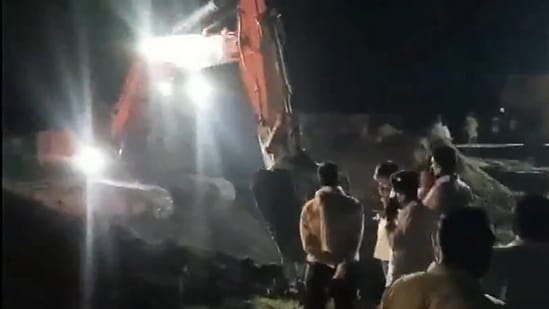
Currently, heavy excavators (JCBs) are working relentlessly to dig a massive parallel trench roughly **30 feet away** from the primary borewell. The strategy is to excavate down to approximately 45 feet, slightly below where the child is lodged, and then manually dig a horizontal tunnel to carefully breach the borewell casing and pull the child to safety.
## The Systemic Peril of Uncovered Borewells
The harrowing scene unfolding in Ujjain is, tragically, not an isolated event. Over the last two decades, India has witnessed dozens of similar incidents, predominantly in rural and semi-urban agricultural belts. Madhya Pradesh, along with states like Rajasthan, Gujarat, and Tamil Nadu, has frequently reported such accidents.
The root cause of these accidents is heavily tied to agrarian economics and water scarcity. As changing climate patterns and erratic monsoons lead to depleted aquifers, farmers are forced to drill deeper to find water. When a drilled borewell fails to yield water, it is deemed a “dry hole.” Sealing these dry holes permanently with concrete requires additional financial expenditure, leading many to resort to temporary—and deadly—fixes, such as covering the hole with a gunny sack, a wooden plank, or loose dirt. Over time, these temporary covers rot or wash away, leaving a hidden trap for unsuspecting children and wildlife. [Source: Public Policy Institute of India on Rural Infrastructure].
Despite widespread public outrage following each incident, the cyclical nature of these tragedies points to a severe systemic failure in rural infrastructure management and safety compliance.
## Expert Perspectives on Rural Safety Protocols
Child safety advocates and disaster management experts have long criticized the lack of enforcement at the grassroots level.
“The recurring tragedy of borewell falls highlights a severe gap between judicial mandates and ground-level implementation,” explains Dr. Vikram Sharma, a public policy analyst specializing in disaster risk reduction in New Delhi. “We do not lack the guidelines; we lack the administrative willpower to enforce them. A borewell is an engineered structure. Leaving it open is not an accident; it is an act of criminal negligence.”
Dr. Sharma notes that while the rescue teams do exceptional, heroic work under immense pressure, the focus must shift from reactive rescues to proactive prevention. “By the time the NDRF arrives, the child has already endured unimaginable trauma. Local administration must be held strictly accountable for any uncapped borewell in their jurisdiction.” [Source: Independent Safety Policy Research].
## Government Guidelines and Enforcement Gaps
To combat this menace, the Supreme Court of India established comprehensive guidelines over a decade ago, which have been subsequently updated by various state governments. However, adherence remains abysmally low.
**Key Mandates for Borewell Drilling and Abandonment:**
| Guideline Category | Supreme Court / State Mandate Details |
| :— | :— |
| **Prior Registration** | Landowners must notify local authorities (Sarpanch or District Collector) at least 15 days prior to drilling. |
| **Signage & Fencing** | Erection of a signboard near the site and barbed wire fencing around the drilling area during the operation. |
| **Capping Protocol** | Any abandoned or dry borewell must be completely filled with clay, sand, boulders, or concrete up to the ground level. |
| **Driller Certification** | Only government-registered agencies are legally permitted to operate borewell drilling rigs. |
| **Panchayat Audits** | Local village councils are required to maintain a registry and conduct regular audits of all open and closed borewells. |
Despite these robust legal frameworks, illegal and unregistered drilling rigs operate extensively across the countryside, often working overnight to evade bureaucratic red tape. Furthermore, local village councils (Panchayats) frequently lack the manpower or the technical mapping tools required to audit thousands of acres of private farmland effectively.
## Technological Interventions in Modern Rescues
As of 2026, the technology utilized in these high-stakes rescue operations has seen marginal but crucial improvements. While the core method remains parallel excavation, the monitoring and stabilization technologies have advanced.
In the Ujjain operation, NDRF teams are utilizing **Ground Penetrating Radar (GPR)** to map the soil density and rock formations before digging the parallel trench. This helps the excavator operators avoid hitting hard rock plates, which could send lethal shockwaves through the soil and collapse the mud surrounding the trapped child.
Furthermore, thermal imaging sensors attached to the drop-cameras are monitoring the boy’s body temperature. The subterranean environment can suffer from sharp temperature drops, increasing the risk of hypothermia for a child already in a state of clinical shock. Heat blowers and climate-controlled air are being cycled through the oxygen pipes to maintain a safe ambient temperature within the narrow shaft.
## Community Vigilance and Psychological Impact
The emotional toll of the incident has heavily impacted the local community. Hundreds of villagers from neighboring areas have gathered near the site, holding impromptu prayer vigils for the safe return of the young boy.
To ensure the safety of the rescue workers and to prevent any interference with the heavy machinery, the Ujjain district police have established a strict **200-meter security perimeter** around the site.
“The anxiety is palpable,” a local journalist reporting from the perimeter noted. “Every time the machinery pauses, a hush falls over the crowd. The community is united in hope, but there is also a rising anger that this was allowed to happen in the first place.”
Authorities are also providing psychological support to the parents, who are remaining at the site, assisting rescuers by talking to their child through the microphone array.
## Conclusion: A Waiting Game and a Call for Change
As the sun sets over Ujjain, the rescue operation enters a critical and delicate phase. The parallel trench is nearing the required depth, and the grueling, dangerous work of manual horizontal tunneling is set to begin. Every passing minute amplifies the physical and psychological stress on the trapped toddler, making time the most critical adversary for the NDRF and SDERF teams. [Source: Hindustan Times].
The Ujjain borewell incident serves as a grim and urgent reminder of a preventable danger lurking beneath India’s agricultural landscapes. While the immediate focus remains solely on the safe extraction of the 2-year-old boy, this tragedy must catalyze stricter administrative action. Future outlooks suggest that utilizing drone-based surveillance to map unregistered drilling sites and imposing severe criminal liabilities on landowners who leave borewells uncovered may be the only way to ensure that the earth does not swallow another innocent life. For now, a family, a village, and a nation wait with bated breath, praying for a miracle in Madhya Pradesh.





