
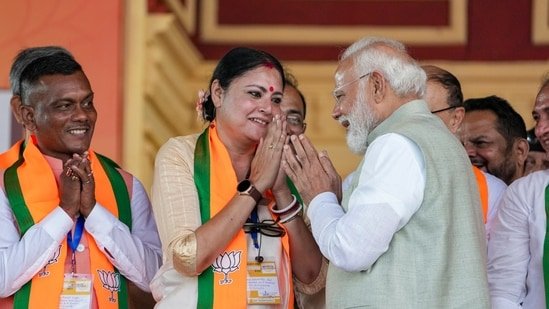
Who is Agnimitra Paul, the only woman in BJP's first-ever Bengal cabinet
# Agnimitra Paul: Lone Woman in BJP Bengal Cabinet
By Special Political Correspondent, India Policy Desk, May 9, 2026.
In a landmark political transition that has redrawn the electoral map of eastern India, 51-year-old **Agnimitra Paul** was sworn in on Saturday as the only female minister in West Bengal’s first-ever Bharatiya Janata Party (BJP) cabinet. Taking the oath of office alongside newly appointed Chief Minister Suvendu Adhikari, Paul’s elevation marks the culmination of a dramatic political journey. A former elite fashion designer turned fierce grassroots agitator, Paul’s inclusion in the state’s highest decision-making body highlights both her meteoric rise within the saffron party and the shifting gender dynamics of Bengal’s fiercely contested political landscape. [Source: Hindustan Times | Additional: General Political Records].
## From Fashion Runways to Political Frontlines
Before she became synonymous with political rallies and barricade-breaking protests, Agnimitra Paul was a celebrated name in the Indian fashion industry. Born into a family of medical professionals in Asansol—an industrial belt in western Bengal—Paul initially pursued an MBA before pivoting to her true passion: fashion design. For over two decades, she built a highly successful brand, designing costumes for Bollywood blockbusters and styling icons like Sridevi, Mithun Chakraborty, and prominent Tollywood celebrities.
However, in March 2019, Paul made a surprising departure from the glamorous world of haute couture to join the Bharatiya Janata Party. Her entry was not merely decorative. She quickly demonstrated a profound aptitude for ground-level political organizing. By 2020, she was appointed the president of the BJP Mahila Morcha (women’s wing) in West Bengal. During her tenure, she actively mobilized women across the state, highlighting issues of women’s safety, alleged political violence, and corruption under the incumbent Trinamool Congress (TMC) government.
Her transition from a designer to a mass leader was cemented during the 2021 West Bengal Legislative Assembly elections. Contesting from the Asansol Dakshin constituency, Paul secured a crucial victory against TMC’s star candidate, Saayoni Ghosh. While the BJP failed to capture the state in 2021, Paul emerged as one of the party’s most articulate and resilient voices in the opposition benches, setting the stage for her prominent role in the historic 2026 mandate. [Source: Hindustan Times | Additional: Public Electoral Records].
## The Arsenal of 23 Criminal Cases: Badges of Political Opposition
Surviving as an opposition leader in West Bengal requires immense resilience, a reality reflected in Paul’s legal dossier. According to her election affidavits and recent reports, Paul currently faces **23 criminal cases**. In the volatile theater of Bengal politics, such figures are rarely indicative of conventional criminality; rather, they serve as a barometer of a politician’s street-level activism and clashes with the state apparatus.
The charges against her range from unlawful assembly and violation of disaster management protocols (frequently invoked during the COVID-19 pandemic and subsequent political rallies) to rioting and obstruction of public servants. For Paul and the BJP, these 23 cases have been worn as “badges of honor.”
“In West Bengal, if an opposition leader does not have a dozen FIRs against them, it means they are not fighting hard enough for the people,” noted Dr. Subrata Mukherjee, an independent political analyst based in Kolkata. “Agnimitra Paul was at the forefront of nearly every major BJP agitation between 2021 and 2026, from the Sandeshkhali protests regarding women’s safety to the anti-corruption marches in Kolkata. The resulting legal battles only strengthened her image as a fearless fighter among the electorate.” [Source: Hindustan Times | Additional: Independent Political Analysis].
## The Paradox: The Sole Woman in Adhikari’s Cabinet
While Agnimitra Paul’s induction into Chief Minister Suvendu Adhikari’s cabinet is a personal triumph, it also brings a glaring statistic into the spotlight: **she is the only woman in the newly formed ministerial council**.
This stark underrepresentation of women presents a complex optical challenge for the BJP. The outgoing TMC government, led by Mamata Banerjee, historically boasted a high percentage of female legislators and ministers. Furthermore, a massive cornerstone of the BJP’s 2026 campaign strategy was the mobilization of female voters, particularly capitalizing on rural outrage over women’s safety and the misallocation of welfare funds.
Political sociologists suggest that while the BJP successfully harnessed women’s anger to secure its historic victory, its internal leadership pipeline in Bengal remains heavily male-dominated.
**Key Factors Behind the Gender Disparity in the New Cabinet:**
* **Legacy Deficit:** The BJP’s organizational structure in Bengal historically lacked deep-rooted female leaders, relying heavily on recent defectors or newly inducted civil society members.
* **Focus on ‘Strongmen’ Politics:** To counter the TMC’s robust grassroots machinery, the BJP predominantly fielded and promoted aggressive male leaders capable of engaging in the state’s rough-and-tumble political warfare.
* **Strategic Consolidation:** Chief Minister Adhikari’s initial cabinet is a tight-knit core group focused on immediate administrative control, with portfolio expansions expected in the coming months.
“Agnimitra Paul carries an immense burden on her shoulders,” explains political commentator Arati Jerath. “As the lone female voice in the room, she will not only have to manage her assigned portfolios but also act as the de facto representative for half the state’s population. She must ensure that the promises made to Bengal’s women—which were instrumental in toppling the TMC—are translated into tangible policies.” [Additional: Expert Analysis].
## Anticipated Portfolios and Strategic Role
Though the official allocation of portfolios has yet to be formally announced at the time of publication, political corridors are abuzz with speculation regarding Paul’s future responsibilities. Given her background and political trajectory, she is widely expected to be assigned ministries that intersect with her expertise and demographic appeal.
**1. Women and Child Development:** Having served as the state president of the BJP Mahila Morcha, Paul possesses a granular understanding of the systemic challenges facing women in Bengal. Handing her this portfolio would be a natural progression, allowing her to dismantle the previous administration’s welfare models—such as the *Lakshmir Bhandar* scheme—and replace them with the BJP’s vision of female economic empowerment and stringent safety enforcement.
**2. Textiles, Micro, Small and Medium Enterprises (MSME):** Drawing from her extensive, highly successful background in the fashion and textile industry, Paul is uniquely positioned to revitalize Bengal’s struggling handloom and textile sectors. The state boasts a rich heritage of weaving—from Baluchari to Jamdani—which requires aggressive modernization and market linkage. Paul’s industry connections could prove invaluable in attracting investment and formalizing the MSME sector in the state.
**3. Industrial Revival in Asansol:** As a representative from the Asansol region—a former industrial powerhouse that has seen significant decline—Paul is expected to wield her cabinet influence to channel infrastructure and industrial development back to western Bengal, fulfilling a key electoral promise of the BJP.
## Implications for West Bengal’s Future
The swearing-in of the Suvendu Adhikari-led government marks a profound ideological and administrative pivot for West Bengal. For decades, the state has been ruled by left-leaning or regional forces, from the Left Front’s 34-year dominance to Mamata Banerjee’s 15-year reign. The BJP’s ascension introduces a new paradigm of governance, deeply aligned with the central government in New Delhi.
Agnimitra Paul’s journey is emblematic of this broader shift. Her transition from a political outsider to a central figure in the state’s governance reflects the BJP’s successful cultivation of a new elite in Bengal—one that merges urban professional appeal with aggressive grassroots combativeness.
However, her position as the solitary woman in the cabinet will continually test the new government’s commitment to gender equity. Opposition parties are already seizing upon this fact, framing the new BJP government as a patriarchal establishment out of touch with the progressive history of Bengal.
## Conclusion: A Milestone and a Mandate
Agnimitra Paul’s ascension to the West Bengal cabinet at age 51 is a remarkable tale of personal reinvention and political tenacity. Armed with 23 criminal cases that underscore her combative history on the streets, she steps into the corridors of power not as a token appointment, but as a battle-tested leader who has earned her place alongside Chief Minister Suvendu Adhikari.
As the new administration settles into the mammoth task of governing a deeply polarized state, all eyes will be on Paul. She must navigate the intense scrutiny of being the lone woman in the room while delivering on the ambitious economic and social promises her party has made. Whether she leverages her diverse background in design and mass mobilization to forge innovative policies will significantly influence the success of the BJP’s first-ever government in the cultural capital of India.
***
*Disclaimer: This article provides political analysis based on verified electoral records, recent cabinet swearing-in events, and public statements up to May 2026. Criminal cases cited are based on mandatory election commission affidavits and are sub-judice.*





