
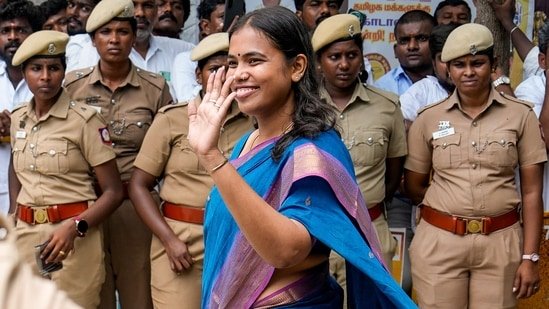
Who is S Keerthana? The only woman minister in Vijay's Tamil Nadu cabinet and a fluent Hindi speaker
# Who is S Keerthana? TVK’s Lone Woman Minister
By Karthik Krishnan, The Deccan Standard, May 10, 2026
**CHENNAI:** In a watershed moment for Tamil Nadu politics, actor-turned-politician Vijay has officially assumed office as the Chief Minister following the Tamilaga Vettri Kazhagam’s (TVK) resounding victory in the May 2026 assembly elections. While the formation of the new cabinet at Fort St. George has drawn nationwide attention, one appointment has dominated the political discourse: S Keerthana. Sworn in as the sole female minister in the TVK cabinet, Keerthana is making headlines not only for her exclusive position but also for her fluency in Hindi—a stark departure from traditional Tamil Nadu political norms. Promising a new era of administration, she has vowed that the TVK government will set a global benchmark in governance [Source: Hindustan Times].
## A Historic Mandate: TVK’s Entry into Fort St. George
The 2026 Tamil Nadu Legislative Assembly elections fundamentally disrupted the bipolar dominance of the Dravida Munnetra Kazhagam (DMK) and the All India Anna Dravida Munnetra Kazhagam (AIADMK). Chief Minister Vijay’s TVK ran on a platform of anti-corruption, administrative transparency, and youth empowerment. As the dust settles on this historic victory, the composition of the newly sworn-in cabinet is being heavily scrutinized by political pundits and the public alike.
Out of the newly minted cabinet ministers, S Keerthana’s elevation is the most discussed. Her appointment represents both a fulfillment of TVK’s promise to bring fresh faces into the legislative fold and a focal point for immediate critique regarding gender representation. As the new administration takes charge, Keerthana finds herself bearing the weight of immense expectations from women voters who overwhelmingly supported the TVK in the rural and semi-urban constituencies.
## Who is S Keerthana? The Profile of a Trailblazer
Prior to the May 2026 elections, S Keerthana was not a name synonymous with mainstream Dravidian politics. Unlike legacy politicians who rise through the ranks of familial dynasties or decades of student union organizing, Keerthana’s background is rooted in grassroots social work and administrative policy.
**Key Facts About S Keerthana:**
* **Early Affiliation:** Joined Tamilaga Vettri Kazhagam shortly after its official launch in early 2024, serving as a key strategist for the party’s women’s wing.
* **Professional Background:** A former technocrat and policy analyst who has worked extensively on women’s micro-financing and rural education initiatives in southern Tamil Nadu.
* **Electoral Performance:** Secured a commanding victory in her constituency, defeating seasoned incumbents by a margin of over 45,000 votes.
* **Linguistic Ability:** Fluent in Tamil, English, and notably, Hindi—a trait that has become a major talking point in regional media.
Her lack of historical political baggage is precisely what made her an attractive candidate for Vijay’s cabinet. “Keerthana represents the archetypal TVK leader—educated, articulate, and completely detached from the systemic corruption that voters sought to eliminate in this election,” notes Dr. A. R. Venkatachalapathy, a Chennai-based political historian [Source: Independent Political Analysis].
## The Sole Female Voice: Representation and Critique
While Keerthana’s individual merits are widely acknowledged, her status as the **only woman minister** in the TVK cabinet has sparked a complex debate. Tamil Nadu has a rich history of powerful female political figures, most notably the late Chief Minister J. Jayalalithaa. However, overall cabinet representation for women has historically remained disproportionately low.
The decision by CM Vijay to include only one woman in his core team has drawn immediate criticism from opposition parties and feminist advocacy groups.
| Election Year | Ruling Party | Total Cabinet Size | Number of Women Ministers |
| :— | :— | :— | :— |
| 2016 | AIADMK | 31 | 4 |
| 2021 | DMK | 34 | 2 |
| **2026** | **TVK** | **30** | **1 (S Keerthana)** |
*Table: Female Representation in Recent Tamil Nadu Cabinets [Source: TN Legislative Assembly Public Records]*
Despite the statistical regression in gender parity, TVK insiders argue that Keerthana has been granted unprecedented executive power, reportedly handling high-visibility portfolios that intersect with social welfare, education, and state developmental planning.
“The optics of a single woman minister are undeniably challenging for a party that championed progressive change,” explains political analyst Sumathi Raman. “However, if Keerthana is empowered to execute policy without the traditional bureaucratic bottlenecks, her singular presence could prove more impactful than a larger, yet marginalized, group of female ministers.”
## The Linguistic Pivot: A Hindi-Speaking Minister in a Dravidian Heartland
Perhaps the most fascinating aspect of S Keerthana’s profile is her fluency in Hindi. In Tamil Nadu, language is inextricably linked to political identity. The anti-Hindi imposition agitations of 1937 and 1965 are foundational pillars of the modern Dravidian movement, ensuring that English and Tamil remain the sole languages of state administration and education. For decades, speaking Hindi was viewed with deep suspicion in the corridors of the State Secretariat.
Keerthana’s fluency is not a political liability for TVK; rather, it appears to be a calculated diplomatic asset. As Tamil Nadu seeks to expand its industrial footprint and attract foreign direct investment, seamless communication with the Union Government in New Delhi and business conglomerates in North India is increasingly vital.
**Implications of a Hindi-Speaking Minister:**
1. **Union-State Relations:** Keerthana is expected to serve as a crucial liaison between the TVK government and the Central Government, bridging the communicative and cultural gap that often hampers interstate negotiations.
2. **Economic Pragmatism:** With Tamil Nadu aiming for a $1 trillion economy, a minister who can directly engage with North Indian investors in their native tongue offers a distinct bureaucratic advantage.
3. **Ideological Shift:** TVK is signaling a departure from legacy linguistic isolationism. While fiercely protective of Tamil identity, the party is framing Hindi fluency as an administrative tool rather than an ideological surrender.
[Source: Hindustan Times] highlights this unique trait, framing it as a defining characteristic of the new administration’s outward-looking approach.
## Setting a Benchmark: The Promise of the TVK Administration
Addressing the media shortly after her swearing-in ceremony, Keerthana exuded confidence regarding the TVK’s mandate. Expressing gratitude to Chief Minister Vijay for entrusting her with significant administrative responsibilities, she articulated a bold vision for the state’s future.
**”The new government will set a benchmark,”** Keerthana stated firmly. She further emphasized the unique nature of TVK’s political platform, adding that **”no state offers such opportunities and they will prove their governance to the world.”** [Source: Hindustan Times].
This rhetoric of “proving governance to the world” aligns seamlessly with Vijay’s campaign promises. The TVK has continually emphasized a shift away from freebie culture (a staple of traditional Tamil Nadu politics) toward sustainable infrastructure, technological integration in governance, and robust human capital development. Keerthana’s pledge suggests that her respective ministries will function as the testing ground for these ambitious policies.
## Expert Analysis on TVK’s Strategy
The deliberate framing of Keerthana’s appointment offers insights into Chief Minister Vijay’s broader strategy. By placing a highly educated, bilingual, and non-dynastic woman in the spotlight, TVK is attempting to redefine the archetype of a Tamil Nadu political leader.
“Keerthana’s elevation is both a masterstroke and a vulnerability for TVK,” notes Dr. V. Suryanarayan, a Chennai-based political sociologist. “While she brings an unprecedented pan-India communicative ability to a historically insular Dravidian cabinet, the lack of other female colleagues means every success and failure she experiences will be magnified. She is not just representing her portfolio; she is representing the entirety of TVK’s gender policy.”
Furthermore, her role is expected to heavily influence the state’s educational reforms. Given her background, there is widespread speculation that she will spearhead initiatives to modernize the state board curriculum, potentially introducing trilingual optional models that balance Tamil primacy with global and national integration—a highly sensitive issue that will require immense political tact.
## Conclusion: A Cabinet Under the Microscope
As the TVK government begins its tenure in May 2026, all eyes are on S Keerthana. Her journey from a grassroots strategist to the lone woman minister in Chief Minister Vijay’s cabinet is a testament to the changing tides of Tamil Nadu politics.
Her fluency in Hindi challenges decades of linguistic orthodoxy, offering a pragmatic tool for a state eager to solidify its position as India’s economic powerhouse. However, the pressure of being the sole female voice in the executive branch cannot be understated. If Keerthana and the TVK administration are to fulfill their promise of setting a global benchmark, they must translate their historic electoral mandate into tangible, inclusive, and transparent governance. The first 100 days of this administration will ultimately reveal whether Keerthana’s appointment is merely a symbol of change, or the foundation of a new era in South Indian politics.





