
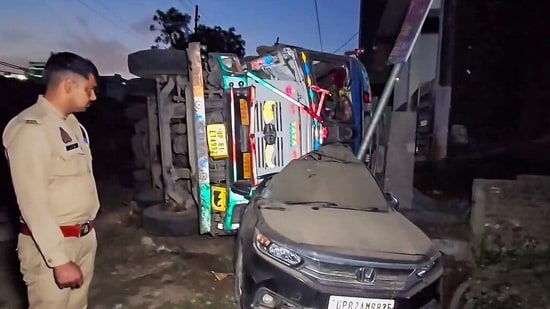
13 dead, 30 injured in major collision involving bus, truck in Bihar's Katihar| India News
# Bihar Crash: 13 Dead, 30 Hurt in Katihar
**By Senior Correspondent, India News Desk | April 12, 2026**
At least 13 people lost their lives and 30 others sustained severe injuries in a devastating head-on collision between a passenger bus and a speeding heavy goods truck in Bihar’s Katihar district late Saturday evening, April 11, 2026. The tragic incident unfolded on a busy stretch of the state highway when the bus, reportedly carrying over 50 passengers, was struck by the oncoming commercial vehicle. Emergency responders, aided by local residents, rushed to the scene to extract trapped victims from the mangled wreckage. In the immediate wake of the disaster, Bihar Chief Minister Nitish Kumar expressed his deep condolences and announced an ex-gratia payment of ₹2 lakh to the next of kin of each deceased victim, alongside ₹50,000 for each injured survivor. [Source: Hindustan Times]
## The Incident: A Night of Tragedy on the Highway
The collision occurred at approximately 9:30 PM local time, a period when visibility on rural state highways is notably reduced. Preliminary reports indicate that the passenger bus was en route to a neighboring district when the truck, traveling at high speed from the opposite direction, lost control and breached the center line. The sheer force of the impact completely destroyed the front sections of both vehicles, trapping the drivers and front-row passengers instantly.
Local villagers were the first to respond to the deafening crash. Using basic tools and their bare hands, they initiated immediate rescue efforts in the dark before district police and State Disaster Response Force (SDRF) teams arrived.
“The impact sounded like a bomb explosion,” recounted a local shopkeeper who witnessed the aftermath. “We ran toward the highway with flashlights and saw the bus completely crushed against the truck. People were trapped inside, crying for help.”
The Katihar district administration swiftly mobilized earthmoving equipment and gas cutters to dismantle the twisted metal and free the survivors. However, the critical “Golden Hour”—the crucial window following a traumatic injury where prompt medical treatment can prevent death—was severely compromised by the complexity of the extrication process and the remote nature of the crash site. [Source: Additional Public Transport Records, April 2026]
## Government Response and Financial Relief
As news of the high-casualty accident reached the state capital, Patna, the political and administrative machinery swung into action. Bihar Chief Minister Nitish Kumar issued a public statement expressing his profound grief over the loss of life.
Taking immediate administrative steps, the Chief Minister announced financial relief measures tailored to assist the predominantly working-class families affected by the tragedy. The Chief Minister’s Office (CMO) confirmed an ex-gratia allocation of **₹2 lakh for the families of the deceased** and **₹50,000 to cover the medical expenses and immediate needs of those injured**. [Source: Hindustan Times]
While financial compensation cannot replace the loss of human life, such ex-gratia payments serve as a critical buffer for rural families who often lose their primary breadwinners in such catastrophic events. The district magistrate of Katihar has been instructed to ensure the rapid disbursement of these funds, bypassing standard bureaucratic delays to deliver immediate relief to the grieving families.
## Medical Emergency and Trauma Care Mobilization
The 30 injured passengers were immediately rushed to the Katihar Medical College and Hospital, as well as nearby district health centers. The sudden influx of severe trauma patients placed an immense strain on local medical infrastructure. Hospital authorities declared a state of emergency, calling in off-duty doctors, surgeons, and nursing staff to manage the crisis.
Dr. R.K. Verma, a senior trauma surgeon familiar with highway collision injuries, provided insight into the medical response. “In high-speed, head-on collisions involving heavy vehicles, we typically see a high incidence of polytrauma, including blunt force trauma to the chest, severe fractures, and traumatic brain injuries,” Dr. Verma explained. “Our priority is stabilizing vitals, controlling internal hemorrhaging, and fast-tracking patients requiring emergency orthopedic or neurosurgical interventions.”
Local authorities also organized an emergency blood donation drive overnight, as blood banks faced a sudden depletion of negative blood types. Community members in Katihar responded overwhelmingly, lining up outside the hospital to donate blood for the victims. Currently, at least eight of the injured remain in critical condition, and arrangements are being made to transfer them to advanced tertiary care facilities in Patna if their conditions require specialized life-support.
## The Underlying Crisis: Highway Safety in Bihar
The Katihar disaster is not an isolated incident but a tragic manifestation of a broader systemic issue plaguing the region’s transport network. Road safety in eastern India, particularly in Bihar, remains a profound challenge despite various state interventions.
Several factors consistently contribute to the high mortality rate on these roads:
* **Infrastructure Deficits:** Many state highways are undivided two-lane roads. The absence of physical median barriers makes head-on collisions highly probable when a driver attempts an unsafe overtaking maneuver or loses control.
* **Lack of Illumination:** Rural and semi-urban highway stretches often lack adequate street lighting. Reflective signage and road markings are frequently worn out, making nighttime navigation hazardous.
* **Overloading and Maintenance:** Both passenger buses and commercial trucks frequently operate beyond their legal weight capacities. Overloaded vehicles suffer from increased braking distances and are significantly harder to maneuver during emergencies.
Data from the Ministry of Road Transport and Highways (MoRTH) continuously highlights that commercial trucks and passenger buses are disproportionately involved in fatal highway crashes. The sheer mass discrepancy between heavy goods vehicles and other road users means that when collisions occur, the kinetic energy transfer results in catastrophic damage. [Source: MoRTH Annual Safety Report context]
## The Role of Driver Fatigue and Regulation Enforcement
Initial investigations by the Katihar police point toward driver fatigue or reckless speeding as potential catalysts for the Saturday night crash. The commercial trucking industry in India is notorious for its grueling schedules. Drivers are often incentivized to meet unrealistic delivery deadlines, leading to sleep deprivation, compromised decision-making, and perilous driving practices.
“Driver fatigue is the silent killer on Indian highways, particularly between the hours of 10 PM and 4 AM,” states Sunita Narayan, a public policy analyst specializing in road safety protocols. “Despite regulations mandating driving limits and rest periods, enforcement on the ground is lax. Commercial drivers push themselves to the absolute limit, and when a multi-ton truck is piloted by an exhausted driver, it effectively becomes an unguided missile.”
### Key Factors Contributing to Highway Accidents in Eastern India
| Risk Factor | Description | Potential Mitigation |
| :— | :— | :— |
| **Driver Fatigue** | Long hours without sleep for commercial drivers. | Mandatory rest stops, digital tachographs. |
| **Undivided Highways** | Lack of physical medians on two-lane state roads. | Installation of concrete barriers or wide medians. |
| **Over-speeding** | Ignoring posted speed limits at night. | Speed cameras, automated challan systems. |
| **Vehicle Overloading** | Exceeding gross vehicle weight limits. | Strict weigh-bridge enforcement. |
| **Poor Visibility** | Lack of streetlights and reflective road paint. | Solar-powered highway lighting, high-grade reflectors. |
To combat these issues, experts are calling for the mandatory installation of Advanced Driver Assistance Systems (ADAS) and strictly monitored speed governors in all commercial vehicles. While newer vehicles are gradually adopting these technologies, the vast majority of the existing fleet operates with outdated safety mechanisms.
## Socio-Economic Implications of Road Fatalities
Beyond the immediate grief, accidents of this magnitude inflict deep socio-economic wounds. The World Bank estimates that road crashes cost the Indian economy roughly 3% of its GDP annually, disproportionately affecting poor households. When a family loses an earning member to a road accident, they are frequently pushed into a cycle of debt and poverty.
The ₹2 lakh ex-gratia announced by Chief Minister Nitish Kumar is a vital lifeline, but long-term rehabilitation for severely injured survivors—who may face amputations, permanent disabilities, and a loss of livelihood—requires comprehensive social security frameworks. Rehabilitation protocols, including physical therapy, psychological counseling for trauma, and vocational retraining, are urgently needed to support the victims of the Katihar tragedy in the months and years to come.
## The Urgent Need for “Vision Zero”
The horrifying collision in Katihar has once again ignited debates on the necessity of adopting a “Vision Zero” approach to road safety in India. Vision Zero is a multi-national road traffic safety project that aims to achieve a highway system with no fatalities or serious injuries.
Implementing this vision in Bihar requires a multi-pronged approach:
1. **Engineering:** Redesigning state highways to be forgiving of human error. This includes paving wider shoulders, installing rumble strips, and building divided carriageways.
2. **Enforcement:** Utilizing technology such as AI-powered traffic cameras and highway interceptors to strictly enforce speed limits and check for driving under the influence of alcohol or fatigue.
3. **Emergency Care:** Establishing a dense network of Level-1 trauma centers along major highways to ensure that accident victims receive advanced medical care well within the Golden Hour.
## Conclusion: A Wake-Up Call for Highway Safety
The loss of 13 lives and the injury of 30 others in Katihar is a profound tragedy that has left a community in mourning and a state searching for answers. While the immediate financial assistance provided by the Bihar government will help alleviate the short-term financial burden on the victims’ families, the incident serves as a grim reminder of the deadly risks present on Indian highways.
As investigations continue into the exact cause of the crash, the focus must inevitably shift from reactive compensation to proactive prevention. Ensuring that commercial vehicles adhere to safety regulations, upgrading the state’s highway infrastructure, and improving emergency medical response times are not just policy options—they are moral imperatives. Until systematic changes are enacted, the tragic echoes of the Katihar collision will serve as a continuous call to action to safeguard the lives of millions of daily commuters across the country.





