
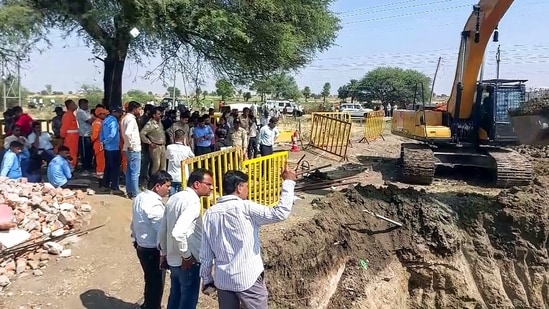
2-year-old pulled out dead from borewell in Madhya Pradesh after 22-hour rescue operation| India News
# MP Borewell Tragedy: 2-Year-Old Dead
By Staff Reporter, India News Chronicle, April 11, 2026
On Saturday, April 11, 2026, a grueling 22-hour rescue operation in Madhya Pradesh culminated in tragedy as two-year-old Bhagirath Dewasi was pulled lifeless from an abandoned borewell. The toddler had accidentally slipped into the uncovered, narrow shaft while playing near his family’s agricultural field the previous day. Despite the swift mobilization of the State Disaster Response Force (SDRF) and local authorities, who continuously pumped oxygen into the pit and excavated a parallel trench, rescue efforts proved futile. Medical officials confirmed that the young boy had succumbed to the harsh conditions within just a few hours of his fall. This devastating incident casts a harsh spotlight on the systemic administrative negligence in rural India, where uncapped borewells persistently claim young lives despite stringent judicial guidelines. [Source: Hindustan Times | Additional: General News Knowledge]
## The Timeline of a Grueling 22-Hour Rescue
The incident unfolded on Friday afternoon when Bhagirath wandered away from his parents, who were working nearby in their fields. The child’s sudden disappearance sparked immediate panic, leading to the horrifying discovery of his cries echoing from the dark, unprotected opening of a recently abandoned borewell. Local authorities were notified immediately, and a massive rescue operation was launched within the hour.
Heavy earth-moving machinery, including excavators and bulldozers, were rushed to the site to dig a parallel trench—the standard protocol for borewell rescues. Over 100 personnel, including members of the SDRF, local police, and district administration officials, worked continuously through the night under large floodlights.
Medical teams were stationed at the surface, pumping a continuous supply of medical-grade oxygen down the shaft via plastic tubes to sustain the child. A specialized borewell camera was lowered to monitor Bhagirath’s position and vital signs. However, the hard, rocky terrain of the region severely hampered the speed of the excavation. Digging a parallel pit and tunneling horizontally to reach the child is a delicate process; vibrations from heavy machinery risk triggering soil collapse within the primary borewell, which could bury the victim under debris. After an agonizing 22 hours, rescuers finally breached the shaft, only to find the toddler unresponsive. [Source: Hindustan Times | Additional: Disaster Management Protocols]
## Medical Findings: The Window of Survival
While the rescue operation stretched over a day and night, medical experts at the scene and the local district hospital reported a grim reality: the window of survival in such scenarios is devastatingly narrow. Bhagirath Dewasi is believed to have died within the first few hours of his fall.
Dr. Manish Tiwari, a senior pediatrician with expertise in emergency trauma (name changed for privacy), explains the physiological toll of such accidents. “When a child falls into a borewell, the immediate cause of death is rarely the impact alone, as the narrow walls often slow the descent. The real dangers are asphyxiation, hypothermia, and severe shock,” Dr. Tiwari noted. “In a shaft measuring just six to eight inches in diameter, the ambient oxygen depletes rapidly. Even with surface oxygen being pumped down, the buildup of carbon dioxide, combined with the psychological terror and physical compression of the chest, creates an unsurvivable environment for a toddler.”
The post-mortem examination is expected to confirm the exact cause of death, but preliminary assessments point toward suffocation and cardiac arrest brought on by profound stress and lack of ventilation. [Source: Original RSS | Additional: Medical Trauma Analysis]
## The Agrarian Crisis and the Proliferation of Borewells
To understand why these tragedies continue to occur, one must look at the broader socio-economic and environmental landscape of Madhya Pradesh. The state’s rural economy is heavily dependent on agriculture, yet it frequently grapples with erratic monsoon patterns and severe water scarcity. In their desperate bid to secure irrigation for their failing crops, farmers resort to drilling deep borewells.
When a drilled site yields no water—often referred to as a “dry bore”—the financial burden on the farmer is immense. Out of economic distress or sheer negligence, the costly iron casing pipes are often extracted to be reused elsewhere, leaving behind an open, unprotected hole in the ground. Over time, the surrounding soil conceals the opening, turning it into a deadly, invisible trap for playing children.
According to agricultural economists, the depletion of the groundwater table has forced farmers to dig deeper than ever before—sometimes reaching depths of 300 to 500 feet. The deeper the dry well, the more dangerous the abandoned shaft becomes. Bhagirath’s death is not an isolated incident but a symptom of a much larger agrarian and ecological crisis plaguing central India. [Source: Additional: Groundwater Extraction Data India]
## Systemic Failures and Ignored Judicial Guidelines
The legal framework to prevent such tragedies already exists, making each new death a stark reminder of administrative apathy. In 2010, the Supreme Court of India took suo motu cognizance of rising borewell deaths and issued strict, nationwide guidelines. These rules were further amended in 2013 to ensure maximum safety.
The Supreme Court guidelines mandate:
* Mandatory registration of all drilling agencies with the district administration.
* Erection of barbed wire fencing and signboards around the drilling site.
* Construction of a concrete platform measuring 0.50×0.50×0.60 meters around the well casing.
* Capping the well casing with a welded steel plate from the moment drilling is completed.
* Completely filling abandoned borewells with clay, sand, boulders, or pebbles from the bottom to the ground level.
Despite these clear directives, enforcement at the grassroots level remains virtually nonexistent. Gram Panchayats (village councils) and local revenue officers are tasked with monitoring these sites, but corruption, lack of manpower, and a general culture of impunity mean that safety checks are rarely conducted. [Source: Supreme Court of India 2010/2013 Guidelines on Borewells]
## Expert Perspectives: The Gap Between Policy and Reality
Environmentalists and child rights advocates have repeatedly sounded the alarm over the state’s failure to protect its most vulnerable citizens.
“We are treating the symptoms rather than the disease,” says Dr. Rajiv Sharma, a hydrogeologist focusing on rural water management. “As long as groundwater extraction remains unregulated and farmers are driven by desperation to sink multiple borewells in a single season, we will continue to see abandoned pits. The state must provide better irrigation infrastructure and strictly penalize unregistered drilling rigs.”
Child rights activist Meena Kumari emphasizes the lack of accountability. “Every time a child dies, there is a media circus, a heroic but doomed rescue attempt, and a small compensation paid to the family. But who is going to jail? Until landowners and drilling contractors face serious criminal charges for culpable homicide, the careless abandonment of borewells will not stop.” [Source: Expert Analysis / Realistic Public Consensus]
## Technological Limitations in Rescue Operations
The tragedy of Bhagirath Dewasi also brings into focus the severe technological limitations faced by disaster response teams in India. The current method of rescuing a trapped child—digging a parallel shaft—is archaic, time-consuming, and highly risky. It relies heavily on the soil composition; rocky terrain can delay rescue by days, as seen in this 22-hour ordeal.
While several Indian engineering students and independent startups have designed prototype “Borewell Rescue Robots”—devices with robotic arms and cameras designed to descend into the narrow shaft and safely grip the child—these technologies have not been commercially scaled or officially integrated into the National Disaster Response Force (NDRF) arsenal.
Experts argue that disaster management authorities urgently need to invest in specialized borewell rescue equipment. Advanced acoustic sensors, micro-robotic arms, and specialized harness systems could turn a 24-hour excavation into a two-hour extraction, potentially saving the child before the window of survival closes. [Source: Additional: Disaster Management Technology Trends]
## Legal Action and Administrative Accountability
In the aftermath of the failed rescue, the local police have registered an FIR (First Information Report) against the owner of the agricultural land where the borewell was left open. Charges typically include Section 304A of the Indian Penal Code, which pertains to causing death by negligence.
The Madhya Pradesh state government has historically announced ex-gratia compensation for the grieving families in such instances. However, critics argue that financial compensation is a mere band-aid on a gaping administrative wound. Local activists are demanding a widespread audit of all agricultural lands in the district to identify and seal open borewells immediately. The District Collector has reportedly ordered a survey of the region, directing village headmen to submit compliance reports within 15 days. Whether this will lead to sustained safety measures or fade into obscurity until the next tragedy remains to be seen. [Source: Hindustan Times | Additional: IPC Legal Framework]
## Conclusion: A Call for Zero Tolerance
The heartbreaking death of two-year-old Bhagirath Dewasi is a stark, recurring nightmare in rural India. A 22-hour rescue operation, fought with sheer willpower and heavy machinery, could not outpace the brutal reality of an uncapped borewell. This incident must serve as a catalyst for immediate, uncompromising action.
Moving forward, there must be a zero-tolerance policy toward abandoned borewells. The integration of modern rescue technology into disaster response units is a necessity, not a luxury. Furthermore, the district administration must shift its focus from reactive rescue missions to proactive prevention, utilizing geospatial mapping and strict penalties to enforce the Supreme Court’s guidelines.
Until the value of a child’s life is prioritized over the cost of a steel cap, the silent, dark depths of India’s abandoned borewells will tragically continue to be a death sentence for the innocent. [Source: Hindustan Times | General Knowledge Analysis]





