
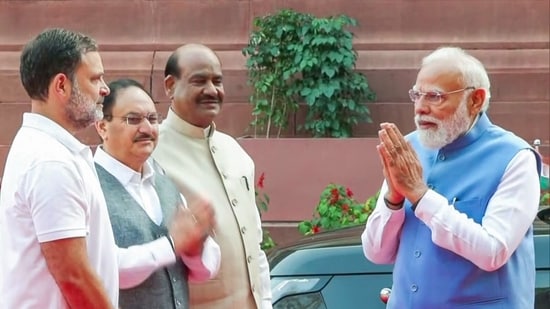
PM Modi steps out of car, stops for conversation with Rahul Gandhi in Parliament premises
# Modi & Rahul Share Rare Chat at Parliament
**By Senior Political Desk, National News Observer, April 11, 2026**
On Saturday morning, New Delhi witnessed an unexpected moment of bipartisan civility as Prime Minister Narendra Modi paused to converse with Congress leader Rahul Gandhi on the Parliament premises. The rare interaction unfolded on April 11, 2026, when both leaders arrived to pay floral tributes to social reformer Mahatma Jyotiba Phule on his birth anniversary. As PM Modi’s convoy was departing, he surprisingly stepped out of his vehicle to exchange pleasantries with Gandhi. Captured on video and quickly going viral, this brief but cordial exchange has sparked widespread discussion across the nation regarding the evolving dynamics of India’s fiercely competitive political landscape. [Source: Hindustan Times].
## A Surprise Encounter on a Solemn Day
The Parliament complex in New Delhi is no stranger to intense political drama, but it is rarely the site of unscripted, warm interactions between the nation’s two most prominent political rivals. The morning began with a scheduled, solemn event: the offering of floral tributes at the portrait and statue of Mahatma Jyotiba Phule, a towering 19th-century anti-caste crusader and champion of women’s education.
Both Prime Minister Narendra Modi and Leader of Opposition Rahul Gandhi, along with a host of other parliamentarians, were present to honor the legendary reformer. Following the official tribute, standard protocol dictated that the Prime Minister would depart the premises under high security. The official video released by news agencies shows the Prime Minister’s motorcade slowly making its way through the Parliament driveway.
Suddenly, in a departure from routine, PM Modi signaled his security detail to halt. He stepped out of his armored vehicle, walked a few paces, and approached Rahul Gandhi, who was standing nearby conversing with other opposition members. The visual of the Prime Minister reaching out, followed by a firm handshake and a visibly warm exchange of words that lasted for nearly a minute, immediately caught the attention of the national press core. Both leaders were seen smiling before PM Modi retreated to his car and departed.
**Key Facts from the Encounter:**
* **Date & Time:** Saturday, April 11, 2026, during the morning tribute sessions.
* **Location:** The driveway of the Parliament House complex, New Delhi.
* **Duration:** The impromptu conversation lasted approximately 45 to 60 seconds.
* **Context:** Both leaders were honoring Mahatma Jyotiba Phule’s birth anniversary.
[Source: Hindustan Times | Additional: Parliament of India Protocol Records]
## The Significance of Jyotiba Phule’s Legacy
To understand the backdrop of this interaction, one must look at the immense political and social capital surrounding Mahatma Jyotiba Phule in contemporary Indian politics. Born on April 11, 1827, Phule founded the Satyashodhak Samaj (Truth Seekers’ Society) in 1873 to secure human rights and social justice for low-caste people. Alongside his wife, Savitribai Phule, he was a pioneer of women’s education in India.
In the run-up to the 2026 electoral cycles, both the ruling Bharatiya Janata Party (BJP) and the Indian National Congress have aggressively courted the legacy of Phule. For the BJP, honoring Phule aligns with the party’s broader strategy of consolidating Other Backward Classes (OBC) and marginalized communities under its developmental umbrella. For the Congress and Rahul Gandhi, Phule’s legacy is central to their intensified demand for a nationwide caste census and proportional representation in governance and wealth.
“The fact that this rare moment of camaraderie happened under the figurative gaze of Jyotiba Phule is poetically significant,” notes Dr. Sameer Raghavan, a New Delhi-based political sociologist. “Phule’s entire life was dedicated to breaking down rigid barriers. For a brief moment, the rigid, seemingly insurmountable barrier between India’s ruling establishment and its principal opposition also appeared to soften.”
Both leaders’ presence at the tribute underscores a unified national acknowledgment of social justice icons, even as their respective parties bitterly dispute the methods and policies required to achieve that justice.
## Decoding the Political Body Language
In Indian politics, where every gesture is scrutinized and every silence analyzed, the body language displayed by both leaders speaks volumes. The video footage reveals a relaxed Prime Minister Modi taking the initiative to bridge the physical gap, demonstrating statesmanship and cordiality. Rahul Gandhi, in turn, responded with immediate respectful attention, reciprocating the smile and engaging in the dialogue without hesitation.
Political commentators have pointed out that such visuals are crucial for the health of a democracy. Dr. Meena Swaminathan, a veteran political analyst, explains the psychological impact of such imagery: “Over the past few years, the political discourse in India has become highly vitriolic. Supporters of both factions often view the other not just as political opponents, but as existential threats. When the two apex leaders pause to share a smile and a handshake, it sends a subconscious de-escalatory signal to their respective cadres. It reinforces the idea that despite ideological warfare, basic human civility and parliamentary decorum still exist.”
The brief exchange lacked the stiffness often associated with forced political photo-ops. Instead, it appeared genuinely spontaneous, adding to its viral appeal across various social media platforms.
## Breaking the Ice: A Shift in Dynamics?
The timing of this encounter cannot be overlooked. The recent parliamentary sessions, particularly the Winter Session of 2025 and the turbulent Budget Session of early 2026, were characterized by intense deadlocks, frequent adjournments, and sharp rhetorical attacks. The Congress party, reinvigorated by a more robust opposition alliance, has relentlessly challenged the Modi government on issues ranging from economic disparities and unemployment to allegations of institutional overreach.
Conversely, the BJP has consistently attacked the Congress for allegedly obstructing national progress and engaging in divisive identity politics. The floor of the Lok Sabha has frequently witnessed fiery exchanges between the Prime Minister and the Leader of the Opposition.
Given this context of relentless political combat, the Saturday morning chat feels like a sudden thaw in a deep freeze. However, seasoned political observers caution against reading too much into the policy implications of the handshake.
“A handshake in the driveway does not translate to an agreement on the floor of the House,” states Raghavan. “The BJP will not dilute its governance agenda, and Rahul Gandhi will not abandon his aggressive oppositional stance. What this does is simply lower the temperature of personal animosity, which is a welcome relief for parliamentary democracy.”
## Historical Context: Bipartisanship in Indian Politics
While modern Indian politics is heavily polarized, the country has a rich tradition of camaraderie between staunch ideological opponents. This recent encounter evokes memories of past political eras where personal relationships transcended party lines.
| Era / Leaders | Nature of Camaraderie | Historical Context |
| :— | :— | :— |
| **Jawaharlal Nehru & Atal Bihari Vajpayee** | Mutual Respect | Despite Vajpayee being a young, fierce critic, PM Nehru famously predicted Vajpayee would one day become Prime Minister, encouraging his parliamentary interventions. |
| **Rajiv Gandhi & Atal Bihari Vajpayee** | Personal Support | In a famous instance, PM Rajiv Gandhi secretly included Vajpayee in India’s UN delegation so the latter could receive medical treatment in New York. |
| **Narendra Modi & Sharad Pawar** | Cordial Relations | Despite intense state-level rivalries in Maharashtra, PM Modi has publicly referred to the veteran NCP leader as a respected senior figure in Indian politics. |
| **Narendra Modi & Rahul Gandhi** | Rare Interactions | Prior to the April 2026 encounter, direct, informal interactions have been exceedingly rare, usually limited to customary greetings during official ceremonies. |
*Table: Instances of Bipartisan Camaraderie in Indian Political History. [Source: Public Political Records and Historical Archives]*
As the table illustrates, personal civility among top leaders is woven into the fabric of India’s parliamentary history, even if such instances have grown sparser in the era of 24/7 news cycles and hyper-partisan social media.
## Reactions from the Political Spectrum and Public
Unsurprisingly, the video of the interaction exploded across the internet within minutes of being broadcast. The hashtag #ModiRahulChat began trending nationwide on X (formerly Twitter) and other social media platforms.
**BJP and NDA Perspectives:**
Supporters of the ruling alliance praised PM Modi’s gesture as a hallmark of true leadership. “Stepping out of the convoy to greet the Leader of Opposition shows the Prime Minister’s magnanimity and respect for democratic traditions,” shared a senior BJP spokesperson on social media. They framed the event as an example of Modi’s statesmanship, elevating him above petty partisan squabbles.
**Congress and INDIA Bloc Perspectives:**
Conversely, supporters of the opposition viewed the interaction as an acknowledgment of Rahul Gandhi’s elevated stature in the national political arena. Congress leaders pointed out that Gandhi’s relentless grassroots campaigns and his firm standing in Parliament have compelled the highest echelons of the ruling party to engage with him respectfully. “Rahul Gandhi has always advocated for ‘Mohabbat ki Dukaan’ (a shop of love) in the marketplace of hatred. He met the PM’s gesture with his characteristic grace,” noted a Congress general secretary.
**The Neutral Citizenry:**
For the average citizen and neutral observers, the reaction was predominantly one of relief and appreciation. In an era where family WhatsApp groups and social circles are frequently divided by toxic political arguments, seeing the two supreme leaders of those warring factions sharing a lighthearted moment provided a much-needed perspective on the nature of democracy.
## Conclusion: Civility Amidst Ideological Battles
The brief, unscripted conversation between Prime Minister Narendra Modi and Rahul Gandhi on the Parliament premises is a potent reminder that democratic politics need not be devoid of human grace. While the tribute to Mahatma Jyotiba Phule brought them together in physical proximity, it was a conscious choice of statesmanship and mutual respect that facilitated the interaction.
Looking ahead, it is highly unlikely that this moment of camaraderie will alter the fundamental ideological battle lines drawn for the remainder of 2026 and beyond. The Congress will continue to demand a caste census and scrutinize the government’s economic policies, while the BJP will continue to champion its narrative of national resurgence, cultural nationalism, and infrastructural development. The political machinery of both sides will soon return to its usual antagonistic rhythm.
However, the image of the Prime Minister stepping out of his car to greet his chief rival will endure in the public memory. It serves as a vital benchmark for political discourse in India—a reassuring signal to 1.4 billion citizens that beneath the loud, chaotic, and often bitter surface of electoral politics, the foundational pillars of democratic mutual respect remain intact. As the legacy of Jyotiba Phule teaches, true progress requires dialogue, and on a quiet Saturday morning in New Delhi, India witnessed exactly that.





