
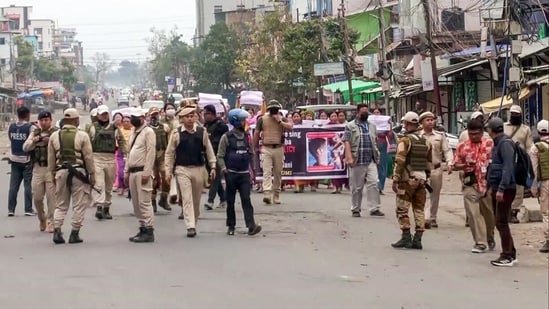
21 injured in fresh clashes in Manipur's Bhishnupur, two vehicles set ablaze| India News
# Manipur Unrest: 21 Hurt in Bishnupur
**By Vikram Desai, The National Dispatch | April 16, 2026**
On Wednesday, April 15, 2026, fresh unrest erupted in Manipur’s Bishnupur district, leaving at least 21 people injured and two private vehicles engulfed in flames. The clashes ignited when local residents intercepted three private vehicles transporting police personnel dressed in civilian clothing. Deep-seated mistrust and heightened civilian vigilance in the heavily polarized region quickly escalated a routine transit into a violent confrontation. Authorities have since deployed additional rapid-response security forces to pacify the volatile area. This latest incident starkly underscores the fragile security situation in the northeastern Indian state, where complex, long-standing ethnic divisions continue to challenge peacebuilding efforts. [Source: Hindustan Times].
## Anatomy of the Bishnupur Confrontation
The skirmish in Bishnupur serves as a microcosm of the broader administrative and social challenges plaguing Manipur. According to preliminary reports, a convoy of three private vehicles was passing through a local neighborhood when it was halted by resident watch groups. These civilian checkpoints have become increasingly common across both the valley and hill districts, established by locals anxious about the infiltration of armed miscreants.
Upon stopping the vehicles, residents discovered that the occupants were armed but dressed in civilian attire. When the occupants were identified—or suspected by the crowd—as state police personnel operating in plainclothes, panic and anger rapidly set in. In the ensuing chaos, verbal altercations devolved into physical clashes. The mob subsequently set two of the three vehicles ablaze, sending thick plumes of black smoke into the sky, which further panicked neighboring areas.
Local medical facilities reported treating 21 individuals for various injuries sustained during the melee. While most injuries were categorized as non-life-threatening—ranging from blunt force trauma to lacerations—the psychological impact on the community is severe. Security reinforcements, including the Rapid Action Force (RAF) and central paramilitary units, were immediately rushed to the scene to disperse the crowd and enforce order, relying on tear gas and baton charges to establish a buffer around the burning vehicles. [Source: Hindustan Times | Additional: Regional Security Reports].
## The Trust Deficit and Civilian Vigilance
To understand the sudden escalation in Bishnupur, one must examine the profound trust deficit that has defined Manipur’s social landscape since the massive ethnic violence that first broke out in May 2023. Over the past three years, the relationship between civilians and state law enforcement has been severely strained.
In many highly sensitive districts like Bishnupur—which sits precariously close to the geographical and demographic fault lines separating the Meitei-dominated Imphal Valley and the Kuki-Zo-dominated hill regions—civilians have taken security into their own hands. Women-led vigilante groups and youth volunteers routinely patrol streets, inspect passing vehicles, and demand identification from travelers.
“The fundamental issue in Manipur today is the absolute collapse of public faith in standard security mechanisms,” explains Dr. Amitava Sen, a New Delhi-based conflict resolution analyst specializing in Northeast Indian geopolitics. “When civilians intercept an unmarked car carrying armed men in plainclothes, their immediate assumption is not that these are covert law enforcement officers, but rather that they are hostile actors. The tragic irony is that the state’s attempt to maintain a low profile directly triggered the public’s deepest fears.”
## Security Protocols Under the Microscope
The Bishnupur incident has sparked intense debate regarding standard operating procedures (SOPs) for state police and central forces operating in hyper-sensitive conflict zones. Historically, police utilize plainclothes operations for intelligence gathering, counter-insurgency recon, or to avoid drawing undue attention while traversing hostile territories.
However, in a region where unmarked vehicles and disguised combatants have frequently been associated with ambushes and targeted violence, the tactical decision to transport police in private, civilian-looking vehicles is now facing heavy scrutiny.
Security experts argue that transparency, rather than obfuscation, is crucial in areas plagued by paranoia. By utilizing unmarked cars without adequate coordination with local administrative heads or central forces, the operation inadvertently mimicked the tactics of armed militias. Following the clash, senior police officials have reportedly initiated an internal review of deployment protocols to prevent similar misunderstandings. Authorities are now tasked with balancing the need for covert intelligence operations with the imperative of avoiding civilian panic.
## Contextualizing the Three-Year Crisis
The events of April 15 cannot be viewed in isolation. They are the latest ripples in a wave of unrest that has battered Manipur for nearly three years. The conflict, which originally erupted over a court directive regarding the Scheduled Tribe (ST) status of the majority Meitei community, quickly spiraled into a deeply entrenched ethnic conflict between the valley-dwelling Meiteis and the hill-dwelling Kuki-Zo tribes.
**Key Impacts of the Ongoing Manipur Crisis (2023-2026):**
* **Displacement:** Tens of thousands of residents remain in relief camps, unable to return to their ancestral homes due to security concerns.
* **Buffer Zones:** Central forces, including the Assam Rifles and the Central Reserve Police Force (CRPF), maintain heavy deployments along the “buffer zones” separating the hills and the valley.
* **Economic Stagnation:** The prolonged instability has severely damaged the local economy, disrupting agriculture, trade routes, and highway transport.
* **Information Blackouts:** Periodic suspensions of mobile internet services remain a frequent government tool to curb the spread of rumors, albeit at the cost of crippling digital commerce and communication.
Bishnupur district, sharing borders with the hill district of Churachandpur, has historically been a flashpoint for skirmishes. Even in periods of relative calm, the proximity of the two divided populations means that tensions continually simmer just beneath the surface, requiring only a minor spark—such as a misunderstood police convoy—to ignite a major conflagration. [Source: Public Geopolitical Data].
## Socio-Economic and Psychological Toll
Beyond the immediate physical injuries sustained by the 21 individuals in Bishnupur, the perpetual cycle of violence is exacting a heavy psychological toll on the populace. Children are growing up in an environment defined by barricades, curfews, and suspicion.
“Every time an incident like this happens, it pushes the timeline for reconciliation back by months,” says Meena Singh, a civil rights advocate operating out of Imphal. “The local economy in districts like Bishnupur relies heavily on mobility—farmers needing to reach markets, students needing to reach schools. When a clash occurs, transportation freezes. Markets shut down. The trauma is re-lived all over again.”
The burning of the two vehicles is also a stark reminder of the economic destruction inherent in the conflict. For ordinary citizens, the loss of property, combined with the continuous disruption of livelihoods, has created a sense of pervasive hopelessness. Local businesses struggle to secure loans, and outside investment into the state has plummeted to historic lows.
## Government Response and Next Steps
In the immediate aftermath of the Bishnupur clashes, state authorities have moved to contain the narrative and physical fallout. Section 144 of the CrPC, which prohibits the gathering of four or more people, has been strictly enforced across sensitive blocks within the district. Flag marches by central paramilitary forces were conducted throughout Wednesday evening to restore a semblance of order and deter further arson.
Political leaders at both the state and central levels have issued routine appeals for calm, urging citizens not to take the law into their own hands. However, analysts point out that administrative appeals often fall on deaf ears when the underlying structural issues—disarmament of militias, safe return of internally displaced persons (IDPs), and a comprehensive political dialogue—remain unaddressed.
The Ministry of Home Affairs (MHA) in New Delhi continues to monitor the situation closely. There is growing pressure on the central government to revamp its peace-brokering strategy. The current approach, heavily reliant on military containment and buffer zones, has succeeded in preventing large-scale massacres but has failed to foster genuine social cohesion or rebuild inter-community trust.
## Pathways to Reconciliation: A Distant Hope?
If Manipur is to break free from this grinding cycle of localized clashes and systemic mistrust, bold confidence-building measures (CBMs) are urgently required. Security experts advocate for the establishment of joint-community monitoring committees, where respected elders and civil society leaders from conflicting groups work directly with law enforcement to verify the identities of passing convoys and prevent misunderstandings.
Furthermore, there is an urgent need for the complete professionalization of police deployments in buffer zones. The use of clear insignias, designated official vehicles, and pre-authorized transit routes could significantly reduce the likelihood of plainclothes officers being mistaken for hostile actors.
Ultimately, however, administrative and tactical tweaks will only serve as temporary bandages. A lasting resolution demands a robust, inclusive political dialogue that addresses the core grievances of all communities involved. The state must bridge the gap between the hills and the valley not just with armed battalions, but with equitable governance, resource distribution, and transitional justice.
## Conclusion: A Fragile Road Ahead
The Wednesday clash in Bishnupur, leaving 21 injured and two vehicles in ashes, is a tragic testament to the volatility that continues to grip Manipur in 2026. What should have been a standard movement of personnel spiraled into chaos simply because the foundational trust required for a society to function has been shattered.
As the injured recover and the burnt wreckage is cleared from the streets of Bishnupur, the broader questions for Manipur remain unanswered. Until the deep-rooted paranoia is replaced by mutual dialogue and state accountability, the region will remain a tinderbox, where even a simple misunderstanding over an unmarked car can ignite the flames of conflict. Both state and central authorities face an uphill battle to restore not just law and order, but the very fabric of social trust.





