
Southern pushback grows over proposed Lok Sabha seat hike, delimitation exercise| India News
# South India Battles Lok Sabha Seat Hike
**By Special Policy Correspondent, The Indian Dispatch, April 15, 2026**
On Wednesday, April 15, 2026, a formidable political bloc of Southern Indian states intensified its resistance against the Union Government’s proposed delimitation exercise and the subsequent expansion of Lok Sabha seats. Driven by fears of severe political marginalization, leaders from Tamil Nadu, Kerala, Karnataka, Andhra Pradesh, and Telangana are protesting the reallocation of parliamentary constituencies. With the exercise currently slated to rely on the latest published census—effectively the 2011 demographic data—Southern states argue they are being structurally penalized for their historical success in implementing national family planning and population control measures. [Source: Hindustan Times]
## The Approaching Constitutional Deadline
The roots of this looming constitutional crisis stretch back decades. Article 81 of the Indian Constitution mandates that the allocation of Lok Sabha seats to states must be proportionate to their population. However, recognizing that this would punish states that successfully controlled their population growth, the Indira Gandhi government passed the 42nd Constitutional Amendment in 1976. This amendment froze the state-wise distribution of Lok Sabha seats based on the 1971 Census.
In 2001, the Atal Bihari Vajpayee government extended this freeze for another 25 years through the 84th Amendment, explicitly stating that the number of state-wise seats would not be altered until the publication of the first census undertaken after the year 2026.
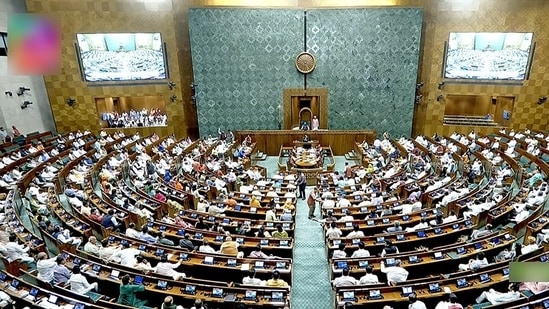
As that critical 2026 deadline arrives, the political landscape of India is bracing for a seismic shift. The newly constructed Parliament building, the Sansad Bhavan, was designed with an expanded seating capacity capable of accommodating 888 Lok Sabha members, heavily signaling the Union Government’s intent to lift the freeze and increase the overall number of parliamentarians. However, the Southern states perceive this expansion not as a strengthening of democracy, but as a demographic penalty.
## The “Demographic Penalty” and the 2011 Census Factor
The core of the Southern pushback lies in the stark divergence in demographic trajectories between the North and the South over the last fifty years. States like Kerala and Tamil Nadu achieved replacement-level Total Fertility Rates (TFR) as early as the 1990s, responding effectively to the Union government’s aggressive population control campaigns. Conversely, northern states like Uttar Pradesh, Bihar, Rajasthan, and Madhya Pradesh continued to experience rapid population growth.
According to recent updates regarding the upcoming delimitation, the exercise will be based on population data from the latest published census. Given the unprecedented delays in conducting and publishing the 2021 Census—initially derailed by the COVID-19 pandemic and subsequent administrative hurdles—the foundational data effectively defaults to the 2011 Census at present. [Source: Hindustan Times]
Even using the 2011 baseline, the demographic skew is monumental. If parliamentary seats are reapportioned strictly on the principle of “one person, one vote” using this data, the political center of gravity will shift drastically northward. Southern states argue that tying democratic representation strictly to unchecked population growth fundamentally undermines the federal compact that has held the diverse nation together.
## Projected Shift in Political Power
If the Lok Sabha seat count is expanded to approximately 848-888 seats and distributed based strictly on recent demographic proportions, the comparative weight of the Southern states in the lower house will plummet.
**Estimated Proportional Changes Under Unrestricted Delimitation:**
| Region / State | Current Lok Sabha Seats | Estimated Post-Delimitation Share (Proportional) | Net Influence |
| :— | :— | :— | :— |
| **Uttar Pradesh** | 80 | ~120 – 130 | **Massive Gain** |
| **Bihar** | 40 | ~65 – 70 | **Gain** |
| **Rajasthan** | 25 | ~40 – 45 | **Gain** |
| **Tamil Nadu** | 39 | ~45 – 48 | **Relative Loss** |
| **Kerala** | 20 | ~22 – 24 | **Relative Loss** |
| **Andhra Pradesh** | 25 | ~28 – 30 | **Relative Loss** |
*(Note: Data projections are based on independent demographic analyses of 2011 census figures extrapolated to proposed 848-seat models. [Source: Public Policy Projections, 2026])*
While Southern states might see a nominal increase in their total number of MPs, their *percentage share* of the overall Parliament will shrink dramatically. This means a government could easily secure a commanding parliamentary majority by dominating just a few highly populated Northern states, effectively rendering the political will of the entire Southern peninsula irrelevant at the national level.
## Economic Contributions vs. Political Clout
The political grievance is dangerously compounded by an ongoing economic dispute. Southern states have long argued that they act as the economic engine of the nation, contributing a disproportionately high share of direct and indirect taxes to the Union exchequer.
Under the frameworks established by recent Finance Commissions, tax devolution has increasingly utilized population as a key metric, leading to complaints from the South that their wealth is being redistributed to poorer, highly populated Northern states with lower governance metrics.
“We are witnessing a double jeopardy scenario for South India,” explains Dr. Hariharan Swaminathan, a Chennai-based constitutional scholar and federalism expert. “First, the Southern states lose out on their rightful share of financial resources because they stabilized their populations. Now, they are poised to lose their political voice in Parliament for the exact same reason. A federation cannot survive if its most economically productive and socially developed regions are stripped of their political agency.” [Source: Independent Expert Commentary]
The prospect of a delimitation exercise based on the 2011 census has catalyzed a rare, cross-party unity among Southern political parties. Regional heavyweights and national opposition parties operating in the South are jointly warning that pushing through this delimitation without constitutional safeguards could trigger a North-South divide unprecedented in India’s modern history.
## Voices from the Ground
The rhetoric emanating from Southern capitals has escalated significantly over the past week following the latest parliamentary murmurs regarding the seat hike.
P. R. Venkatraman, a prominent political analyst based in Bengaluru, notes the volatility of the situation. “The Union Government is walking a tightrope. The democratic principle of ‘one person, one vote’ is foundational, and Northern states rightly ask why the vote of a citizen in Uttar Pradesh should carry less mathematical weight than a vote in Kerala. However, India is an asymmetrical federation, not just a unitary majoritarian state. Ignoring the developmental achievements of the South to reward demographic explosion in the North will tear the social fabric.”
Furthermore, Chief Ministers across the Southern states have initiated preliminary dialogues to form a unified negotiating bloc. Their primary demand is the establishment of a robust constitutional mechanism that guarantees the current proportional representation of states remains intact, regardless of any absolute increase in the number of Lok Sabha seats.
## Proposed Constitutional Solutions and Alternatives
As the crisis looms, constitutional experts and policymakers are scrambling to find a middle ground that satisfies the democratic need for equal representation without disenfranchising the South. Several potential solutions are currently being debated in New Delhi policy circles:
1. **Another Constitutional Freeze:** The simplest, though politically fraught, solution is to pass another constitutional amendment extending the freeze on the state-wise allocation of seats until 2050. By that time, demographers project that population growth in Northern states will have largely stabilized, making reapportionment less politically explosive.
2. **Proportional Expansion:** Under this model, the overall number of seats in the Lok Sabha would be increased to utilize the new Sansad Bhavan, but the new seats would be distributed in a way that maintains the exact proportional ratio established in 1971. While this protects the South, it fails to address the “one person, one vote” disparity, meaning Northern MPs would continue to represent vastly larger constituencies than their Southern counterparts.
3. **Empowering the Rajya Sabha:** Some federalism advocates suggest that if the Lok Sabha is to be restructured purely on population metrics, the Rajya Sabha (Upper House) must be radically reformed to function like the United States Senate—granting equal representation to all states regardless of population. This would act as a legislative veto for smaller and Southern states against majoritarian overreach.
4. **Decentralization of Power:** A broader devolution of powers from the Union, Concurrent, and State lists could be negotiated. By transferring more legislative and financial autonomy to state governments, the stakes of losing representation in the central Parliament would be significantly lowered.
## Conclusion and Future Outlook
The impending delimitation exercise represents one of the most severe tests of India’s federal structure since independence. The reliance on the 2011 Census data, as reported, merely brings the mathematical reality of India’s demographic divide into sharp relief. [Source: Hindustan Times]
As April 2026 progresses, the pushback from the South is transitioning from academic debate to active political mobilization. The Union Government faces a monumental challenge: it must uphold the democratic ideals of equal voter representation while ensuring that the states that most successfully adhered to national development policies do not find themselves politically exiled in the very parliament they helped build.
How New Delhi navigates this intricate web of demography, democracy, and federalism over the coming months will likely dictate the political stability of the Indian republic for the next half-century. Without careful consensus-building and constitutional innovation, the delimitation exercise risks fracturing the nation along its most vulnerable geographic fault lines.





