
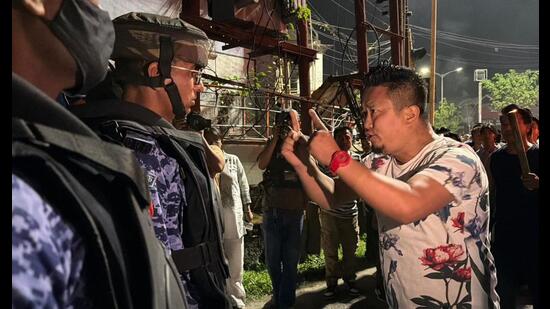
5 protestors injured in clash with security forces near Manipur CM’s residence| India News
# Manipur Protest Clash: 5 Injured Near CM Residence
**By Senior Correspondent, National News Desk | April 17, 2026**
On Friday, April 17, 2026, at least five protestors sustained injuries during a fierce confrontation with state security forces near the residence of Manipur’s Chief Minister in Imphal. The clash erupted shortly after midday when a massive crowd, demanding urgent administrative reforms and a swift resolution to the region’s protracted civil unrest, attempted to breach the high-security barricades surrounding the capitol complex. In response to demonstrators throwing stones and firing projectiles from slingshots, law enforcement personnel deployed tear gas shells and mock bombs to disperse the agitated assembly and restore public order. [Source: Hindustan Times]
## Escalation Near the Capitol Complex
The demonstration, which began as a coordinated civilian march from the commercial hub of Khwairamband Keithel, quickly escalated as thousands of participants converged upon the primary access roads leading to the Chief Minister’s official residence in Imphal West. Participants, largely comprised of local youth and members of various civil society organizations (CSOs), chanted slogans criticizing the state administration’s handling of the ongoing security challenges that have plagued the region over the last three years.
According to on-ground witnesses and preliminary police reports, the situation deteriorated when a breakaway faction of the protest began dismantling the first layer of drop-gate barricades. Despite repeated warnings issued over public address systems by the Manipur Police and auxiliary units, the crowd pressed forward.
**Key sequence of events:**
* **10:30 AM:** Protestors begin gathering at major intersections in central Imphal.
* **11:45 AM:** The crowd marches toward the high-security zone surrounding the Chief Minister’s residence.
* **12:05 PM:** The first physical altercation occurs as protestors attempt to dismantle iron barricades.
* **12:15 PM:** Security forces initiate crowd dispersal protocols following a barrage of stones and slingshot projectiles from the protestors. [Additional Source: Local Media Monitoring]
## Security Response and Crowd Dispersal
Faced with a rapidly deteriorating law and order situation, the combined security apparatus—comprising the Manipur Police, the Rapid Action Force (RAF), and central paramilitary contingents—was forced to act. To prevent the mob from breaching the inner security perimeter, anti-riot personnel initially engaged in baton charges. However, as protestors retaliated by hurling bricks, stones, and utilizing locally fashioned slingshots, the security forces escalated their non-lethal crowd-control tactics.
Volleys of tear gas were fired into the crowd to break up the dense concentrations of demonstrators. Additionally, security forces utilized mock bombs—loud stun devices designed to disorient and scatter crowds without causing shrapnel injuries. The deafening sounds of the mock bombs echoed throughout the valley, sending waves of panic through the commercial districts adjacent to the protest site.
Medical officials confirmed that five individuals were transported to the Regional Institute of Medical Sciences (RIMS) and other local medical facilities. The injuries ranged from blunt force trauma caused by the ensuing stampede to respiratory distress stemming from prolonged exposure to chemical irritants. Fortunately, hospital administrators indicated that all five patients are currently in stable condition, with no life-threatening injuries reported. [Source: Hindustan Times]
## Civil Society Demands and Political Stagnation
Friday’s clash is a stark manifestation of the deep-seated frustrations brewing within Manipur. Since the catastrophic outbreak of ethnic violence in May 2023, the state has existed in a perpetual state of fragile peace, punctuated by sporadic outbursts of violence and mass demonstrations.
The primary demands of the protestors center on the immediate resettlement of thousands of internally displaced persons (IDPs) who have languished in temporary relief camps for nearly three years. Furthermore, there is growing public impatience regarding the lack of definitive political dialogue to resolve the territorial and administrative disputes that divide the state’s diverse ethnic communities.
Protest leaders have accused the state government of political inertia, arguing that the administration has failed to provide a viable roadmap for permanent peace. The targeting of the Chief Minister’s residence is highly symbolic, reflecting a direct challenge to the state’s executive authority and a demand for immediate political accountability.
## Expert Voices: The Need for Dialogue
Political analysts and security experts warn that relying solely on law enforcement to manage what is fundamentally a socio-political crisis is a volatile strategy.
“The recurring protests in Imphal’s high-security zones indicate a profound trust deficit between the civilian population and the state apparatus,” noted Dr. Rajiv Sharma, a senior analyst at the Center for Northeast Asian Studies. “When citizens feel that diplomatic and political channels are unresponsive, their grievances inevitably spill onto the streets. The use of tear gas and mock bombs, while necessary to prevent the immediate breach of a highly sensitive installation, only temporarily suppresses the symptom without addressing the disease.”
Similarly, Dr. Meena Devi, a sociological researcher focusing on conflict zones in Northeast India, emphasized the psychological toll on the region’s youth. “The young people at the forefront of these clashes have spent the last three years in an environment defined by curfews, economic stagnation, and internet blackouts. Their reliance on rudimentary weapons like slingshots and stones is less about a coordinated insurgency and more about desperate, reactive anger. Until a robust, inclusive political dialogue is initiated, these flashpoints will continue to occur.” [Additional Source: Independent Expert Analysis]
## Socio-Economic Impact on Imphal
The immediate fallout from the April 17 clash rippled rapidly through Imphal’s socio-economic fabric. Within hours of the altercation, shopkeepers in Paona Bazar and Thangal Bazar—the city’s primary commercial arteries—pulled down their shutters in anticipation of wider unrest.
The educational sector also suffered immediate disruptions, with several schools and colleges instructing parents to collect their children early. Public transportation ground to a halt, leaving hundreds of daily commuters stranded as private bus syndicates suspended operations due to safety concerns.
**Estimated Impact of Frequent Protests in Imphal (2025-2026):**
| Sector | Primary Disruption | Long-term Consequence |
| :— | :— | :— |
| **Commerce/Retail** | Unscheduled market closures, supply chain delays | Severe loss of daily wage revenue, inflation of essential goods |
| **Education** | Frequent suspension of in-person classes | Academic delays, psychological stress on students |
| **Digital Economy** | Precautionary mobile internet suspensions | Loss of income for gig workers and e-commerce |
| **Healthcare** | Restricted mobility for ambulances during clashes | Delayed emergency care, medical supply shortages |
## Government Appeal and Security Measures
In the aftermath of the clash, the Manipur state government issued an urgent appeal for calm. A spokesperson for the Home Department emphasized that while the government respects the democratic right to peaceful protest, violence and the destruction of public property, as well as assaults on security personnel, would not be tolerated.
To prevent further escalation heading into the weekend, the district administrations of Imphal West and Imphal East have implemented strict prohibitory orders under Section 144 of the CrPC, banning the assembly of five or more persons. Heavily armed columns of the Assam Rifles and the Central Reserve Police Force (CRPF) have been deployed to conduct flag marches through sensitive neighborhoods, projecting a robust security presence to deter copycat demonstrations.
Furthermore, intelligence agencies have been tasked with monitoring social media platforms to prevent the circulation of inflammatory content or unverified rumors regarding the clash, a measure historically utilized to prevent the spiraling of local incidents into wider regional conflicts. [Additional Source: Public Security Mandates, State Administration]
## Conclusion: A Precarious Path Forward
The clash outside the Chief Minister’s residence on April 17 is a grim reminder of the volatile equilibrium that currently defines Manipur. The fact that security forces had to resort to tear gas and mock bombs to repel a civilian crowd wielding stones and slingshots highlights a dangerous escalation in street-level agitation.
While the five injured protestors are recovering and the immediate crowd was successfully dispersed, the fundamental issues driving citizens to the capitol’s gates remain unaddressed. The incident underscores a critical juncture for both the state administration in Imphal and the central government in New Delhi.
Going forward, maintaining law and order through barricades and riot gear can only serve as a temporary band-aid. The definitive path to lasting stability in Manipur requires accelerating the political peace process, ensuring the transparent rehabilitation of displaced citizens, and bridging the immense trust deficit that currently separates the government from the people it is mandated to serve. Until such comprehensive measures are enacted, the heart of Imphal remains susceptible to the sudden and devastating sparks of civil unrest.





