
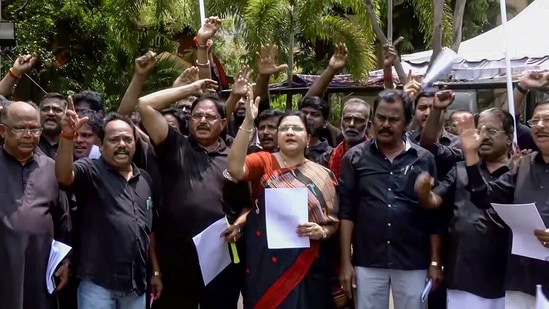
What's the G-word at heart of delimitation fear? Gerrymandering, a term from the US, explained in the Indian context| India News
# India’s Delimitation & Gerrymandering Fear
By Special Correspondent, National Affairs Desk | April 17, 2026
In April 2026, as Prime Minister Narendra Modi’s government moves closer to initiating the long-awaited nationwide delimitation exercise, a controversial political concept originating from the United States has entered the Indian lexicon: gerrymandering. The impending redrawing of electoral boundaries threatens to dramatically alter India’s political map, sparking intense anxiety among opposition parties and southern states. While the ruling administration promises equitable democratic representation and the essential implementation of the historic Women’s Reservation Act, critics argue the current legislative framework leaves ample room for strategic manipulation. This raises a critical question for the world’s largest democracy: Will the constitutionally mandated redistricting become a tool for partisan entrenchment? [Source: Hindustan Times, April 17, 2026].
## Decoding the ‘G-Word’ in the Indian Context
To understand the mounting political apprehension in New Delhi, one must first understand “gerrymandering.” Coined in 1812 after Massachusetts Governor Elbridge Gerry signed a bill creating a partisan district shaped like a mythological salamander, the term refers to the deliberate manipulation of electoral boundaries to favor a specific political party or demographic group.
In the United States, gerrymandering is a highly visible, often legally contested practice utilizing two primary techniques: **”packing”** (concentrating opposing voters into a few districts to reduce their influence elsewhere) and **”cracking”** (diluting the voting power of the opposition across many districts).
In India, the context is structurally different but practically similar. India’s state borders are rigid, meaning parliamentary seats cannot cross state lines. However, the internal boundaries of parliamentary (Lok Sabha) and assembly constituencies within a state are entirely malleable during a delimitation exercise. The fear is that the upcoming Delimitation Commission—despite being a statutory independent body—could draw internal state boundaries in a way that “cracks” opposition strongholds or “packs” minority voters into single constituencies, effectively neutralizing their broader electoral impact. [Source: Historical Political Science Precedents | Hindustan Times].
## The Historical Freeze and the Impending Thaw
The root of today’s crisis traces back half a century. In 1976, during the Emergency, the 42nd Amendment froze the number of Lok Sabha seats and their state-wise allocation based on the 1971 Census. The primary objective was to encourage population control; states that successfully reduced their fertility rates did not want to be “punished” by losing parliamentary representation to states with booming populations.
In 2001, the 84th Amendment extended this freeze until the first census taken after the year 2026. With the calendar now hitting that crucial milestone, the constitutional mandate requires a fresh delimitation.
“We are standing at a constitutional precipice,” notes Dr. Rajesh Venkatraman, a constitutional scholar at the Centre for Policy Research. “The freeze was a necessary band-aid for demographic disparities. Ripping it off now, without a consensus-based formula, risks alienating entire regions of the country. The fear of gerrymandering is amplified because the stakes—the very balance of federal power—have never been higher.”
## The North-South Demographic Divide
The most glaring manifestation of delimitation anxiety is the North-South divide. Over the last five decades, southern states—such as Kerala, Tamil Nadu, Andhra Pradesh, and Karnataka—have effectively stabilized their populations, achieving replacement-level fertility rates. Conversely, northern states like Uttar Pradesh, Bihar, and Rajasthan have seen massive population expansions.
If Lok Sabha seats are reallocated purely on the basis of the latest population figures, the political center of gravity will shift drastically northward.
**Projected Impact of Population-Based Delimitation:**
| Region | Current Lok Sabha Seats | Projected Seats (Post-2026 Estimate) | Net Change |
| :— | :— | :— | :— |
| **Northern Hindi Heartland (UP, Bihar, MP, Rajasthan)** | 174 | ~230+ | **Massive Gain** |
| **Southern States (TN, Kerala, Karnataka, AP, Telangana)** | 129 | ~105 | **Significant Loss** |
*Data representation based on demographic projections by independent electoral trusts up to 2026.*
Southern political leaders view this potential outcome as a betrayal of India’s federal compact. They argue that they are being penalized for successfully implementing national family planning policies. When this demographic reality merges with the fears of localized gerrymandering, the delimitation exercise transforms from an administrative duty into an existential threat for regional political parties.
## Government Promises vs. Legislative Reality
Prime Minister Narendra Modi’s government has repeatedly assured the nation that the delimitation process will be transparent, fair, and beneficial to the democratic ethos. The government ties the delimitation exercise to a universally celebrated cause: the Nari Shakti Vandan Adhiniyam (Women’s Reservation Act), which reserves 33% of seats in the Lok Sabha and state assemblies for women. The implementation of this act is constitutionally contingent upon the completion of the next delimitation.
However, the opposition points out a glaring disconnect between the government’s promises and the actual legislative framework.
According to the laws governing the process, the Delimitation Commission’s orders have the force of law and cannot be called into question before any court. The Commission consists of a retired Supreme Court judge, the Chief Election Commissioner, and respective State Election Commissioners. While associate members (sitting MPs and MLAs) are involved, they do not have voting rights within the Commission.
“The institutional design of the Delimitation Commission is meant to insulate it from politics, but in practice, the lack of judicial review is a double-edged sword,” argues Sunita Narayanan, an electoral reforms advocate. “If the ruling party at the center can indirectly influence the methodology—such as which specific census blocks are merged or divided—there is no legal recourse for the opposition. This is where the specter of gerrymandering truly haunts the process.” [Source: Independent Electoral Analysis].
## The Mechanics of Fear: How Gerrymandering Could Happen
In the Indian context, the manipulation of boundaries does not require drawing bizarre, salamander-like shapes. Given the highly localized nature of caste and community voting patterns, even subtle shifts in constituency borders can yield massive electoral dividends.
Here is how the “G-word” could theoretically be executed in India:
1. **Diluting Minority Votes:** By dividing a district with a dense population of religious or linguistic minorities into three separate constituencies, the minority vote is “cracked,” preventing them from forming a majority in any single seat.
2. **Neutralizing Opposition Incumbents:** By redrawing boundaries to include hostile voting blocks in an opposition leader’s historically safe constituency, their chances of reelection can be severely diminished.
3. **Strategic Reservation of Seats:** Delimitation also involves rotating the seats reserved for Scheduled Castes (SC) and Scheduled Tribes (ST). Manipulating which specific seats are designated as reserved can strategically upend opposition strongholds.
While the Delimitation Act mandates that constituencies be geographically compact and contiguous, the vast and varied terrain of India provides sufficient leeway for subjective boundary drawing. Critics of the current administration express concern that the deployment of advanced data analytics and micro-level polling data—tools not available during the last delimitation in 2002—could be weaponized to optimize boundaries with surgical precision.
## International Lessons: Avoiding the American Pitfall
The growing use of the term gerrymandering in Indian political discourse is a direct result of the highly publicized failures of redistricting in the United States. In the US, state legislatures largely control the drawing of congressional maps, leading to extreme partisan manipulation. It is not uncommon for a party winning 45% of the statewide vote to secure 65% of the state’s congressional seats due to manipulated boundaries.
India’s system, reliant on an independent commission, is inherently safer than the American legislative model. However, experts warn against complacency. Countries like the United Kingdom and Australia utilize deeply transparent, multi-stage public consultation processes for redistricting, complete with algorithmic checks for partisan bias. India’s upcoming delimitation must adopt similar modern safeguards to maintain public trust.
“If India wants to avoid the democratic decay seen in American gerrymandering, the Delimitation Commission must adopt radical transparency,” states a recent policy brief from the Association for Democratic Reforms (ADR). “Draft maps must be subjected to independent statistical analysis to prove they do not disproportionately favor any single political entity.”
## Conclusion: The Path Forward for India’s Democracy
As India approaches the expiration of the constitutional freeze on constituency boundaries, the debate over delimitation is evolving from an abstract administrative issue into a fierce battle for the soul of federalism. The introduction of the “G-word” into Indian political vocabulary reflects a maturing, yet deeply anxious, democratic electorate.
The Modi government faces the monumental task of balancing the democratic principle of “one person, one vote” with the federal necessity of protecting the political agency of southern states. Furthermore, it must ensure that the process of enacting the much-needed Women’s Reservation Act is not shadowed by allegations of partisan boundary manipulation.
The fears surrounding gerrymandering in India are not merely about the drawing of lines on a map; they are fundamentally about trust. Unless the upcoming Delimitation Commission operates with unprecedented transparency, embraces public scrutiny, and establishes clear, mathematically neutral criteria for constituency creation, the specter of gerrymandering will continue to cast a long, polarizing shadow over the future of Indian democracy.





