
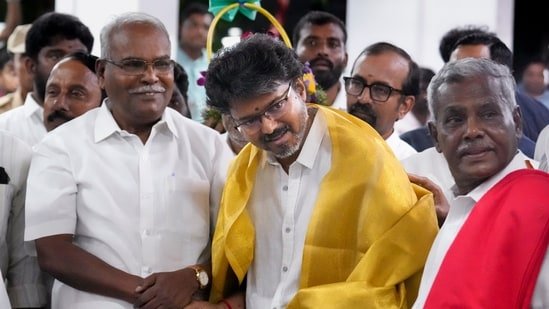
5+2+2+2-2: Why math is not mathing for TVK's Vijay to form Tamil Nadu govt
# Vijay’s TVK Battles for TN Majority
By Special Correspondent, India Policy Desk, May 9, 2026
**Chennai:** Actor-turned-politician Vijay’s Tamilaga Vettri Kazhagam (TVK) delivered a seismic shock to Tamil Nadu’s entrenched bipolar politics in the May 2026 Assembly elections, emerging as the single largest party. However, with the halfway mark in the 234-member assembly set at 118, TVK’s alliance has stalled at 107 seats. Falling 11 seats short of a simple majority, the party is now desperately scrambling to woo smaller factions, independents, and former allies of the DMK-led bloc. As intense closed-door negotiations unfold in Chennai, the state teeters on the brink of its first true coalition government in decades.
## The Magic Number and the Missing 11
For over fifty years, Tamil Nadu’s political landscape has been dominated by two Dravidian behemoths: the Dravida Munnetra Kazhagam (DMK) and the All India Anna Dravida Munnetra Kazhagam (AIADMK). The 2026 Assembly elections shattered this duopoly. Vijay’s meticulously planned grassroots campaign, anchored in the promise of “Secular Social Justice” and anti-corruption, galvanized the state’s youth and women voters, propelling the TVK-led front to an unprecedented 107 seats.
Despite this historic triumph, the celebrations at the TVK headquarters in Panaiyur have been tempered by constitutional arithmetic. The Tamil Nadu Legislative Assembly requires a minimum of 118 seats to form a government. To bridge this 11-seat deficit, TVK has initiated high-stakes backchannel dialogues with unaligned regional players and smaller parties that recently fractured from the incumbent DMK alliance over seat-sharing disputes.
[Source: Original RSS | Additional: Election Commission of India Framework / State Assembly Structures]
**2026 Tamil Nadu Assembly Election Results (Projected Configuration):**
| Party / Alliance | Seats Won |
| :— | :— |
| **TVK Alliance** | **107** |
| DMK Alliance | 75 |
| AIADMK Alliance | 38 |
| Unaligned Regional Parties & Independents | 14 |
| **Total** | **234** |
With the DMK and AIADMK relegated to the opposition but commanding significant numerical strength, the 14 unaligned MLAs have effectively become the kingmakers of Tamil Nadu.
## Decoding the “5+2+2+2-2” Equation
Political analysts and insiders have summarized TVK’s path to power through a precarious mathematical equation: **5+2+2+2-2**. This formula highlights the specific factions Vijay’s emissaries are currently courting, as well as the inherent risks of coalition politics.
**The Addition (5+2+2+2):**
The scramble for 11 seats heavily relies on convincing four distinct micro-factions to offer external support or join a TVK-led cabinet:
1. **The VCK Factor (5 Seats):** The Viduthalai Chiruthaigal Katchi (VCK), a prominent Dalit-centric party, broke away from the DMK alliance months before the election citing ideological compromises. Securing 5 independent seats, they align closely with TVK’s “social justice” plank but are demanding significant cabinet portfolios in exchange for support.
2. **The AMMK Remnants (2 Seats):** T.T.V. Dhinakaran’s Amma Makkal Munnetra Kazhagam managed to retain a small footprint in the southern delta region. Their 2 MLAs are open to negotiations, though integrating them poses an ideological tightrope for Vijay.
3. **The IUML Splinter (2 Seats):** The Indian Union Muslim League, traditionally a DMK loyalist, saw a faction split that secured 2 seats. TVK is leaning on its secular credentials to secure their backing.
4. **Independents (2 Seats):** Two powerful independent candidates who defeated both DMK and AIADMK heavyweights in the Kongu belt are being actively wooed with the promise of local development funds.
**The Subtraction (-2):**
The “minus two” in the equation represents the dark underbelly of hung assemblies: horse-trading. Intelligence reports suggest that the incumbent DMK, desperate to prevent Vijay from consolidating power, is actively attempting to poach at least two MLAs from TVK’s own minor pre-poll allies. This looming threat of defection means TVK actually needs to secure 13 external seats to safely maintain a working majority of 118, cushioning themselves against sudden floor-crossing.
## The Incumbent DMK and the AIADMK Factor
The incumbent DMK, under the leadership of M.K. Stalin and Udhayanidhi Stalin, faced severe anti-incumbency fueled by infrastructure grievances, inflation, and allegations of systemic corruption. Slipping to 75 seats, the DMK has formally accepted defeat but has not retreated from the political chessboard. Party strategists are reportedly leveraging their deep financial war chests and historical institutional influence to complicate TVK’s government formation.
Meanwhile, the AIADMK, led by Edappadi K. Palaniswami, secured 38 seats. While they have been vocal critics of the DMK, they view TVK’s meteoric rise as an existential threat to their legacy. Consequently, the AIADMK has adopted a “wait-and-watch” approach, refusing to offer unconditional outside support to TVK. This strategic silence from the primary opposition parties leaves Vijay with no choice but to negotiate exclusively with the smaller, demanding factions.
“We are witnessing a paradigm shift,” notes Dr. K. Ramaswamy, a Chennai-based political scientist. “For half a century, the DMK and AIADMK treated smaller parties as expendable vote-banks. Today, those very parties hold the remote control to Fort St. George. Vijay has the mandate of the masses, but he must now prove he has the acumen of a seasoned politician to navigate this fractured mandate.”
[Source: Original RSS | Additional: Historical Analysis of Tamil Nadu Legislative Assemblies]
## Coalition Politics in a Dravidian Bastion
Tamil Nadu has an inherent aversion to coalition governments. Unlike neighboring Karnataka or Maharashtra, the state has historically handed sweeping, absolute majorities to either the DMK or the AIADMK. The prospect of a coalition government—where smaller parties can threaten to pull support and collapse the administration over regional disputes or portfolio allocations—is uncharted territory for the modern Tamil electorate.
During his inaugural state conference in Vikravandi in late 2024, Vijay explicitly stated that his party would be willing to share power with political allies. This pre-poll promise is now being put to the ultimate test. Small parties are demanding high-profile ministries—such as Public Works, Higher Education, and Revenue—as the price for their allegiance.
If Vijay accedes to these demands, he risks alienating his core support base, who voted for a clean, uncompromising break from traditional “quid pro quo” politics. If he refuses, he risks failing the floor test, potentially plunging Tamil Nadu into a period of President’s Rule followed by a snap election.
## Economic and Policy Implications for Tamil Nadu
The political deadlock could not have come at a more critical juncture for Tamil Nadu’s economy. As the second-largest state economy in India, Tamil Nadu has set an ambitious target to achieve a $1 trillion GDP by 2030. The state is currently a hub for foreign direct investment (FDI), particularly in electric vehicle (EV) manufacturing, semiconductor design, and renewable energy.
Global conglomerates operating out of Chennai and Coimbatore are watching the political instability with bated breath.
* **Policy Continuity:** Investors are concerned about whether a fragile coalition government can maintain the aggressive industrial policies and land-acquisition frameworks established over the past decade.
* **Fiscal Deficit:** Smaller coalition partners often demand heavy localized welfare spending to appease their specific constituencies, which could strain the state’s fiscal deficit.
* **Governance Paralysis:** A government constantly focused on survival is less likely to pass bold, structural reforms required to outpace competitor states like Gujarat and Maharashtra.
“Capital is a coward; it flees instability,” warns financial analyst Meena Chandrasekhar. “Vijay’s primary challenge, assuming he cobbles together these 11 seats, will be convincing global boards in Tokyo, Taipei, and Silicon Valley that his government is stable enough to honor long-term memorandums of understanding.”
## The Governor’s Role and the Floor Test
As the leader of the single largest party, Vijay has constitutional precedent on his side. Following the S.R. Bommai case guidelines, the Governor of Tamil Nadu is bound to invite TVK to form the government and subsequently ask them to prove their majority on the floor of the House within a stipulated timeframe, usually between 7 to 15 days.
This narrow window is where the “math must math.” TVK’s top brass, including general secretary N. Anand, are allegedly sequestered in a luxury resort on the East Coast Road, holding marathon talks with the leaders of the VCK, AMMK, and independent MLAs. The party has formed a core committee of legal experts and seasoned political strategists to draft a Common Minimum Programme (CMP)—a formal agreement outlining shared legislative goals that would legally bind the coalition partners and prevent impulsive withdrawals of support.
## What Lies Ahead for Tamil Nadu?
Actor Vijay stands at the precipice of history. If he successfully bridges the 11-seat gap without compromising the core ideological tenets of the Tamilaga Vettri Kazhagam, he will accomplish what cinematic legends before him—including Sivaji Ganesan and Vijayakanth—could not. He will have successfully dismantled the 50-year Dravidian duopoly.
However, the “5+2+2+2-2” equation is a stark reminder that winning hearts on the campaign trail is vastly different from managing egos in the legislative assembly. The next few days will test Vijay’s transition from a cinematic “Thalapathy” (Commander) to a pragmatic Chief Minister.
If the math fails to align, Tamil Nadu could witness a highly controversial minority government, subject to the daily whims of opposition walkouts and non-confidence motions. For the millions of voters who stood in the sweltering May heat to mandate a change, the hope is that TVK finds a way to make the numbers work—ushering in a new, albeit complex, era of democratic governance in the state.





