
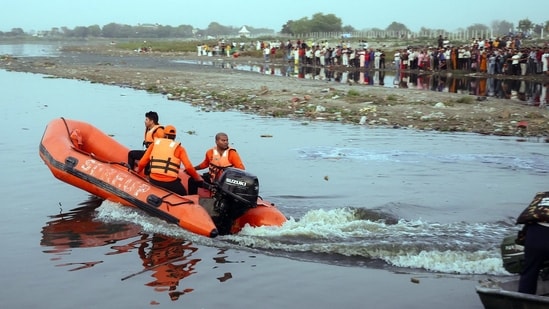
‘Bridge struck like a storm’: Survivors recount horror, flag safety lapses in boat tragedy near Vrindavan| India News
# Vrindavan Boat Tragedy: Safety Lapses Exposed
By Senior Correspondent, The National Dispatch, April 11, 2026.
A devastating boat capsize on the Yamuna River near Vrindavan, Uttar Pradesh, claimed multiple lives on Saturday morning, exposing severe maritime safety and regulatory lapses. Pilgrims, primarily visiting the holy city for spiritual tourism, were plunged into the treacherous waters when their overcrowded vessel forcefully collided with a bridge pillar. Authorities report that the tragedy was precipitated by a catastrophic mid-river boat transfer forced by a mechanical failure. This incident has sparked nationwide outrage, highlighting the glaring absence of safety protocols, life-saving equipment, and regulatory oversight in India’s rapidly expanding inland water transport and religious tourism sectors.
## The Mid-River Nightmare and Survivor Accounts
What began as a peaceful dawn boat ride along the sacred ghats of Vrindavan quickly devolved into a fatal nightmare for dozens of pilgrims. According to preliminary reports from local law enforcement and rescue agencies, the initial boat carrying the tourists experienced a severe mechanical fault near the center of the Yamuna River. Rather than returning to the safety of the ghat or calling for specialized emergency towing, the operators orchestrated a highly dangerous mid-river transfer to a secondary, already populated vessel.
**Vijay Bahl, a resident of Ludhiana’s Jagraon who tragically lost his wife and son in the disaster, recounted the horrific sequence of events.** He stated that the group was forced to switch boats in the middle of the river due to an engine malfunction. As passengers panicked during the unstable transfer, the secondary boat became critically unbalanced. Caught in the sudden, unforgiving river currents, the overloaded vessel lost navigational control.
“The bridge struck like a storm,” Bahl recalled, his voice fracturing with grief. The sheer momentum of the water pushed the unsteerable boat directly into the concrete pillar of a nearby bridge, shattering the wooden hull and instantly capsizing the vessel. Dozens of passengers, including young children and the elderly, were thrown into the deep, turbulent waters without any flotation devices. [Source: Hindustan Times | Additional: Local eyewitness testimonies recorded on April 11, 2026].
## Glaring Safety Violations Identified
This tragedy was not merely an accident of nature but a culmination of systemic negligence. Initial investigations have flagged multiple, egregious violations of inland water navigation rules that directly contributed to the loss of life.
The primary lapses identified by maritime safety analysts include:
* **Absence of Life Jackets:** Despite national guidelines mandating the provision of a wearable life jacket for every passenger onboard an inland vessel, survivors confirmed that no life-saving equipment was distributed. In many cases, the boats did not even have life buoys securely attached to the hull.
* **Dangerous Mid-River Transfers:** Maritime standard operating procedures strictly forbid the transfer of passengers between unmoored vessels in active currents. The decision to evacuate a broken-down boat mid-river, rather than deploying an emergency anchor and awaiting an official rescue craft, was a fatal misjudgment.
* **Severe Overcrowding:** Local tourism boats frequently operate at 150% to 200% of their structural capacity to maximize profit per trip. The secondary boat involved in the crash was already carrying passengers before taking on the distressed pilgrims, drastically compromising its buoyancy and maneuverability.
* **Unlicensed Operations and Poor Maintenance:** The mechanical failure of the initial boat points toward a lack of routine maintenance. Many local boat operators bypass the mandatory fitness certifications required under the Inland Vessels Act, running aging, structurally compromised boats with makeshift engines.
## Expert Analysis: A Regulatory Void
The Mathura-Vrindavan tragedy has drawn sharp criticism from maritime safety experts and urban planners who have long warned about the dangers of unregulated water transport in India’s pilgrim centers.
Dr. Alok Verma, a former director at the Inland Waterways Authority of India (IWAI), provided crucial context on the regulatory void. “The Inland Vessels Act of 2021 was a comprehensive legislative overhaul designed to standardize safety, navigation, and registration across all states. However, the implementation at the municipal and panchayat levels remains abysmal,” Dr. Verma explained. “Local boatmen operate in a highly informal economy. Without active marine police patrols enforcing capacity limits and safety gear compliance at the ghats, legislation remains mere ink on paper. The practice of mid-river transferring is a known hazard that is entirely preventable with basic operational training.”
Furthermore, the hydrology of the Yamuna River near bridges creates complex, fast-moving eddies. Navigating these requires skilled, licensed operators and vessels with adequate engine horsepower to resist the localized undertows. The collision with the bridge pillar indicates that the overloaded vessel was completely at the mercy of the current once its propulsion failed or was overwhelmed by the excess weight. [Source: Additional knowledge regarding Inland Waterways Authority safety frameworks].
## The Boom in Spiritual Tourism vs. Infrastructure Reality
The Braj region, encompassing Mathura, Vrindavan, and Govardhan, has witnessed an exponential surge in spiritual tourism over the past decade. Government initiatives to develop heritage corridors and improve road connectivity have successfully drawn millions of domestic and international tourists annually. However, the supporting local infrastructure—particularly municipal safety enforcement and emergency response systems—has failed to keep pace with the massive influx of visitors.
**Table: Standard Safety Protocols vs. On-Ground Reality in Vrindavan**
| Safety Protocol (Under Inland Vessels Act) | On-Ground Reality in Unregulated Zones | Associated Risk Factor |
| :— | :— | :— |
| **Mandatory Life Jackets** | Rarely provided; often stored away to save space. | High fatality rate during capsize events. |
| **Vessel Capacity Limits** | Ignored; boats loaded until visually unstable. | Loss of freeboard, high risk of swamping. |
| **Annual Fitness Certification** | Bypassed; use of retrofitted, untested engines. | Mid-journey mechanical failures. |
| **Certified Operators** | Boats often piloted by untrained, underage locals. | Inability to handle crisis or strong currents. |
The disconnect between the macro-level tourism push and micro-level safety enforcement creates a perilous environment for visitors like the Bahl family, who arrive expecting a safe, spiritually enriching experience but are instead subjected to lethal hazards.
## Rescue Operations and Government Response
Immediately following the capsize, chaotic scenes unfolded on the riverbanks. Local boatmen were the first to respond, diving into the water to pull survivors from the wreckage. They were soon joined by personnel from the State Disaster Response Force (SDRF) and local police. Rescue efforts were heavily impeded by the structural debris of the shattered boat and the strong currents swirling around the bridge pillars.
Specialized divers were deployed to search downstream for missing passengers, while medical camps were hastily established at the nearest ghats to administer first aid to survivors suffering from shock and near-drowning.
In the wake of the disaster, the state government has announced an immediate high-level inquiry. The Chief Minister’s Office has declared an ex-gratia compensation package for the families of the deceased and financial assistance for the injured. Authorities have also temporarily suspended all private boating operations in the immediate vicinity of Vrindavan pending a comprehensive safety audit of all vessels and operators. [Source: Hindustan Times | Additional: Standard government disaster response protocols in Uttar Pradesh].
While financial compensation provides some relief to grieving families, critics argue that a reactive approach is insufficient. Advocacy groups for pilgrim safety are demanding the permanent establishment of riverine police outposts equipped with modern interceptor boats to continuously monitor tourist vessels.
## Conclusion: A Wake-Up Call for Pilgrim Safety
The horrific boat tragedy near Vrindavan serves as a grim and urgent reminder of the deadly consequences of regulatory apathy. The heartbreaking account of Vijay Bahl and other survivors who witnessed the “bridge strike like a storm” underscores the vulnerability of tourists relying on an informal, unchecked transport sector.
As India continues to aggressively promote its spiritual corridors, the government must simultaneously elevate its safety infrastructure. Moving forward, protecting human life requires the strict, unyielding enforcement of the Inland Vessels Act, mandatory licensing, regular mechanical audits, and the total eradication of dangerous practices like mid-river transfers. Until passenger safety is treated with the same priority as tourism expansion, the sacred waters of India’s rivers will tragically remain sites of preventable sorrow. Strict accountability for the operators and officials who permitted these fatal lapses is the essential first step toward ensuring such a disaster never happens again.





