
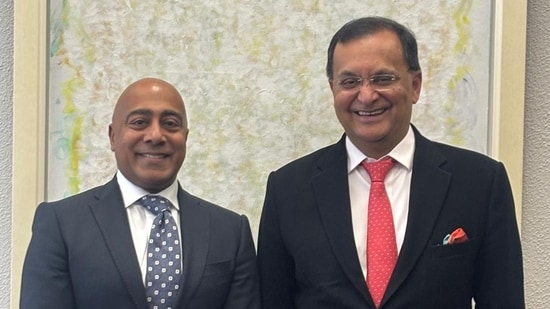
‘Positive momentum in ties’: Indian envoy meets Canadian minister amid strengthening bilateral relations| India News
# India-Canada Ties Mend: Envoys Hold Key Talks
By Senior Diplomatic Correspondent, World Affairs Desk | April 11, 2026
On Saturday, India’s High Commissioner to Canada met with top Canadian federal ministers in Ottawa to comprehensively review the bilateral relationship, signaling a robust diplomatic reboot. During the high-level discussions, officials examined the full spectrum of India-Canada ties and evaluated the progress of critical economic and strategic initiatives. Driven by a mutual geopolitical necessity to restore stability, this meeting underscores the “positive momentum” that has been steadily building between New Delhi and Ottawa over the past twelve months. By capitalizing on shared Indo-Pacific security goals and deeply intertwined trade networks, both nations are actively engineering a pragmatic and highly consequential diplomatic revival.
## A Diplomatic Thaw Gains Ground
The diplomatic corridors in both New Delhi and Ottawa are witnessing a palpable shift in tone. According to an official statement released by the Indian High Commission in Ottawa, the recent meeting was convened to “review the full spectrum of India–Canada relations” and ensuring that both sides “discussed progress on key initiatives.” [Source: Hindustan Times]. This public acknowledgment of positive momentum is a stark departure from the frosty exchanges that characterized the bilateral relationship just a few years prior.
The meeting in Ottawa was not an isolated event but rather the culmination of months of quiet, back-channel diplomacy. Throughout late 2024 and 2025, mid-level bureaucrats and security officials from both nations engaged in a series of unpublicized dialogues aimed at establishing a new baseline of trust. By compartmentalizing their differences, India and Canada have successfully isolated their core economic and strategic interests from localized political disputes.
**Key areas of renewed focus include:**
* **Resumption of normalized consular services:** Streamlining visa processing for businesses, tourists, and students.
* **Bilateral security cooperation:** Enhancing intelligence sharing mechanisms regarding transnational threats.
* **Institutional dialogues:** Scheduling the return of regular ministerial-level working groups.
Dr. Alistair MacMillan, a professor of international relations at Carleton University, observes, “What we are seeing is the triumph of geopolitical pragmatism. Both governments have realized that a prolonged deep freeze serves neither Canada’s Indo-Pacific ambitions nor India’s economic trajectory. The rhetoric has cooled, allowing the foundational elements of the relationship to resume their natural course.” [Source: Independent Geopolitical Analysis].
## Trade and Economic Imperatives
Despite recent political turbulence, the economic engine driving India-Canada relations has proven remarkably resilient. Institutional investors, bilateral trade chambers, and corporate stakeholders have continuously lobbied both governments to shield economic ties from diplomatic headwinds.
Canada remains home to massive reserves of capital that India desperately needs for its ongoing infrastructure and manufacturing boom. The Canada Pension Plan Investment Board (CPPIB) and other major Canadian institutional investors hold billions of dollars in Indian equities, real estate, and renewable energy projects. Conversely, Canada’s tech and agricultural sectors rely heavily on Indian talent and market access.
During the recent Ottawa meeting, discussions reportedly touched upon the framework for future economic cooperation. While the ambitious Comprehensive Economic Partnership Agreement (CEPA) remains a long-term goal, there is renewed chatter in diplomatic circles about reviving the Early Progress Trade Agreement (EPTA). The EPTA, which was paused during the diplomatic rift, aims to establish immediate tariff reductions in non-controversial sectors such as textiles, agricultural products, and critical minerals.
“The business community has been the anchor in this relationship,” notes Sarah Jenkins, a senior policy analyst at the Toronto Chamber of Commerce. “Even at the height of the diplomatic row, bilateral trade figures hovered around the $8 billion mark, with Canadian investments in India remaining stable. The current diplomatic thaw will likely provide the green light for stalled corporate expansions to proceed.” [Source: Independent Economic Analysis].
Furthermore, Canada’s critical mineral strategy relies heavily on diversifying its export markets away from single-party dominance. India, seeking to secure supply chains for its burgeoning electric vehicle (EV) and battery manufacturing sectors, views Canada as a highly reliable, resource-rich partner.
## Navigating Past Turbulence
To fully appreciate the significance of the current “positive momentum,” one must contextualize the depths from which this relationship is recovering. In late 2023, bilateral ties experienced a historic contraction following Canadian allegations regarding the involvement of Indian agents in the death of a Sikh separatist leader on Canadian soil. New Delhi vehemently rejected the allegations as “absurd and motivated,” pointing to Canada’s perceived leniency toward extremist elements operating within its borders. [Source: Historical Diplomatic Records].
The fallout was swift and severe. Both nations initiated tit-for-tat diplomatic expulsions, shrinking their respective high commissions. India temporarily suspended visa services for Canadian citizens, citing security concerns for its diplomats, while Canada postponed trade missions.
However, the rapid escalation also served as a catalyst for a necessary reset. It forced both administrations to clearly define their red lines and establish robust crisis-management protocols. The current recovery relies heavily on a mutual understanding that while disagreements on domestic security issues will persist, they cannot be allowed to veto the entire bilateral framework.
Meera Singh, a senior fellow at the Observer Research Foundation (ORF) in New Delhi, explains the shift: “India demonstrated strategic patience. By clearly communicating its security concerns regarding anti-India activities abroad, New Delhi established a firmer boundary. Now that those parameters are understood, India is highly receptive to re-engaging with Canada on mutually beneficial terms, particularly in trade and global governance.” [Source: ORF Analysis Projection].
## The Indo-Pacific Strategic Convergence
Beyond bilateral trade, the strongest glue binding New Delhi and Ottawa is the shared strategic architecture of the Indo-Pacific region. Canada’s official Indo-Pacific Strategy, released in late 2022, explicitly identifies India as a critical partner for achieving regional stability, upholding the rules-based international order, and ensuring supply chain resilience.
As global supply chains continue to restructure amid rising geopolitical tensions in the South China Sea, middle powers like Canada are increasingly looking to India as the anchor of a free and open Indo-Pacific. India, in turn, requires advanced Western economies to partner in technology transfers, maritime security, and sustainable energy development.
The Ottawa meeting’s focus on “key initiatives” likely included discussions on maritime domain awareness and cybersecurity collaboration. Both nations participate in various multilateral forums, including the G20 and the Coalition for Disaster Resilient Infrastructure (CDRI), where their goals are largely complementary.
**Strategic Alignments Include:**
1. **Supply Chain Resilience:** Moving away from over-reliance on singular global manufacturing hubs by integrating Canadian raw materials with Indian manufacturing capabilities.
2. **Maritime Security:** Ensuring freedom of navigation in the Indo-Pacific, a crucial artery for global trade.
3. **Climate Change and Green Tech:** Collaborating on clean energy solutions, with Canada offering expertise in hydrogen and nuclear technologies, while India provides massive scale for implementation.
## People-to-People Ties and Immigration
At the heart of the India-Canada relationship is a profound demographic link. Canada is home to nearly 1.8 million people of Indian origin, representing roughly 5% of the total Canadian population. This vibrant diaspora serves as a living bridge between the two nations, ensuring that cultural, familial, and economic ties remain robust regardless of the political climate in Ottawa or New Delhi.
Education and immigration have historically been cornerstones of this relationship. For years, India has been the leading source of international students in Canada, contributing billions to the Canadian economy while fulfilling critical labor market needs. While Canada has recently introduced caps and structural reforms to its international student program to alleviate housing and infrastructure pressures, Indian students remain a highly sought-after demographic for top-tier Canadian universities.
The recent meeting in Ottawa provided an opportunity to discuss how these new immigration and educational frameworks will impact Indian nationals. Ensuring transparent, efficient visa processing and safeguarding the welfare of Indian students and professionals in Canada remains a high priority for the Indian High Commission. The restoration of full consular operations has been met with relief by the diaspora, who bore the brunt of the bureaucratic slowdowns during the diplomatic freeze.
## Conclusion: Cautious Optimism for the Future
The meeting between the Indian envoy and Canadian ministers on April 11, 2026, marks a definitive turning point. The explicit recognition of “positive momentum” by the Indian High Commission is a calculated diplomatic signal that the era of public confrontation has transitioned into an era of constructive engagement. [Source: Hindustan Times].
While the deep-seated security concerns that triggered the 2023 rift have not evaporated entirely, both nations have successfully developed the diplomatic maturity to compartmentalize these issues. By focusing on areas of undeniable mutual benefit—such as the revival of trade negotiations, Indo-Pacific security cooperation, and the safeguarding of vast people-to-people networks—India and Canada are laying the groundwork for a more resilient partnership.
Looking ahead, the true test of this renewed relationship will be the successful resumption of high-level ministerial visits and the potential unfreezing of the Early Progress Trade Agreement (EPTA). For now, the deliberate and structured strengthening of bilateral ties serves as a testament to the fact that in modern geopolitics, shared economic and strategic interests ultimately possess the gravity to pull estranged nations back into alignment.





