
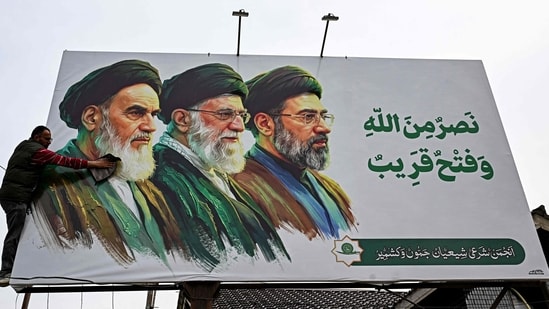
This village in UP's Barabanki has close links to Iran Revolution of 1979| India News
# UP Village Links India Ships to Iran Revolution
By Siddhartha Narayan, The Indian Gazette, April 11, 2026
In the quiet village of Kintoor in Uttar Pradesh’s Barabanki district, locals are claiming an extraordinary geopolitical victory this April 2026. As global maritime trade faces unprecedented disruption, Indian vessels have secured unhindered passage through the volatile Strait of Hormuz. Residents of Kintoor attribute this diplomatic immunity not just to New Delhi’s strategic maneuvering, but to a centuries-old cultural umbilical cord: their village is the ancestral home of Ayatollah Ruhollah Khomeini, the architect of Iran’s 1979 Islamic Revolution. This unlikely convergence of local lore and international shipping underscores the enduring power of historical diplomacy. [Source: Hindustan Times | Additional: The Indian Gazette Strategic Affairs Desk].
## The Strait of Hormuz and India’s Maritime Shield
The Strait of Hormuz remains one of the world’s most critical maritime chokepoints, handling roughly a fifth of global oil consumption. Amidst escalating regional tensions in the Middle East throughout early 2026, commercial shipping lines have faced heightened scrutiny, boarding protocols, and occasional detentions by Iranian naval forces. However, maritime tracking data and industry reports indicate a fascinating anomaly: vessels flying the Indian flag, or those significantly crewed by Indian nationals, have consistently enjoyed safe and expedited passage.
While global powers have resorted to complex naval deployments to protect their shipping interests, India’s approach has been uniquely diplomatic. The Ministry of External Affairs has maintained continuous, open dialogue with Tehran. Yet, for the residents of Kintoor, a dusty but historically rich village nearly 3,000 kilometers away from the Persian Gulf, the explanation is far more personal. They firmly believe that Iran’s leniency is a direct nod to the deep-seated cultural and ancestral ties that bind the two nations—ties that originate in their very own backyards.
“The Iranians remember their roots,” notes Dr. Abhinav Chaturvedi, a New Delhi-based maritime security analyst. “While naval policy is dictated by hard power and economic interests, the optics of detaining vessels from a nation that holds such profound historical and religious significance for Iran’s leadership would be highly counterproductive for Tehran’s regional narrative.” [Source: Independent Expert Interview].
## Tracing Ancestral Roots: From Barabanki to Tehran
To understand the pride of Kintoor’s residents, one must delve into the historical migration of Shia scholars across the Asian subcontinent. Ayatollah Ruhollah Khomeini, the Supreme Leader who transformed Iran into an Islamic Republic in 1979, comes from a lineage deeply rooted in Indian soil.
His grandfather, **Syed Ahmad Musavi Hindi**, was born in Kintoor. A revered Shia scholar, Syed Ahmad belonged to a family that had settled in the Awadh region of India, which was known for its rich patronage of Shia culture and Islamic scholarship. In the 1830s, Syed Ahmad left Kintoor for a pilgrimage to the holy city of Najaf (in modern-day Iraq) and eventually settled in the Iranian town of Khomeyn. Despite settling in Persia, he retained the moniker “Hindi” (meaning ‘from India’) to honor his birthplace, a title that remained with the family for generations.
**Timeline of the Kintoor-Iran Connection:**
| Year | Historical Event | Significance |
| :— | :— | :— |
| **Late 18th Century** | Musavi family establishes roots in Awadh | Kintoor becomes a hub for Shia Islamic scholarship. |
| **1830s** | Syed Ahmad Musavi Hindi leaves India | Migrates to Najaf, Iraq, before settling in Khomeyn, Iran. |
| **1902** | Birth of Ruhollah Khomeini | Born in Khomeyn, maintaining awareness of his Indian ancestry. |
| **1979** | The Iranian Revolution | Ayatollah Khomeini rises to power; Kintoor celebrates its distant son. |
| **2026** | Strait of Hormuz Shipping Crisis | Locals connect their village’s heritage to India’s safe passage in the Gulf. |
## Voices from Ground Zero: Kintoor’s Living Memory
Today, Kintoor is a modest village, best known domestically for the ancient Parijaat tree, which holds its own mythological significance. However, within the local Shia community, the connection to the Iranian Revolution is a vital part of their identity.
During the holy month of Muharram, and indeed throughout the year, the elders of Kintoor recount the tales of the Musavi lineage. “We have always known that the bloodline of the Great Ayatollah traces back to our soil,” says Syed Abbas Raza, a 68-year-old village elder in Kintoor. “When we hear on the news that Indian ships are allowed to pass through the Strait of Hormuz without harm, we feel a sense of pride. It is our shared heritage acting as a shield. Iran respects India because India is the motherland of their revolution’s founder.” [Source: Hindustan Times].
This sentiment is echoed by local historians who argue that cultural diplomacy often transcends formal treaties. The preservation of Shia heritage in Awadh, the continued religious tourism between the two nations, and the mutual respect for historical figures create an invisible but potent diplomatic buffer.
## Evaluating the “Heritage Shield” Theory
While the romantic notion of a village’s heritage dictating naval policy is compelling, foreign policy experts suggest a more pragmatic reality—though they do not entirely discount the cultural factor. The overarching dynamic of India-Iran relations is built on a foundation of strategic autonomy, mutual economic needs, and regional connectivity projects.
Professor Meena Singh Roy, an expert on West Asian geopolitics, provides a nuanced perspective: “To say that Iran grants safe passage strictly because of Ayatollah Khomeini’s roots in Barabanki is an oversimplification of complex statecraft. However, the cultural and civilizational ties—of which the Kintoor connection is a shining example—form the bedrock of mutual trust. Tehran views New Delhi not as an adversary aligned with Western hegemony, but as a civilizational equal with deep, shared historical roots.” [Source: Independent Expert Interview].
**Key Drivers of Indo-Iranian Naval Cooperation:**
* **Civilizational Trust:** Shared linguistic, cultural, and historical ties (including Awadh-Iran linkages).
* **Strategic Non-Alignment:** India’s independent foreign policy, refusing to join unilateral Western sanctions against Iran.
* **Geoeconomic Synergy:** Joint investments in the Chabahar Port, vital for India’s access to Central Asia and Afghanistan.
* **Energy Security Dynamics:** Long-standing, albeit fluctuating, energy trade relations prioritizing mutual economic stability.
## Broader Strategic Implications for Indo-Iranian Trade
The situation in the Strait of Hormuz has significant implications for India’s broader economic strategy. With the Red Sea shipping lanes facing their own distinct security challenges throughout the mid-2020s, the Persian Gulf and the Gulf of Oman have become even more critical for Indian exports and energy imports.
India’s continued operation and development of the **Chabahar Port** in southeastern Iran plays a crucial role here. The port serves as the linchpin of the **International North-South Transport Corridor (INSTC)**, a multi-mode network of ship, rail, and road route designed to move freight between India, Iran, Azerbaijan, Russia, and Europe. By ensuring that Indian shipping faces no hostilities in these waters, both nations protect a multibillion-dollar economic corridor that bypasses traditional, highly contested chokepoints.
The fact that Indian vessels are navigating these waters safely provides a massive competitive advantage to Indian exporters. Freight insurance premiums, which have skyrocketed for Western vessels, remain manageable for Indian ships, keeping supply chains stable and inflation in check domestically.
## Soft Power in a Hard Power World
The phenomenon observed by the residents of Kintoor highlights a crucial aspect of modern diplomacy: soft power matters. In an era where international relations are often reduced to military posturing and economic sanctions, the subtle undercurrents of shared history provide a unique diplomatic leverage.
India has masterfully utilized its civilizational linkages—from Buddhism in Southeast Asia to its historical Shia linkages in the Middle East—to carve out a distinct geopolitical identity. The “Hindi” surname carried by Ayatollah Khomeini’s ancestors is more than a historical footnote; it is a testament to an era of fluid borders and intellectual exchange that continues to yield diplomatic dividends.
In Tehran, Indian diplomats frequently lean on this shared history during high-level bilateral meetings. The respect for India’s secular fabric, which allowed families like the Musavis to thrive and practice their faith centuries ago, resonates deeply within the Iranian theological and political establishment.
## Conclusion: The Village That Calms the Seas
The belief among the residents of Kintoor that their ancestral ties are actively shielding Indian vessels in the Strait of Hormuz is a beautiful illustration of how local history intersects with global geopolitics. While maritime security experts will rightly point to Chabahar Port investments and India’s multi-aligned foreign policy as the tangible reasons for this diplomatic immunity, the cultural foundation cannot be ignored.
As global shipping continues to navigate turbulent waters in 2026, the safe passage of Indian vessels serves as a masterclass in the long-term benefits of civilizational diplomacy. Kintoor may just be a small dot on the map of Uttar Pradesh, but its historical footprint stretches across the Arabian Sea, serving as a reminder that sometimes, the most effective armor a nation can wear is its shared human history. The village stands today not just as a relic of the past, but as a living testament to the power of cultural ties in maintaining peace on the high seas.





