
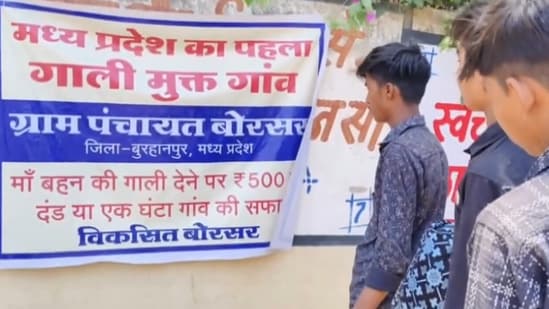
₹500 fine for swearing: This Madhya Pradesh village is on way to become ‘abuse-free’| India News
# MP Village Fines Swearing ₹500
**By Staff Reporter, India News Desk** | April 11, 2026
In an unprecedented move towards grassroots social reform, Borsar village in Madhya Pradesh has introduced a strict ₹500 fine for anyone caught using abusive language or swearing in public spaces. Spearheaded by a local youth who recently returned home after spending nearly two decades working in Mumbai, this initiative aims to transform the rural community into an entirely “abuse-free” zone. Implemented through a unanimous community consensus in early 2026, the policy penalizes foul language to foster mutual respect, reduce localized disputes, and create a healthier psychological environment for the village’s younger generation. This localized social experiment highlights the evolving dynamics of rural Indian governance and cultural self-regulation. [Source: Hindustan Times | Additional: Local Governance Trends in Central India].
## The Catalyst: From Mumbai’s Hustle to Rural Reform
The genesis of this unique social policing initiative traces back to reverse migration, a trend that has steadily reshaped rural Indian demographics over the last few years. The campaign in Borsar was catalyzed by a local resident who moved back to his native village a few months ago after living and working in Mumbai for almost twenty years.
Returning to the quiet agrarian life of Madhya Pradesh, the former city-dweller experienced a distinct cultural shock—not from the lack of urban amenities, but from the normalization of explicit and abusive language in everyday village discourse. In many rural pockets, casual swearing is often deeply woven into the local dialect. Expletives are frequently used not just in moments of anger, but as casual fillers in everyday conversations among friends, family members, and even in front of children.
Recognizing that this linguistic habit contributed to a hostile atmosphere and frequently escalated minor disagreements into physical altercations, the youth proposed a radical idea to the village elders and the Gram Panchayat (village council). He argued that to truly develop Borsar, the community needed to focus on cultural and behavioral infrastructure just as much as physical infrastructure like roads and sanitation. Following a series of town-hall-style meetings (Gram Sabhas), the village collectively agreed to launch an aggressive campaign against public swearing.
## How the ₹500 Fine Mechanism Works
To ensure the initiative was more than just empty rhetoric, the Panchayat established a tangible deterrent: a ₹500 financial penalty. In rural Madhya Pradesh, where agricultural wages and daily labor earnings are carefully managed, a ₹500 fine represents a significant economic pinch. It is substantial enough to act as a powerful deterrent without being entirely ruinous to a household.
**Key Features of the Borsar Initiative:**
| Component | Detail |
| :— | :— |
| **Location** | Borsar Village, Madhya Pradesh |
| **Penalty Amount** | ₹500 per infraction |
| **Target Behavior** | Public swearing, abusive language, verbal harassment |
| **Enforcement** | Village committee, community reporting, Panchayat verification |
| **Fund Allocation** | Village Development Fund (Gram Vikas Nidhi) |
| **Primary Objective** | Cultivate an abuse-free environment, protect children’s development |
The enforcement mechanism relies heavily on community policing and social accountability. If a resident is caught using abusive language in village squares, markets, or during community gatherings, witnesses can report the incident to a designated village committee. To prevent false accusations or personal vendettas, a quick informal hearing is conducted by the Panchayat elders to verify the claim.
Once proven, the offender is required to pay the fine. Crucially, the collected funds do not go into private pockets. The Panchayat channels the money into the village’s development fund, utilizing it for public goods such as upgrading the local school’s infrastructure, installing streetlights, and improving village sanitation facilities. This creates a psychological pivot: a negative action (swearing) inadvertently funds a positive community outcome, though the ultimate goal remains zero revenue from zero infractions.
## Changing Behavioral Patterns in Rural India
The initiative in Borsar opens a fascinating window into the sociology of language and aggression in rural communities. For decades, the normalization of harsh vernacular has been viewed simply as a byproduct of a rugged, labor-intensive lifestyle. However, contemporary sociological studies suggest that linguistic environments heavily influence community psychology.
Dr. Sameer Shrivastava, a sociologist specializing in rural Indian demographics, explains the deeper implications of Borsar’s experiment. “Language is the foundational architecture of community relations. When abusive language is normalized, the threshold for physical violence is inherently lowered. Disagreements over land, water, or cattle quickly escalate because the linguistic bridge to peaceful negotiation has already been burned by expletives,” he notes. “What Borsar is doing is attempting a cognitive reset. By taxing the use of swear words, they are forcing individuals to pause and think before they speak. That micro-second of hesitation is often all it takes to de-escalate a conflict.” [Source: Independent Sociological Analysis, April 2026].
This cognitive reset is already showing signs of success. Local residents report a palpable drop in the decibel levels of arguments near the village squares. The fear of social embarrassment, coupled with the financial penalty, has encouraged residents to adopt more respectful forms of communication.
## Impact on the Youth and Next Generation
Perhaps the most critical demographic targeted by this initiative is the village youth and children. Before the ban, children growing up in Borsar were absorbing toxic linguistic habits simply by walking down the street or playing near adult gatherings. Educators have long pointed out that children mimic the behavioral cues of the adults around them, carrying that aggression into school classrooms.
Local teachers have praised the Gram Panchayat’s decision. An environment free from verbal abuse allows for better cognitive and emotional development. When children do not hear expletives being normalized, they are less likely to use them to assert dominance among their peers. Furthermore, the initiative serves as a real-time civics lesson for the younger generation, demonstrating how communities can come together to identify a social flaw and democratically implement a solution to fix it.
“The children are becoming the strongest enforcers of this new rule,” shares a local primary school teacher. “They are acutely aware of the ₹500 fine and often remind their parents and elders to watch their tongues. It is reversing the traditional dynamic; the youth are holding the older generations accountable for their public conduct.”
## Legal and Administrative Perspectives
From a legal standpoint, the ₹500 fine for swearing operates in a fascinating gray area of Indian local governance. Formal laws under the Indian Penal Code (IPC), such as Section 294, do prohibit the use of obscene words in public places, but enforcing such laws in remote villages for everyday vernacular is practically impossible for the local police.
This is where the power of the Panchayati Raj system comes into play. While a Gram Panchayat does not function as a formal criminal court, it holds immense social authority. The fine in Borsar acts as a social contract rather than a strictly legal penal code. Because the community collectively agreed to the rule via a Gram Sabha resolution, the enforcement relies on communal consent and social pressure rather than police intervention.
Legal experts view such localized resolutions as highly effective forms of alternative dispute resolution and community self-regulation, provided they do not infringe upon fundamental human rights or escalate into illegal social boycotts.
Advocate Neha Patil, who works closely with Panchayat administration frameworks, points out, “As long as the fines are reasonable, applied fairly without caste or gender bias, and the funds are utilized transparently for public welfare, these local resolutions embody the true spirit of decentralized governance envisioned by the Constitution. They handle micro-civic issues effectively without burdening the judicial system.” [Source: Legal Frameworks of Panchayati Raj System].
## A Model for Other Gram Panchayats?
News of Borsar’s ₹500 swearing fine has begun to ripple across Madhya Pradesh and neighboring states, driven by digital news platforms and social media sharing. What started as one man’s vision after returning from Mumbai has the potential to spark a broader movement for linguistic and behavioral hygiene in rural India.
Several neighboring village councils have reportedly requested copies of Borsar’s resolution to study its implementation. The idea resonates deeply with Sarpanches (village heads) who struggle daily to mediate petty quarrels that stem from verbal abuse. If Borsar successfully navigates the growing pains of this initiative and maintains a transparent ledger of the fines collected and utilized, it could serve as a blueprint for a nationwide rural campaign focused on civic etiquette.
## Conclusion: A Step Toward Holistic Village Development
The Borsar village initiative is a testament to the fact that meaningful development goes far beyond concrete roads and digital connectivity; it is intrinsically linked to the social and cultural fabric of the community. By heavily penalizing the use of swear words, this Madhya Pradesh village is taking a courageous stand against normalized toxicity.
The cross-pollination of urban professional standards—brought back by a youth who spent 20 years in Mumbai—and traditional rural governance has created a hybrid model of social reform. As the campaign gains momentum in April 2026, the real test for Borsar will be long-term consistency. Will the fear of the ₹500 fine permanently alter the village’s vernacular, or is it a temporary phase? Regardless of the long-term outcome, the village has already achieved a significant victory by sparking a crucial dialogue about respect, communication, and the environment being shaped for the next generation. As Borsar walks the path to becoming truly ‘abuse-free,’ it leaves a compelling message for communities worldwide: the words we choose construct the society we live in.





